
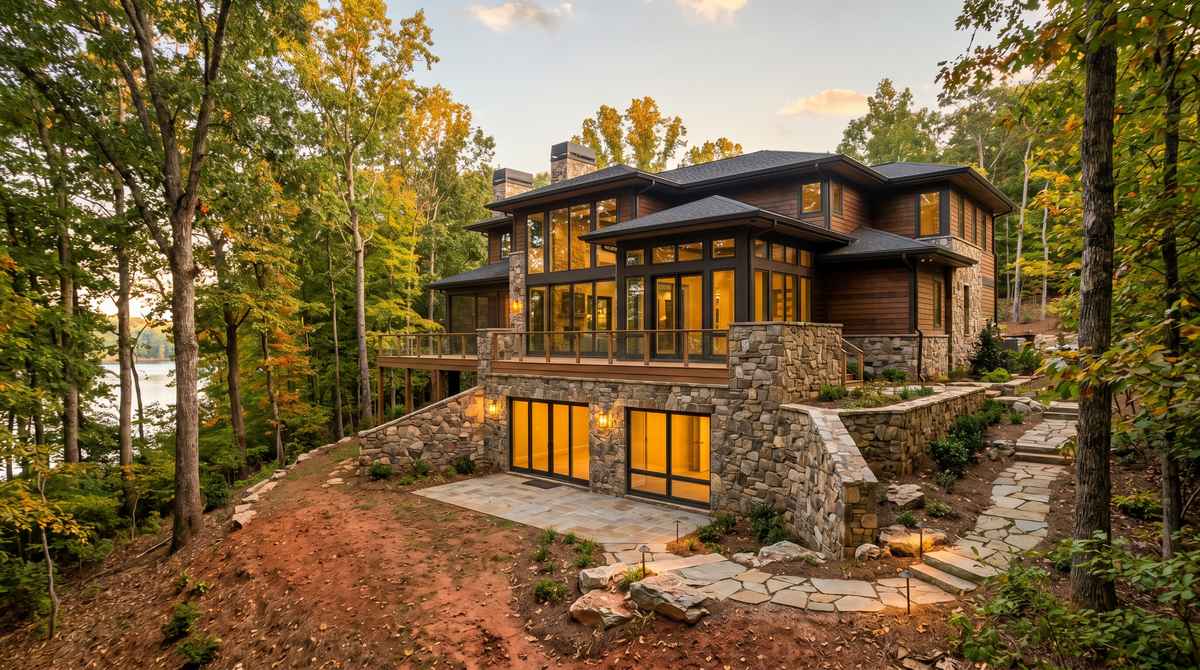
When our clients ask about building a custom home builder lake wylie sc basement project on a sloped lot, we welcome the conversation. Lake Wylie, SC lots — particularly those near River Hills, Handsmill on Lake Wylie, and Paddlers Cove — routinely feature the topographic relief that makes true basements not only feasible but often the most efficient use of the site. Done correctly, a basement custom home here adds hundreds of finished square feet, solves grade challenges, and increases resale value considerably.
In this guide we cover the soil and bedrock conditions unique to the Carolina Piedmont, the waterproofing and drainage systems that perform in York County SC’s rainfall patterns, walk-out versus daylight configurations, and realistic cost premiums so you can plan with accurate numbers.
Why Lake Wylie Lots Are Ideal for Basement Construction
The topography around Lake Wylie is the product of the Piedmont physiographic province — a gently rolling landscape cut by streams and ridge lines that drain into the Catawba River basin. Duke Energy’s management of Lake Wylie creates an irregular shoreline with significant elevation change between the water’s edge and the building pad on most lakefront lots. That gradient is exactly what a builder needs to construct a walk-out or daylight basement without expensive artificial fill or retaining systems.
Inland lots in Clover School District and the broader York County SC area share similar characteristics: enough slope to allow a basement entry or at minimum full daylight windows on the downhill elevation. Compared to the flat coastal plain lots further east in the Carolinas, Lake Wylie building sites are far more basement-friendly.
We evaluate slope, setback, and soil bearing capacity on every lot before recommending a basement. Lots with an 8–12% grade change across the footprint are typically the sweet spot — enough drop to expose a full below-grade level without requiring extraordinary excavation depth on the uphill side.
- Carolina Piedmont topography frequently provides 8–15 feet of natural grade relief across a standard building footprint.
- Lakefront lots in communities like River Hills and Handsmill often slope steeply toward the water, making walk-out basements the natural design solution.
- York County SC code and Duke Energy setback requirements define buildable envelopes; we evaluate both before committing to a basement design.
- Basement construction is generally more cost-effective on sloped lots than constructing equivalent square footage above grade.
Carolina Piedmont Soil and Bedrock: What the Geotechnical Report Will Tell You
Piedmont soils are among the most variable in the eastern United States. In the Lake Wylie corridor we commonly encounter three conditions: red clay (Cecil or Mecklenburg series), decomposed granite (saprolite), and shallow bedrock ledges. Each condition has different implications for basement excavation, foundation wall design, and waterproofing strategy.
Red Clay Behavior
Cecil clay is expansive. It swells when wet and contracts when dry, which exerts lateral pressure on basement walls and creates the cycle of hydrostatic loading that causes most basement failures in this region. We specify poured concrete or reinforced masonry walls with engineered lateral bracing to handle those loads. We never spec standard 8-inch block walls alone for below-grade applications in clay-heavy sites.
Saprolite and Bedrock
Decomposed granite (saprolite) is granular and drains reasonably well, but it can conceal shallow unweathered rock ledges that require blasting or hydraulic breaking — a cost variable that must be addressed in the pre-construction feasibility analysis. We require a geotechnical boring report on any site where bedrock is suspected within 12 feet of the proposed basement floor elevation.
- A soil boring report typically costs $1,200–$2,500 and is worth every dollar on a Lake Wylie sloped lot.
- Expansive clay soils require specific wall reinforcement and exterior waterproofing systems — not just damp-proofing.
- Shallow bedrock discovery mid-excavation is a significant change-order risk; we identify it before breaking ground.
- Saprolite layers drain better than clay but still require a complete drainage board and perimeter system.
- We review York County SC soil surveys as a preliminary screen before ordering borings.
Walk-Out vs. Daylight Basement: Definitions and Design Implications
These two terms are often used interchangeably, but they describe meaningfully different configurations that affect livability, cost, and egress compliance.
Walk-Out Basement
A walk-out basement has at least one full-height exterior door that opens directly to grade on the downhill side. The entire downhill wall is at or near grade, meaning natural light enters through full-size windows and the sliding or French door. In a Lake Wylie lakefront home, the walk-out level typically faces the water — creating a second main living level with lake views, patio access, and the ability to host a bar, media room, or guest suite that functions identically to any above-grade space.
Daylight Basement
A daylight basement has windows on the below-grade walls that are large enough to admit natural light but does not have a door to grade. Code still requires emergency egress windows in sleeping rooms per IRC Section R310. Daylight configurations work on lots with moderate slope where you have enough drop for windows but not a full door opening on the downhill face.
- Walk-out basements command a higher resale premium because finished square footage is fully daylit and feels like above-grade living space.
- Daylight basements cost slightly less to waterproof because fewer openings penetrate the exterior shell.
- Both types must meet York County SC building code egress requirements in sleeping rooms.
- HVAC zoning for the basement level should be designed independently to avoid conditioning a large below-grade space with an undersized system.
Waterproofing and Drainage Systems That Perform in York County, SC
York County averages approximately 47 inches of annual rainfall, and much of it falls in intense summer convective events. That rainfall pattern — combined with clay soils that shed water laterally rather than absorbing it — demands a waterproofing specification that goes beyond what many builders in drier climates would consider standard.
We specify a layered system: a cementitious crystalline waterproofing coat applied to the positive (exterior) face of the foundation wall, a drainage board (dimple mat) over the waterproofing to keep soil pressure off the membrane, a granular drainage backfill column at the base of the wall, a perforated pipe perimeter drain at footing elevation, and a sump pit with a primary pump plus a battery-backup secondary pump. The battery backup is not optional given the frequency of power outages during the same storm events that generate the highest hydrostatic loads.
Interior drainage systems (drain tile inside the slab perimeter feeding a sump) are a secondary option, but we prefer exterior systems where the grade permits the excavation access. Exterior waterproofing addresses the problem at the source rather than managing water that has already entered the wall assembly.
- York County’s clay-heavy soils shed water laterally — perimeter drainage at the footing is essential, not optional.
- Crystalline waterproofing on the exterior wall face outperforms rubber membrane systems on Piedmont soil sites.
- A battery-backup sump pump is a must given the storm frequency in the Lake Wylie corridor.
- Drainage board (dimple mat) separates soil pressure from the waterproofing membrane and extends its service life.
- We warrant our basement waterproofing systems and carry them through the inspection process with York County building officials.
For more on drainage infrastructure we handle as part of site development, see our drainage systems and services page.
Cost Premium for Basement Construction in Lake Wylie, SC
The most common question we receive: how much does a basement add to the total cost of the home? The honest answer depends on lot conditions, basement size, finish level, and how much of the excavation is driven by rock versus soil. That said, as of 2026 our clients typically see the following ranges:
Unfinished basement shell (excavation, foundation walls, slab, waterproofing, basic electrical): $35–$55 per square foot of basement footprint, depending on rock and soil conditions. On a 1,500 SF footprint that represents a typical range of $52,500–$82,500 over a slab-on-grade alternative.
Finished walk-out basement (full HVAC zone, framing, insulation, drywall, flooring, full bathroom rough-in): Add $40–$65 per square foot over the shell cost. A fully finished 1,500 SF walk-out level often runs $115,000–$185,000 above what the same home would cost with a slab, but adds equivalent or greater value in appraisal because the square footage is classified as above-grade-equivalent on a walk-out.
Rock excavation surcharges typically add $8,000–$30,000 depending on depth and extent of ledge. We identify this risk during pre-construction and include contingency language in the contract rather than surprising clients mid-build.
- Unfinished basement shell: typical range $35–$55/SF over slab-on-grade as of 2026.
- Finished walk-out level adds $40–$65/SF of finish cost on top of shell cost.
- Rock excavation is the primary cost wildcard — a geotechnical boring report significantly narrows this uncertainty.
- Walk-out basements frequently appraise as above-grade living space, improving the cost-to-value ratio.
Our team handles detailed cost estimating early in the process. See our budget development and cost estimating service for how we structure that work, and review cost of custom homes in Lake Wylie, SC for broader context on total project budgeting.
Integrating the Basement Into Your Full Custom Home Design
A basement is most valuable when it is designed into the home from the first drawing, not added as an afterthought. The floor plan stack must account for load-bearing wall alignment between levels, mechanical chase routing, stair placement, and the egress door or window locations that are mandated by code. Retrofitting a basement design onto a floor plan originally drawn for slab-on-grade construction adds cost and usually produces suboptimal layouts.
We begin the design conversation with the basement configuration as a variable — often the first decision made after site analysis. That sequence allows the architect and our team to position the main-level great room directly above the walk-out level, align kitchen plumbing stacks efficiently, and design the stair in a location that serves both floors without consuming prime living space on either level.
For clients in communities like Handsmill on Lake Wylie or Paddlers Cove who want a lower-level entertaining area that faces the water, we design the walk-out wall as a full glass-and-door assembly with the same quality of fenestration as the main level. That design decision significantly increases the finished value of the space.
- Design the basement as part of the original floor plan, not as a later add-on — it affects structural framing, mechanical routing, and egress throughout the home.
- Stair placement is a critical design decision that affects usability of both the basement and the main level.
- Walk-out glass wall assemblies facing Lake Wylie create lower-level entertaining spaces that rival any above-grade room.
- HVAC zoning for the below-grade level should be planned from the design phase, not added in the field.
Explore our floor plan customization service to see how we work through these decisions, and review our custom home builder in Lake Wylie, SC full guide for an overview of the complete build process.
Permits and Inspections for Basement Construction in York County, SC
York County requires a building permit for any new construction that includes a basement, and the inspection sequence for below-grade work includes specific hold points that must be passed before backfill can proceed. Those inspections cover: footing bearing capacity confirmation, foundation wall placement, waterproofing application, and drain pipe installation. Missing a hold-point inspection requires excavating back to expose the work — a significant cost and schedule penalty.
We have established relationships with York County building officials and schedule our inspection hold points proactively to avoid delays. Our permit acquisition team handles the application process, coordinates with the structural engineer of record, and tracks inspection status throughout construction. More on that process is available on our permit acquisition and coordination page.
Homeowners building in communities with HOAs — River Hills is a notable example in Lake Wylie, SC — also need architectural committee approval before permits are pulled. We manage that submission as part of our HOA approval services.
- York County inspection hold points for below-grade work must be passed before backfill — missing them is a costly mistake.
- We handle permit acquisition and inspection scheduling as a standard part of every basement project.
- HOA communities like River Hills require architectural committee approval before York County permits are pulled.
- The structural engineer of record must review and stamp foundation wall designs for permitted submittals.
Frequently Asked Questions
Can you build a basement on any Lake Wylie, SC lot?
Not every lot is a good candidate. Flat lots near the water’s edge with high seasonal water tables are generally poor candidates because the cost of dewatering and waterproofing becomes disproportionate. Sloped lots — particularly those with 8 feet or more of elevation change across the footprint — are usually the best candidates. We evaluate lot topography, soil conditions, and FEMA flood zone mapping before recommending a basement configuration. Lots in FEMA Zone AE or VE carry additional flood insurance requirements that affect the economics of a below-grade level.
What is the difference between waterproofing and damp-proofing?
Damp-proofing is a single-coat bituminous or asphalt application intended to resist soil moisture vapor. Waterproofing is a fully bonded membrane or crystalline system engineered to resist hydrostatic pressure — the pressure of water accumulating against the wall. In York County SC’s clay soils and high-rainfall environment, damp-proofing alone is insufficient for a finished basement. We specify full waterproofing systems on every below-grade project we build.
How long does basement construction add to the overall schedule?
A basement adds roughly 4–8 weeks to the pre-framing phase of construction, depending on soil and rock conditions. Excavation, foundation wall forming and poring, waterproofing application, drainage installation, and inspection hold points all occur before the framing crew arrives. We account for this in the master schedule from day one so the overall project timeline is accurate from the start. See our timeline for custom homes in Lake Wylie, SC for the full picture.
Do basement homes in Lake Wylie, SC hold their value?
Walk-out basements consistently appraise well in York County SC because the finished square footage is categorized as above-grade-equivalent living space when a walk-out exit exists. Daylight basements with large windows also appraise favorably compared to fully below-grade spaces. The combination of added livable square footage and the entertainment value of a lower level facing the lake makes basement homes a strong long-term asset in the Lake Wylie market.
Ready to Build Your Basement Custom Home in Lake Wylie, SC?
We have built basement custom homes throughout Lake Wylie, SC — in River Hills, Handsmill, Paddlers Cove, and on privately held lakefront parcels across York County SC. Our team manages every phase of the process, from geotechnical review and permit acquisition through waterproofing, finish work, and the final certificate of occupancy inspection.
Call us at (704) 619-6293 or contact us online to discuss your lot and get a preliminary feasibility assessment. There is no cost to that initial conversation, and it is the right first step before committing to a basement design on any Lake Wylie site.