
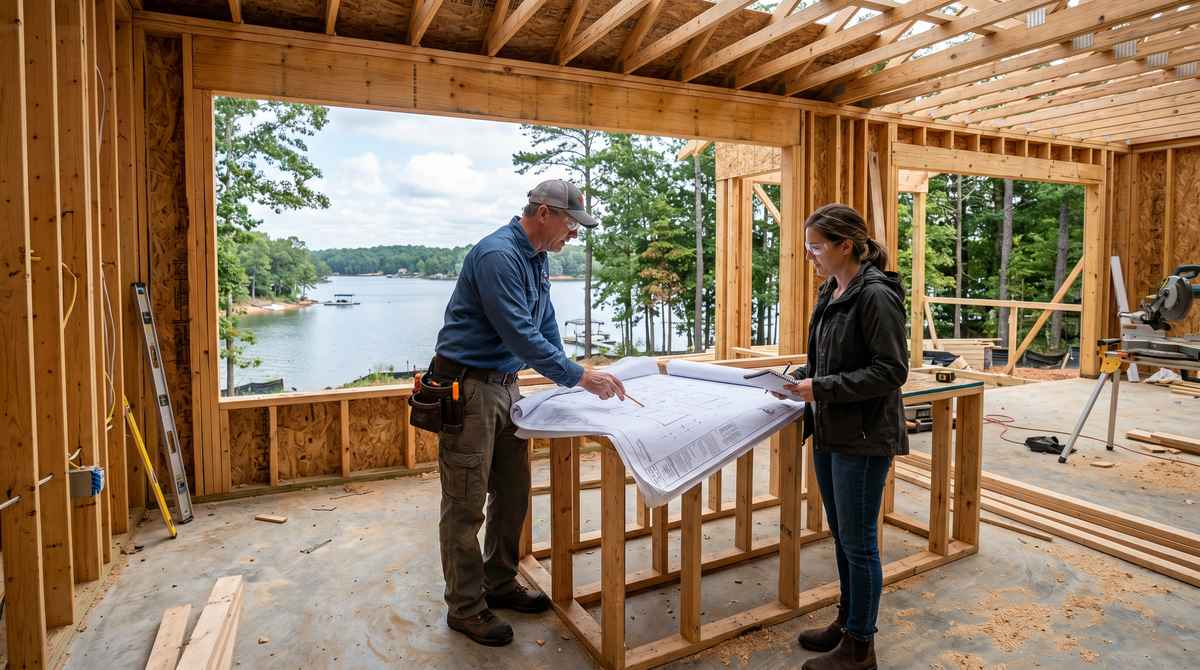
Requesting floor plan changes in a Lake Wylie, SC custom home after construction has begun is far more common than most buyers anticipate — and far more consequential than most understand before they ask. Walking through the framed shell of your home triggers a different level of spatial understanding than reviewing drawings in an office, and it is natural for owners to see the space and immediately want to rethink a wall, expand a closet, or capture a view they had not fully visualized. We have handled hundreds of mid-build revision requests across our 30 years in the Lake Wylie and Charlotte, NC markets. This guide explains the cost economics, the timeline reality, the point in construction when structural changes are still feasible, and how we manage owner-driven revisions without derailing the project.
Why Floor Plan Changes Mid-Build Cost More Than Pre-Construction Revisions
The fundamental reason mid-build changes are expensive is the concept of sunk cost and rework. When you change a wall location before framing begins, the only cost is the architect’s time to revise drawings. When you change that same wall after framing is complete, you pay for: demolition of completed framing, disposal of removed material, revised structural engineering if any load-bearing elements are affected, re-framing labor and material at current market cost, potential rescheduling of downstream trades (mechanical, electrical, plumbing) whose rough-in was based on the original layout, and a revised permit application if the change triggers a significant structural modification.
In the Lake Wylie, SC market as of 2026, the typical cost multiplier for a non-structural wall relocation is 2–4x the original cost of that wall. A structural change — moving a load-bearing wall, changing an opening in a shear wall, or adding an unplanned beam — carries a multiplier of 4–8x or higher, plus the engineering cost to redesign the structural system. A wall that costs $2,000 to frame in the original plan can cost $8,000–$16,000 to relocate at the framing stage, including all associated rework.
Changes compound. Moving a wall often moves an HVAC duct. Moving an HVAC duct affects mechanical rough-in, which may affect an electrical circuit. Cascading trades rework is where the real cost accumulates, and it is rarely apparent when the homeowner makes the initial request. A change that appears to affect only one wall can generate change orders touching framing, HVAC, electrical, and sometimes plumbing. We always present the full scope of a proposed change — including all affected trades — before any work proceeds.
- Mid-build wall relocations typically cost 2–4x the original framing cost
- Structural changes carry a 4–8x multiplier plus engineering fees
- Changes cascade across trades — a single wall move can generate change orders in framing, HVAC, electrical, and plumbing
- The full scope of affected trades must be priced before you authorize any mid-build change
- Pre-construction revisions are the cost-effective alternative; the closer to structural completion, the more expensive the change
The Build Phase Determines What Is Still Feasible
Not all mid-build changes are equally feasible. The critical factor is where the project stands in the construction sequence when the change is requested. There is a meaningful difference between a change requested during design development, a change requested after permit but before framing, a change at framing, a change after rough mechanicals, and a change after drywall.
Before Permit Submission — Low Impact
Any floor plan revision requested before the York County building permit is submitted involves only design and engineering fees. This is the lowest-cost window for changes. Structural revisions may require a licensed engineer to update the structural drawings and a revised permit application, but no rework is needed and no downstream trades are affected. We encourage clients to use the design phase aggressively and hold changes until after permit only if genuinely necessary.
After Permit, Before Framing — Moderate Impact
Once a permit is issued, structural changes require a permit revision or amendment — which adds York County review time, typically 2–4 weeks for a significant structural change. There is no rework cost (framing has not begun), but the schedule impact can be meaningful, particularly if the change requires re-engineering and a re-submittal to York County Building Inspections. Non-structural changes (interior non-load-bearing walls, room layout changes that do not affect the structural system) are less complicated and may not require a permit revision, depending on the scope.
During Framing — High Impact
Changes during framing trigger the demolition and rework scenario described above. This is the most common stage at which owners request changes — standing inside the framed space clarifies dimensions and sight lines in ways that drawings do not. The cost multiplier of 2–8x applies here. Changes that require structural re-engineering must also be reviewed by York County Building Inspections, which adds time. We typically pause affected framing trades when a structural change request is submitted and do not proceed until the change order is priced, approved in writing, engineering is updated, and (if required) the permit revision is issued.
After Rough Mechanical Rough-In — Very High Impact
Once electrical, plumbing, and HVAC rough-in is complete and passed inspection, structural changes become extremely expensive. Moving walls means rerouting ducts and pipes, potentially damaging inspected work, and re-inspecting after rework. At this stage, we have an honest conversation with the homeowner about whether the change is worth its true cost — including both direct costs and the schedule delay — relative to a finish-phase accommodation or a post-occupancy modification. For more on how mechanical systems are integrated into the build sequence, see our guide on energy-efficient home construction in Lake Wylie, SC.
After Drywall — Typically Non-Structural Changes Only
After drywall is hung, structural changes are rarely authorized because they require opening up finished surfaces, reworking what has been inspected, and redrywalling. At this stage, changes are generally limited to finish-level decisions: cabinet layout, fixture locations, trim profiles, and millwork. These changes are still subject to the change-order process but are considerably less disruptive than structural revisions.
- Pre-permit changes cost design/engineering fees only — the most cost-effective window
- Post-permit, pre-framing changes may require a permit revision (2–4 weeks at York County)
- Framing-stage changes carry 2–8x cost multipliers depending on structural involvement
- Post-rough-mechanical changes are extremely expensive — rework of inspected systems required
- Post-drywall changes are generally limited to finish-level modifications
How We Handle Owner-Driven Revision Requests
Our process for handling mid-build change requests is designed to give clients the information they need to make a clear-eyed decision, not to discourage change requests. When an owner-driven revision comes in, our superintendent initiates a scope analysis that identifies all affected trades, develops a not-to-exceed cost estimate for each, and determines whether a permit revision is required with York County. We present this full-scope estimate — not just the framing cost — before any discussion of authorization. We also present the schedule impact as a range of calendar days, not just labor days, because permit revision timelines are outside our control.
The change order is then documented in writing with the full scope description, the not-to-exceed price, the schedule impact, and a place for both parties to sign. Work does not begin until the signed change order is in hand. This is the same process described in our guide to custom home contracts in Lake Wylie, SC, and it protects both the client and our company from disputes about what was authorized and at what cost.
We do not discourage clients from requesting changes. Building a custom home is an iterative process, and standing in the physical space genuinely does reveal things that drawings do not. What we ask is that clients come to us early — before making a change feel urgent — so we have the maximum range of options to offer. A change requested three weeks before framing reaches that wall is managed very differently from a change requested the day the framers arrive on site.
- We present a full-scope cost estimate — all affected trades — before any change is authorized
- Schedule impact is presented as calendar days, including permit revision time if applicable
- Written change orders with signature are required before affected work proceeds
- Earlier requests create more options and lower costs — bring changes to us as soon as they emerge
Changes That Are Worth It — and Changes That Rarely Are
Not all mid-build changes are bad decisions. Some corrections genuinely improve the home substantially enough to justify the cost. In our experience, the changes most worth authorizing mid-build are: structural additions that optimize lake views (a relocated window opening or an expanded great room opening toward the water that could not have been fully visualized from drawings), accessibility-driven changes that affect the client’s long-term ability to use the home, and corrections to errors in the original design that would have created functional problems at occupancy.
The changes that almost never produce satisfaction relative to cost are: moving rooms purely for preference reasons after framing is complete, adding square footage after the foundation is poured, and changes that cascade through multiple trades without a single clear primary benefit. We have completed custom builds in Handsmill, The Landing, and River Hills where owners who waited until post-framing to request major layout changes spent $40,000–$80,000 (typical range, as of 2026) on change orders they would have avoided entirely with earlier decision-making. That is not an argument against building custom — it is an argument for engaging deeply in the design process before construction begins.
Our pre-construction process includes a 3D visualization step specifically designed to surface exactly the kind of “I didn’t realize how this would feel in person” concerns that otherwise emerge at framing. We invest time in pre-construction because it is the highest-leverage window for every dollar of design thinking. See our full overview of the custom home building process in Lake Wylie, SC for how the design and pre-construction phases work in our practice.
- View-optimizing structural changes (windows, openings toward the lake) often justify their mid-build cost
- Accessibility-driven changes are worth executing at any stage
- Preference-driven layout changes post-framing rarely produce satisfaction proportional to their cost
- 3D visualization in pre-construction is the highest-leverage tool to prevent expensive mid-build changes
- Adding square footage after foundation pour is among the most expensive changes possible — avoid entirely
Frequently Asked Questions
At what point in a Lake Wylie custom home build is it too late to change the floor plan?
There is no absolute point of “too late,” but there is a cost inflection after rough mechanical rough-in (electrical, plumbing, HVAC) is complete and inspected. At that point, structural changes require opening up inspected work, rerouting mechanical systems, re-inspection, and drywall replacement — a process that can cost $20,000–$60,000 or more (typical range, as of 2026) for a single room layout change. Post-drywall, changes are generally practical only at the finish level: cabinet layout, fixture locations, trim. The framing stage is when the cost-benefit calculation for structural changes is most nuanced and most worth discussing with your builder in full.
Do mid-build floor plan changes require a new permit in York County, SC?
It depends on the scope of the change. Non-structural interior changes — relocating a non-load-bearing partition wall, for example — typically do not require a permit revision in York County, SC. Structural changes — modifying load-bearing walls, changing beam sizes, altering the roof structure, or adding square footage — require a permit amendment that York County Building Inspections must review and approve before work proceeds. We determine permit revision requirements for each proposed change as part of our change-order scope analysis.
How does a mid-build floor plan change affect my construction loan?
Significant mid-build changes can affect your construction loan in two ways: they may change the total cost of the project (requiring a loan modification if the increase is material), and they may affect the draw schedule by adding milestones or shifting existing ones. Your construction lender should be informed of significant change orders — particularly structural ones — as they may affect the lender’s cost-to-complete analysis. We communicate with construction lenders on behalf of our clients when mid-build changes have material cost implications. See our guide on construction draw schedules in Lake Wylie, SC for context on how changes interact with the draw process.
What is a realistic cost range for a single non-structural wall relocation after framing in Lake Wylie, SC?
For a straightforward non-load-bearing interior wall relocation after framing is complete, typical direct costs in the Lake Wylie, SC market range from $3,000 to $8,000 as of 2026 — covering framing demolition and rework, drywall patching on both sides, and any affected electrical outlets or switches. If the relocation also affects HVAC duct routing or plumbing, add $2,000–$5,000 per affected system. These are general ranges; actual costs depend on wall length, mechanical interference, and trade scheduling. We provide firm not-to-exceed pricing before authorizing any change.
CDG Carolinas brings 30+ years of custom home building experience to every project in Lake Wylie, SC, Fort Mill, SC, Charlotte, NC, and the broader York County area. If you are planning a build or have questions about mid-build changes on an active project, call us at (704) 619-6293 or reach out online.