
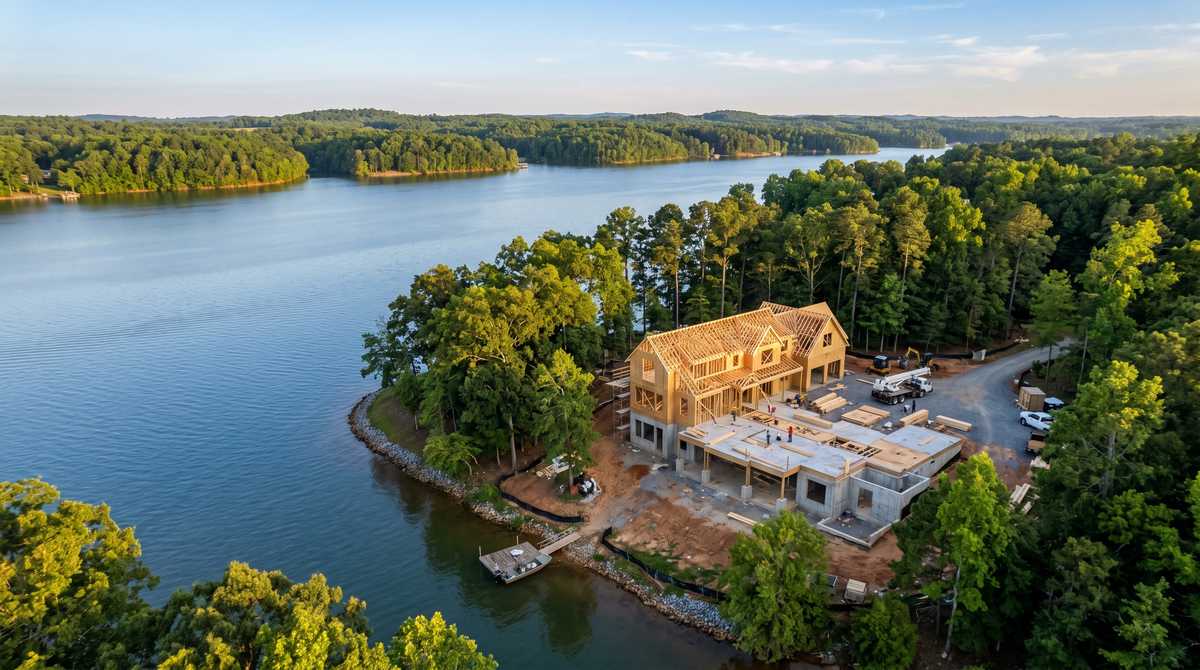
Building a custom home on Lake Wylie, SC is one of the most rewarding investments you can make in the Carolina Piedmont — and one of the most complex. As a custom home builder in Lake Wylie, SC with more than 30 years of experience, we work with waterfront buyers every week who underestimate the regulatory, logistical, and design challenges that come with a lakefront lot. This guide covers everything you need to know before you break ground.
Understanding Duke Energy’s Role on Lake Wylie
Lake Wylie is a reservoir owned and managed by Duke Energy, not a natural lake. That distinction matters enormously when you’re building on the shoreline. Before any construction begins — docks, retaining walls, boat ramps, or any grading within the buffer zone — you need a Duke Energy Lake Services permit. The process involves submitting a Shoreline Management Plan application, site drawings, and often a fee that varies by project scope.
Duke Energy enforces setback rules that determine how close your home, outbuildings, and hardscape can sit to the high-water line. These setbacks are not the same as York County’s standard setback requirements, and both apply simultaneously. We’ve seen clients buy lots before understanding this layered permit system, then discover their planned footprint simply can’t be built where they imagined it.
Timeline is also a factor. Duke Energy lake permit approvals can take 4–12 weeks depending on the complexity of the project and time of year. We coordinate this process in parallel with York County permitting so you don’t lose months waiting on sequential approvals.
- Duke Energy owns and regulates the Lake Wylie shoreline — permits are required before any grading or structure near the water
- Setbacks from the high-water line are enforced separately from York County building codes — both apply
- Dock and boat ramp permits require site drawings and can take 4–12 weeks to process
- We submit Duke Energy and York County permits in parallel to compress your overall timeline
Flood Zone Mapping and FEMA Considerations
Parts of the Lake Wylie shoreline fall within FEMA-designated Special Flood Hazard Areas (SFHAs), particularly in low-lying coves and near tributary inflows. Before you purchase a waterfront lot — and certainly before you design a home on one — you need a current FEMA flood map review and, in many cases, an elevation certificate prepared by a licensed surveyor.
What Flood Zone Designation Affects
Flood zone status affects your finished floor elevation requirements, foundation design, flood insurance costs, and sometimes your ability to obtain a conventional mortgage. A home in Zone AE, for example, must be built to a Base Flood Elevation (BFE) or higher — which may require an elevated foundation, fill, or a combination of both. We design foundations with these requirements built in from the start rather than retrofitting after permit review.
Elevation Certificates and Insurance
An elevation certificate documents the lowest floor elevation of your home relative to the BFE. Lenders in flood zones require them, and they directly influence your annual flood insurance premium. We work with licensed surveyors throughout York County, SC to secure elevation certificates early in the design phase so there are no surprises at closing or after construction.
- Check FEMA flood zone designation before making an offer on a waterfront lot
- Zone AE and Zone X designations carry different finished-floor elevation requirements
- Elevation certificates are required by most lenders in flood-mapped areas
- Flood insurance costs are directly tied to the gap between your floor elevation and the BFE
- Foundation type (slab, crawl, pier) must be chosen with flood zone requirements in mind
Shoreline Setbacks and York County Building Regulations
York County, SC administers its own building and zoning code that applies to all residential construction in the Lake Wylie area, including communities like The Landing, River Hills, Handsmill on Lake Wylie, and Paddlers Cove. Residential shoreline setbacks in York County are typically 35–50 feet from the ordinary high-water mark, though your specific lot’s zoning district and any recorded plat restrictions may impose stricter requirements.
Impervious surface limits are another constraint waterfront buyers frequently overlook. York County caps the percentage of a lot that can be covered by hard surfaces — driveways, patios, rooftops — to protect the lake’s water quality. On smaller waterfront lots, this limit can significantly constrain the footprint of your home and outbuildings. We run impervious surface calculations early in the design process to keep your project within compliance.
York County’s permit process for custom homes involves plan review, inspections at multiple stages, and a final Certificate of Occupancy. We manage every inspection checkpoint and keep you informed at each stage. For a full overview of the permitting process, see our complete Lake Wylie custom home guide.
- York County shoreline setbacks run 35–50 feet from the high-water mark — check your specific zoning district
- Impervious surface limits can constrain your footprint on smaller lakefront lots
- HOA covenants in communities like River Hills and Handsmill may impose additional setbacks beyond county code
- We calculate impervious surface ratios in the design phase to prevent costly redesigns after permit submittal
HOA Architectural Review in Lake Wylie Communities
Most established Lake Wylie communities have active Architectural Review Committees (ARCs) that evaluate new home plans before construction begins. In communities like River Hills Country Club, Handsmill on Lake Wylie, and Paddlers Cove, ARC approval is a contractual obligation — not optional. These reviews assess exterior materials, roof pitch, siding color, window placement, dock design, and even landscaping plans.
What ARC Reviewers Typically Evaluate
ARC checklists vary by community, but common items include: exterior material specifications (fiber cement, brick, stone, wood), roofing material and color, maximum building height, impervious surface compliance, and consistency with neighborhood character. Some communities require approval of the dock and any lakeside structures separately from the primary residence.
Timing the ARC Process
ARC review turnaround ranges from 2 weeks to 45 days depending on the community. In communities with monthly ARC meeting cycles, a late submittal can mean a 4–6 week delay. We prepare complete ARC packages — including renderings, material boards, and site plans — to move through review in a single cycle wherever possible. Our familiarity with the specific requirements of Lake Wylie communities means fewer revision rounds.
- ARC approval is contractually required before construction in most Lake Wylie communities
- Exterior materials, roof pitch, colors, and dock design are all subject to ARC review
- Missing an ARC meeting cycle can add 4–6 weeks to your timeline
- We prepare complete ARC submittal packages to minimize revision rounds
Waterfront Lot Pricing and What Drives Value in 2026
Waterfront lot prices on Lake Wylie have risen steadily with demand from Charlotte metro buyers seeking lakefront living within 30–45 minutes of Uptown. As of 2026, waterfront lots in established Lake Wylie communities typically range from $350,000 to over $900,000 depending on frontage, depth to navigable water, lot size, and community amenities. Deep-water lots with unobstructed views command the highest premiums.
Not all waterfront is equal. A lot with 80 feet of navigable frontage and gentle slope to the water is far more buildable — and valuable — than a lot with 200 feet of shoreline that’s rocky, steep, and restricted by a large Duke Energy buffer. We evaluate lot buildability as part of our pre-purchase consultation service so you know what you’re actually buying before you close.
For context on overall construction costs once your lot is secured, see our detailed breakdown of custom home costs in Lake Wylie, SC. Our service area covers all of York County, SC — learn more on our Lake Wylie service area page.
- Waterfront lots in Lake Wylie communities ranged from roughly $350K to $900K+ as of 2026, depending on frontage and depth
- Deep-water, gently sloped lots with clear views command the highest premiums
- Steep or rocky lots with large Duke Energy buffers limit buildable area significantly
- We offer pre-purchase lot evaluations to assess buildability before you commit
Designing a Waterfront Home for Lake Wylie’s Conditions
A well-designed waterfront home on Lake Wylie works with the lot’s orientation, slope, and view corridors rather than against them. Most of our waterfront clients want the primary living spaces — great room, kitchen, primary suite — oriented toward the water. That means the home’s design must solve for both the street-facing entry and the lake-facing rear elevation simultaneously.
We frequently use walkout basements and tiered foundations on sloped waterfront lots. These approaches manage grade change while creating additional finished square footage and outdoor living levels — screened porches, covered terraces, and direct-access lakeside patios. Moisture management is critical at every level; we specify materials and drainage systems designed for the humidity and occasional flooding exposure that comes with lakefront living in the Carolina Piedmont.
Orientation to prevailing southwest winds and afternoon sun also influences window placement, covered porch depth, and roof overhangs. Homes designed without accounting for these conditions end up with glare-filled interiors and uncomfortable outdoor spaces. Our design trend insights for Lake Wylie cover how we approach these decisions. For ideas on luxury features that complement waterfront living, see our guide to luxury home features.
- Orient primary living spaces toward the water — entry and service functions face the street
- Walkout basements maximize usable square footage on sloped waterfront lots
- Moisture management and drainage systems must be spec’d for lakefront exposure
- Southwest wind and afternoon sun orientation affect window placement, overhangs, and porch depth
Working With a Builder Who Knows Lake Wylie
The regulatory complexity of waterfront construction — Duke Energy permits, FEMA flood zones, York County building codes, and HOA architectural review — makes builder selection more consequential on a lakefront lot than anywhere else. A builder unfamiliar with any one of these layers can cost you months of delay or force expensive redesigns mid-project.
We have built on Lake Wylie’s shoreline for decades. We know which Duke Energy reviewers handle which sections of the lake, which York County inspectors focus on foundation compliance in flood zones, and what River Hills and Handsmill ARCs are looking for in a complete submittal package. That institutional knowledge compresses your timeline and protects your budget.
Before you sign a lot purchase contract or commit to a builder, we encourage you to read our guide on choosing a custom home builder in Lake Wylie, SC and our overview of why hiring a custom builder over a production builder makes sense on a complex waterfront lot.
- Waterfront builds involve Duke Energy, FEMA, York County, and HOA layers — all simultaneously
- Builder unfamiliarity with any layer can cause months of delay or force costly redesigns
- We have built on Lake Wylie’s shoreline for 30+ years — institutional knowledge matters here
- Pre-purchase builder consultations help you evaluate lot risk before you’re committed
Frequently Asked Questions
Do I need a Duke Energy permit to build a dock on Lake Wylie?
Yes. Any structure placed within or adjacent to the Duke Energy managed shoreline — including docks, boat ramps, seawalls, and retaining walls — requires a Lake Services permit from Duke Energy prior to construction. Applications require site drawings and typically take 4–12 weeks for approval. We handle this process as part of our full waterfront build package.
What flood zone is Lake Wylie in?
Different areas of the Lake Wylie shoreline fall into different FEMA flood zone designations. Many lakefront lots are in Zone X (minimal flood hazard), but cove areas and low-lying sections near tributary streams can be in Zone AE, which carries Base Flood Elevation requirements and mandatory flood insurance for federally backed mortgages. A survey and flood zone determination for your specific lot address is essential before purchase.
How far from the water can I build in Lake Wylie, SC?
York County, SC generally requires a 35–50 foot setback from the ordinary high-water mark, but your specific zoning district, recorded plat, and HOA covenants may require more. Duke Energy also enforces its own buffer zone requirements. The effective buildable setback is the largest of all applicable requirements. We conduct a full setback analysis as part of our lot evaluation service.
What are typical waterfront lot prices near Lake Wylie in 2026?
As of 2026, waterfront lots in established Lake Wylie communities such as River Hills, Handsmill, and Paddlers Cove typically ranged from approximately $350,000 on the lower end to well over $900,000 for premier deep-water lots with large frontage and unobstructed views. Lot pricing varies significantly based on water depth, frontage feet, slope, and community amenities. We recommend a pre-purchase lot evaluation before committing to any waterfront parcel.
Ready to Build on Lake Wylie’s Shoreline?
We have guided waterfront buyers through every layer of this process — from initial lot evaluation through Certificate of Occupancy — for more than 30 years. If you’re considering a custom home on Lake Wylie, SC, let’s talk through your lot, your timeline, and your budget before you make any commitments.
Call us at (704) 619-6293 or contact us online to schedule a consultation. We serve York County, SC and the entire Charlotte metro area from our Charlotte, NC office.