
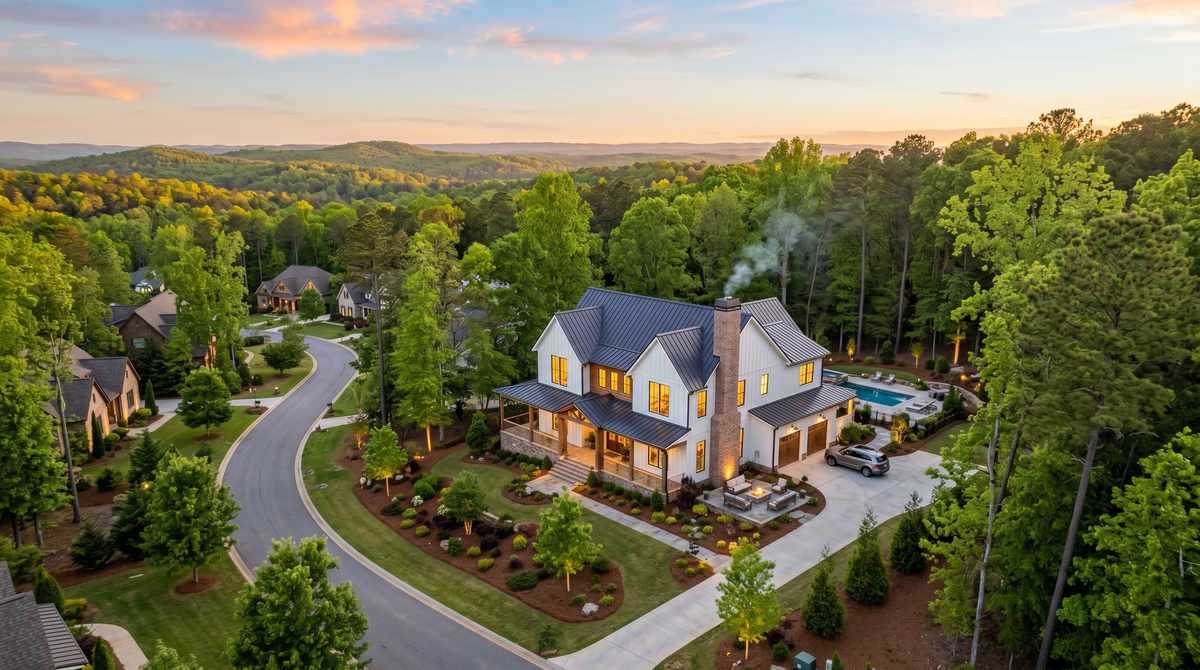
When homeowners start searching for a custom home builder in Indian Land, SC, they quickly discover that the Panhandle isn’t like the rest of Lancaster County. Easy access to Ballantyne employment, top-rated Indian Land schools, and the last sub-$100 per acre buildable inventory inside a 25-minute radius of uptown Charlotte have pushed demand up and timelines out. We build full custom homes on infill lots, subdivision finals, and wooded acreage from Sun City Carolina Lakes down to the Catawba River, and this guide lays out how the Indian Land market really works in 2026.
Why Indian Land, SC Is Charlotte’s Busiest Custom-Home Corridor
Indian Land sits at the narrow top of Lancaster County where US-521 crosses the state line. Residents get South Carolina property taxes (typically 35-45% lower than comparable Mecklenburg homes), Ballantyne and SouthPark within a 15-20 minute drive, and the Lancaster County School District’s newer Indian Land Middle and Indian Land High buildings. That combination is why the Indian Land Panhandle has added roughly 3,000 new residential units every year since 2021, and why a well-executed custom build here appreciates faster than spec inventory in the same ZIP.
Our clients typically choose Indian Land for three reasons: the tax arbitrage, the feeder-pattern schools, and the availability of half-acre to two-acre lots that have already passed perc tests. Charlotte-side alternatives like Ballantyne or Weddington either lack inventory or require a far larger lot budget. For a step-by-step overview of how we approach a new build in this corridor, see our Indian Land home-builder page.
The corridor at a glance
- Lancaster County SC property taxes typically 35-45% lower than Mecklenburg NC equivalents
- Indian Land schools (Lancaster County School District) are among the fastest-improving in the state
- Ballantyne and Waverly employment within 15-20 minutes most hours
- Active buildable inventory ranges from 0.25-acre infill lots to 5+ acre wooded tracts
- Residential permit volume has outpaced Fort Mill for three straight years
Indian Land Lot Selection: What Actually Builds Well
Lot quality decides whether your custom-home budget goes into the house or into site work. We see four lot categories dominate this submarket: platted subdivision lots with utilities stubbed (Sun City Carolina Lakes, Walnut Creek, Tree Tops, The Walk at Red Stone), builder-held infill lots along Jim Wilson Road and Harrisburg Road, larger acreage tracts off Possum Hollow and Doby’s Bridge, and Catawba River-adjacent parcels that carry floodplain overlays.
Subdivision lots are the fastest path to a slab — utilities are in, stormwater is engineered, and the HOA architectural review process is defined. Acreage tracts cost more per square foot once site work is priced in, but they let us deliver walkouts, outbuildings, and detached garages that deed-restricted subdivisions won’t permit. For clients deciding between raw land and a platted lot, our lot-selection guide applies the same framework we use across both counties.
What changes the per-square-foot price
- Well-and-septic versus public water and sewer (typical $25-40k delta for well/septic)
- Slope and grading; anything over 10% fall adds retaining walls and engineered foundations
- Tree clearing volume (SC Forestry burn-permit windows matter in dry months)
- Driveway length, easements, and shared-driveway agreements on older parcels
- Floodplain mapping — FEMA Zone AE requires finished floor elevation above BFE
Lancaster County Permits and HOA Architectural Review
Lancaster County handles building permits for unincorporated Indian Land at the Planning & Zoning office on Hubbard Drive. Typical turnaround on a residential building permit in 2026 is 4-8 weeks from complete application, faster than Mecklenburg County but slower than York County. Zoning in the Panhandle is a mix of RLD (Rural Low Density), MDR (Medium Density Residential), and PD (Planned Development), and setbacks vary by parcel; we always confirm the applicable zoning before design-development drawings are priced.
Most established Indian Land subdivisions layer an HOA architectural review process on top of county permitting. Walnut Creek, Sun City, Tree Tops, and The Ridge each have published design guidelines covering minimum square footage, roof pitch, exterior materials, and landscape specs. We submit architectural packages to the ARC before we pull county permits so a rejection or revision doesn’t ripple into the construction schedule. Lancaster County maintains public permit information for anyone verifying a contractor’s filings.
What to have ready before permit submittal
- Boundary and topographic survey, signed and sealed
- Site plan with impervious-surface calculations and setbacks
- Architectural plans stamped by an NC/SC-licensed architect when required
- Structural, mechanical, electrical, and plumbing plan sets
- SCDHEC septic permit or utility tap documentation
- HOA ARC approval letter when applicable
Budgeting a Custom Home in Indian Land, SC (2026)
Honest 2026 custom-home ranges for Indian Land look like this: $275-$360 per square foot for builder-grade custom on a platted subdivision lot with utilities, $340-$475 per square foot for mid-range custom with upgraded finishes on a larger lot, and $500+ per square foot for luxury custom with high-spec millwork, imported stone, smart-home integration, and complex site work. These are typical ranges as of 2026 and will shift with lumber, labor, and land. Finished-basement walkouts, deep porches, and detached garages sit outside the per-SF number.
Contingency matters more here than in a mature market. We build in 8-12% owner contingency and a separate allowance bucket for finishes that tend to escalate late in the schedule: tile, plumbing fixtures, lighting, and appliance packages. Clients that want to see how this fits together before breaking ground should review our walk-through of custom-home cost drivers and our construction financing overview.
What we include in the base number
- Full architectural design, engineering, and permitting coordination
- Site prep, grading, utilities, foundation, framing, dry-in
- Rough mechanicals, insulation, drywall, interior and exterior finishes
- Standard cabinetry, countertops, flooring, and tile allowances
- Standard landscape package, driveway, and final grading
Typical Build Timeline in the Indian Land Panhandle
A realistic 2026 timeline from signed contract to certificate of occupancy in Indian Land runs 11-14 months for a 3,000-4,500 SF custom home on a lot without major site-work surprises. Design-development takes 8-12 weeks. Permitting runs 4-8 weeks in parallel with final pricing. Site prep through dry-in is 14-20 weeks. Mechanicals, finishes, and punch list typically consume another 18-24 weeks.
Carolina Piedmont weather drives most real schedule risk. Late-winter ground saturation and summer thunderstorm cycles slow grading and framing. We schedule critical-path items — foundation pours, framing, roofing dry-in — against five-day forecast windows, and we preorder long-lead items (windows, custom cabinetry, appliance packages) the day contracts are signed. For a full week-by-week breakdown, see our custom-home timeline guide.
Where timelines usually slip
- Perc test or septic permit delays on acreage tracts (1-4 weeks)
- HOA architectural review revisions before county submittal
- Window and door package lead times (currently 8-14 weeks)
- Custom cabinetry fabrication (12-18 weeks)
- Utility-company set meters once mechanicals pass inspection
Indian Land Neighborhoods and Lifestyle Fit
Not every Indian Land neighborhood works for every client. Sun City Carolina Lakes is a 55+ resort community with amenity-heavy living and restrictive design covenants — ideal for downsizers, wrong fit for families. Walnut Creek and The Ridge cater to family buyers with larger yards and active swim-tennis amenities. Tree Tops and Kingsley Forest skew toward mid-range custom on wooded half-acre lots. Country Place and the older estate neighborhoods off Possum Hollow Road offer acreage for buyers who want horses, workshops, or no immediate neighbors.
When clients describe their lifestyle priorities — commute, schools, lot size, amenity package — we can usually narrow their search to two or three compatible communities inside a single call. If you want to see examples of homes we’ve built across comparable Charlotte-metro markets, our project gallery is a useful reference point.
Quick fit matrix
- Downsizer or 55+: Sun City Carolina Lakes
- Family with active kids: Walnut Creek, The Ridge, The Walk at Red Stone
- Buyer seeking wooded acreage under 3 acres: Tree Tops, Kingsley Forest
- Horse property or 5+ acres: Possum Hollow Road corridor, Shelley Mullis area
- Waterfront or water-access: Catawba River parcels off Van Wyck
Working With a Custom Home Builder in Indian Land, SC
Choosing the right custom home builder in Indian Land comes down to three filters: SC licensing and insurance verification, a documented track record on Panhandle soils and permitting, and transparent cost and schedule reporting. The South Carolina LLR maintains a lookup for residential builders and specialty contractors — any builder should pass verification in under two minutes. Beyond the baseline, ask for recent completed addresses in Lancaster County, references from projects that finished inside the last 24 months, and sample draw-schedule documents that show how change orders are tracked.
We run a single dedicated project manager per build, hold weekly on-site client meetings, and share a live budget tracker that reconciles every invoice against the contracted allowances. That reporting discipline is why most of our Indian Land and Lake Wylie clients come from referrals rather than lead ads. To discuss a specific lot, budget, or timeline, reach out to our team directly.
Frequently Asked Questions
How long does a custom home take to build in Indian Land, SC?
Most custom homes in the 3,000-4,500 SF range take 11-14 months from signed contract to certificate of occupancy, assuming a lot without unusual site-work issues and a permit that clears Lancaster County in the typical 4-8 week window.
What does a custom home cost per square foot in Indian Land in 2026?
Typical ranges as of 2026 are roughly $275-$360 per square foot for builder-grade custom, $340-$475 for mid-range with upgraded finishes, and $500+ for luxury custom. Site work, allowances, and finish selections can move these numbers meaningfully in either direction.
Do I need an architect to build a custom home in Indian Land?
For most residential custom homes in Lancaster County, a full architect is not legally required but is strongly recommended. We coordinate architectural, structural, and MEP design as part of our pre-construction services so clients get properly stamped drawings without managing multiple vendors.
Can I build on my own Indian Land lot rather than buy from a subdivision?
Yes. We regularly build on family-owned lots, inherited parcels, and recently purchased acreage along Possum Hollow, Doby’s Bridge, and Harrisburg Road. The process starts with a boundary and topographic survey, soil testing where septic is required, and a zoning confirmation with Lancaster County.
Ready to talk specifics? Call CDG Carolinas at (704) 619-6293 or reach us through our contact page to schedule a no-pressure conversation about your Indian Land lot, budget, and timeline. We’ll walk you through the feasibility of your site, honest 2026 pricing, and how we’d structure the build from design through final walk-through.