
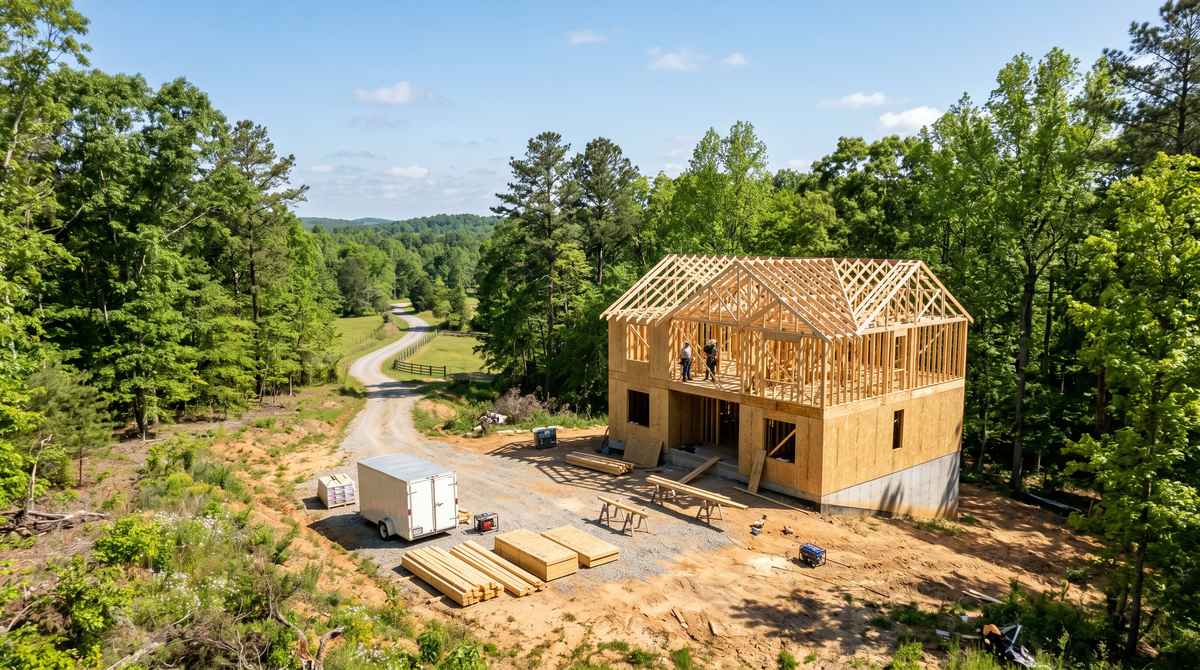
Building a custom home in Lancaster County, SC looks nothing like building in Mecklenburg County or even neighboring York County. Lancaster County has its own planning-and-zoning process on Hubbard Drive, its own mix of public water, well, and septic requirements, and a rural-to-suburban split that puts Indian Land subdivisions on one end and wooded acreage parcels off Van Wyck Road on the other. Owners considering a Lancaster County SC building custom home project in 2026 need to understand the permitting realities, the site-work variables, and the neighborhood-by-neighborhood cost dynamics before land goes under contract.
Lancaster County, SC Custom Home Market in 2026
Lancaster County splits into three distinct residential submarkets. The Panhandle (Indian Land) is the fastest-growing ZIP in the county, dominated by master-planned subdivisions and mid-to-upper custom builds on platted lots. The Van Wyck and northern Lancaster corridor is wooded acreage, horse properties, and custom builds on family-owned tracts. The Lancaster city proper and the Heath Springs side is more affordable, with larger lots and a higher percentage of well-and-septic builds. Each submarket has its own permit volume, inspection wait times, and lot cost profile.
We build across all three submarkets, and our approach shifts with the submarket. Subdivisions need HOA architectural review coordination; acreage parcels need soil testing and utility tie-in planning; in-town parcels need older-plat verification and sometimes utility upgrades. For a closer look at how we structure projects in the Panhandle specifically, see our Indian Land custom home builder page.
Lancaster County submarket snapshot
- Panhandle (Indian Land): subdivision lots, faster permits, HOA ARC layer
- Van Wyck corridor: acreage tracts, septic/well common, longer site prep
- Lancaster city and Heath Springs: larger lots, more public utility coverage
- Countywide residential permits typically issue in 4-8 weeks in 2026
- Property taxes average 35-45% below comparable Mecklenburg County values
Lancaster County Planning, Permits, and Inspections
Lancaster County’s Planning & Building department handles permitting from the Administration Building on Hubbard Drive. The department reviews zoning, setbacks, stormwater, and building plans, and issues permits once plan review and fees are cleared. For 2026, we’re seeing residential plan review turnaround of 4-8 weeks for a complete submittal; incomplete submittals add 2-4 weeks each correction cycle. The SC-licensed residential builder on record signs permit applications and is accountable for each inspection.
Zoning varies widely in Lancaster County. Indian Land parcels are often PD (Planned Development) or MDR (Medium Density Residential) with their own subdivision regs. Van Wyck and rural parcels are typically RLD (Rural Low Density) with larger setback requirements and provisions for agricultural uses on the same tract. Before a lot goes under contract, we verify zoning, overlay districts, floodplain mapping (FEMA Flood Map Service Center references), and access easements through Lancaster County’s public records. That verification prevents the two most common late-stage surprises: setback violations and an unbuildable septic area.
Permit package essentials
- Boundary and topographic survey, signed and sealed by a SC-licensed surveyor
- Site plan showing setbacks, impervious coverage, driveway, utility lines
- Architectural plans with all elevations and wall sections
- Structural, mechanical, electrical, and plumbing drawings
- SCDHEC septic permit or utility tap letter
- SC-licensed Residential Builder or Residential Specialty Contractor signature
Site Work Realities on Lancaster County Lots
Site work decides whether a Lancaster County custom home starts on schedule or bleeds the contingency before framing begins. The three biggest variables are soil type, slope, and septic feasibility. Lancaster County sits on Piedmont clay and weathered granite — good for foundation capacity, challenging for perc rates. On acreage parcels off Van Wyck Road or Possum Hollow, we start with a soil scientist’s percolation evaluation before drawings are finalized. If the perc comes back marginal, the design either relocates the septic area or shifts to an alternative drain-field system that costs more but builds predictably.
Slope matters after soil. A lot with over 10% fall almost always needs a walkout or daylight basement foundation, which shifts both the design and the budget. Grading, driveway cuts, retaining walls, and erosion control together can add 6-15% to the hard-construction budget on sloped acreage parcels. Our grading services and drainage systems pages walk through how we price and execute the site-work scope.
What influences site-work cost
- Soil type and perc rate on septic-served lots
- Total fall across the building pad (affects foundation type)
- Tree clearing volume and SC Forestry burn-permit availability
- Driveway length, shared easements, and culvert requirements
- FEMA floodplain overlays and required finished-floor elevation
- Utility tap distances — public water lines may be 200+ feet from some parcels
Water, Septic, and Utility Planning in Rural Lancaster County
Public water and sewer are common in the Panhandle but spotty in Van Wyck and rural Lancaster. Many acreage parcels rely on a drilled well and a conventional septic drain field. A SCDHEC-permitted residential well in Lancaster County typically runs 250-450 feet deep and produces 5-15 gallons per minute depending on geology. Septic permits are issued by SCDHEC after soil evaluation and site plan review; the permit specifies tank size, trench length, and drain-field placement. We coordinate the well driller, the septic installer, and the site-prep crew so the driveway, well, and drain field don’t conflict with each other or with the future home envelope.
Power, telecom, and gas run through the usual utility vendors. Duke Energy handles electric in most of Lancaster County; Comporium handles telecom in the Panhandle; propane is common in rural areas where natural gas isn’t economical. Our utility tie-in coordination folds all of this into the pre-construction schedule so meters set on time and inspections don’t wait on a missing utility locate.
Well and septic rules of thumb
- Minimum 100-foot separation between well and septic drain field
- SCDHEC septic permit required before foundation inspection
- Drilled well depth in Lancaster County typically 250-450 feet
- Propane tank sizing and placement part of utility planning
- Duke Energy service lead time 6-12 weeks for new meter installs
Budgeting and Financing a Lancaster County Custom Build
Honest 2026 custom-home pricing in Lancaster County tracks closely with the Indian Land and Lake Wylie markets on the Panhandle side, and runs 5-10% lower on comparable builds in the Van Wyck and city of Lancaster submarkets. Typical ranges as of 2026: $265-$345 per square foot for builder-grade custom on a platted or easy-to-build rural lot, $330-$465 per square foot for mid-range with upgraded finishes, and $475+ per square foot for luxury custom with complex site work or acreage amenities. These are the all-in per-SF numbers on a typical 3,000-5,000 SF home envelope; very small or very large builds skew higher per SF.
Construction-to-permanent financing is the most common structure. Most local lenders will fund through a monthly draw schedule tied to inspection milestones. A healthy build carries 8-12% owner contingency on top of the construction budget, plus separate allowance buckets for flooring, cabinetry, tile, plumbing, lighting, and appliances. Our construction financing overview explains the pieces in plain language, and our budget tracking and transparency service shows clients where every dollar lands in real time.
How we keep budgets honest
- Fixed-price or cost-plus contracts with openbook subcontractor pricing
- Pre-construction estimating tied to stamped architectural plans
- Allowances defined by line item, not lumped into a single number
- Change orders documented and client-approved before work starts
- Monthly draw reconciliation against the lender’s inspection schedule
Timeline and Seasonal Build Windows
A 3,500 SF Lancaster County custom home typically runs 11-14 months from signed contract to certificate of occupancy in 2026. Design-development is 8-12 weeks, permitting adds 4-8 weeks in parallel with final pricing, and construction is 40-52 weeks. Weather is the single biggest schedule risk. Late-January through March brings saturated ground that delays grading and foundation work; July and August thunderstorms disrupt roofing and exterior finishes. We scope foundation pours, framing start dates, and roofing dry-in windows against local five-day forecasts to keep critical-path work from stalling.
Materials and specialty items also drive the timeline. Windows and exterior doors currently run 8-14 weeks lead time from order to delivery. Custom cabinetry typically runs 12-18 weeks. We order long-lead items the day contracts are signed so they arrive when the schedule needs them, not after drywall is hung. For the full week-by-week picture, our custom-home timeline guide applies across Lancaster and York County builds.
Seasonal watchpoints
- Jan-Mar: saturated ground, grading and foundation delays
- Apr-Jun: ideal framing weather window
- Jul-Aug: thunderstorm disruption, heat-related labor slowdowns
- Sep-Nov: best paint and exterior-finish window
- Dec: year-end scheduling tightens for trim and finish trades
Choosing the Right Lancaster County Custom Home Builder
Verify SC licensing first. The South Carolina LLR maintains a public lookup for residential builders and specialty contractors — any serious candidate should clear verification in under two minutes. Beyond licensing, ask any builder for five recent addresses in Lancaster County, references who closed inside the last 24 months, and sample draw and change-order paperwork so you can see exactly how they handle money and scope mid-build. If they push back on any of those, keep looking.
We bring 30+ years of Charlotte-metro custom home experience to Lancaster County projects, run a single dedicated project manager per build, and share a live budget tracker every week. Most of our Panhandle and Van Wyck clients come from referral, which is why our project gallery and company background are worth reviewing before a first call.
Frequently Asked Questions
How long do Lancaster County SC building permits take in 2026?
Residential permits typically issue in 4-8 weeks from a complete submittal. Incomplete applications add 2-4 weeks per correction round, so we front-load the plan-review package with everything the county needs on the first pass.
Do I need a SC-licensed builder to build my own custom home in Lancaster County?
Yes for most contracted residential builds over the owner-builder threshold. The SC LLR requires a residential builder or residential specialty contractor license on file for permitted construction. Owner-builders can sometimes self-permit under limited circumstances, but financing and resale almost always assume a licensed builder of record.
Is well-and-septic cheaper than public utilities for a Lancaster County custom home?
Not usually, once all costs are counted. Drilled wells and conventional septic systems often add $25,000-$40,000 to the site-work budget versus a lot with public water and sewer stubbed. The tradeoff is lower monthly utility bills and access to lots that public utilities don’t yet reach.
Can I build on inherited family land in rural Lancaster County?
Almost always, yes. We start with a boundary and topographic survey, a zoning confirmation, soil testing for septic suitability, and driveway and utility planning. Inherited parcels occasionally need easement cleanup or a re-plat before permits can issue, and that extra due diligence is part of our pre-construction scope.
Ready to discuss your Lancaster County lot? Call CDG Carolinas at (704) 619-6293 or use our contact form to schedule a conversation about feasibility, 2026 pricing, and how we’d sequence the build. We’ll walk through the permitting path, the site-work variables, and the realistic schedule before anyone signs a contract.