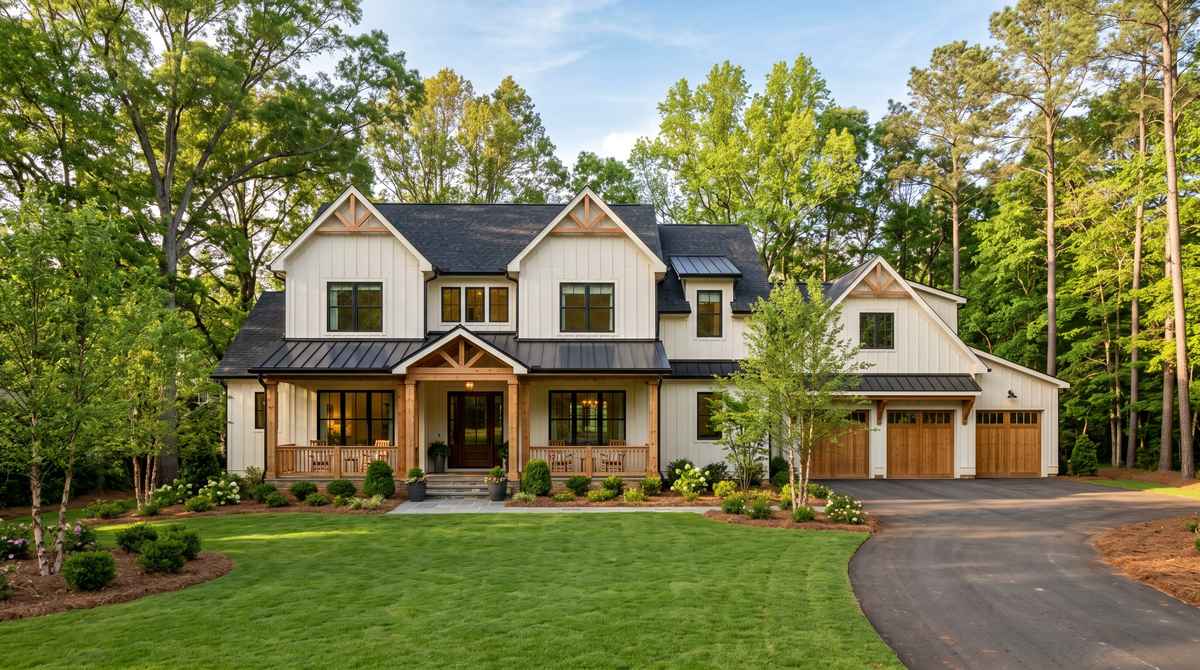
Building a custom home builder Rock Hill SC project means working through York County permitting, Catawba River corridor setbacks, and a local lot market that has tightened substantially since 2023. This roadmap walks through what Rock Hill homeowners actually face in 2026 — from lot acquisition and site evaluation through permitting, construction, and move-in — with realistic timelines and cost ranges grounded in current conditions.
We have spent 30+ years building across the Charlotte metro and York County, and Rock Hill has become one of the most active submarkets we see. The combination of Winthrop University, Piedmont Medical Center, and Riverwalk commercial growth has pulled demand inland from Lake Wylie and Fort Mill, and lot inventory has responded accordingly.
The Rock Hill Lot Market in 2026
Rock Hill’s custom home lot market looks very different than it did three years ago. Infill parcels in established neighborhoods like Oakdale, Boyd Hill, and the streets surrounding Cherry Park command a premium because they deliver mature trees, larger setbacks, and existing utilities at the curb. New subdivisions on the north and east sides — toward India Hook and along Mount Gallant Road — offer more predictable building conditions but fewer mature features.
We tell every client to evaluate three lot categories before committing. Infill residential parcels typically range from one-quarter to one-half acre, with asking prices that reflect scarcity plus proximity to Riverwalk and downtown Rock Hill. New-development lots in active subdivisions trade more frequently and often include utility stubs, graded pads, and recorded HOA covenants that limit design choices. Raw-land parcels — particularly along the Catawba River corridor west of Mount Gallant Road — offer the most flexibility but require the most pre-construction work.
Water table depth, soil composition, and existing vegetation all materially affect per-square-foot costs. Red clay soils common to York County drain poorly and often require additional foundation engineering, especially on sloped lots. A proper geotechnical report before closing has saved our clients five and six figures more than once.
- Infill lots near downtown Rock Hill and Cherry Park trade at a premium for mature trees and utility access.
- New-subdivision lots on the north and east sides come graded with utility stubs but carry HOA design restrictions.
- Raw land along the Catawba River corridor offers the most flexibility but needs soil tests and perc tests.
- York County red clay drains slowly and often requires upgraded foundation engineering.
- Always budget for a geotechnical report before closing on any Rock Hill lot.
York County Permitting and the Rock Hill City Process
Custom home permits inside Rock Hill city limits go through the City of Rock Hill Planning and Development Department. Unincorporated York County parcels are handled by York County Building Codes. The two processes are not interchangeable, and the review timelines differ meaningfully.
As of 2026, we are seeing 5 to 8 week permit review windows in the city when plans are clean on the first submittal, and 4 to 7 weeks in unincorporated York County. That timeline assumes a complete submittal — site plan, energy compliance documentation, structural drawings, and stormwater forms where applicable. Incomplete packages extend review by weeks, not days, because the cycle restarts each time.
Rock Hill’s zoning overlay districts matter on older streets. Properties inside a historic overlay or near the Old Town district face additional design review, particularly for façade materials and roof pitch. Our pre-construction planning team flags these restrictions during the feasibility phase so clients do not redesign after submittal.
Stormwater requirements for lots over a certain disturbed-area threshold add a separate engineering track. Sloped lots draining toward the Catawba or toward a Rock Hill-maintained stormwater structure need a stamped drainage plan, and that review happens in parallel with the building permit — not before it — which is why engaging the civil engineer early is so important.
- City of Rock Hill permits run 5 to 8 weeks on clean first submittals.
- Unincorporated York County permits run 4 to 7 weeks through the county Building Codes office.
- Historic overlay and Old Town properties face additional design review on façade and roof decisions.
- Stormwater engineering runs in parallel with building permit review on lots over the disturbed-area threshold.
- Complete first submittals are the single biggest permit timeline lever.
Catawba River Corridor Considerations
Properties near the Catawba River carry setback, buffer, and floodplain considerations that can reshape a floor plan before it is drawn. The river corridor runs along Rock Hill’s western edge and touches the India Hook peninsula, several parcels off Old Mount Holly Road, and portions of the River District. FEMA flood maps govern the baseline, and York County enforces stream buffers measured from the top of bank.
Vegetated stream buffers typically require undisturbed zones that can eat into the buildable footprint. We routinely see buyers assume a three-acre parcel delivers three acres of build area, then discover after closing that half of it sits inside a protected buffer. A pre-purchase site walk with a builder and a civil engineer prevents this.
Flood zone determinations drive foundation type, insurance requirements, and finished floor elevation. Lots in AE or X-shaded zones may require elevated foundations, flood vents on any enclosed ground-level space, and additional insurance disclosures at closing. Our custom home building team coordinates with a licensed surveyor to pull the elevation certificate before we lock foundation plans.
- Catawba River stream buffers reduce buildable area on riverfront and near-river lots.
- FEMA flood zones dictate foundation type, insurance, and finished floor elevation.
- Pre-purchase site walks with a builder catch buffer conflicts before closing.
- Elevation certificates from a licensed surveyor are required in flood-prone zones.
- Buffer-compliant site plans preserve clean review timelines at the county.
Design Priorities That Fit Rock Hill
Rock Hill homebuyers in 2026 tend to prioritize three things: covered outdoor living, flexible main-level spaces, and energy performance tuned for hot, humid Carolina summers. The architectural design choices we see landing well in this market reflect those priorities without chasing trends that age quickly.
Covered Outdoor Living
Rock Hill’s weather pattern — long hot summers with frequent afternoon thunderstorms and mild shoulder seasons — makes covered outdoor space a genuine year-round asset. Screened porches with vaulted ceilings, outdoor kitchens positioned away from prevailing wind, and permeable hardscape patios all add usable square footage without the conditioned-space cost.
Main-Level Primary Suites
Demand for main-level primary suites has climbed steadily in Rock Hill, especially among buyers relocating from Charlotte or coming out of larger two-story homes. A well-designed main-level primary does not have to feel like a ranch — our popular floor plan approaches keep the social spaces open and the primary suite zoned for privacy.
Energy Performance
Hot-humid-climate design choices pay back quickly in Rock Hill. Advanced framing, spray-foam or closed-cell attic insulation, high-SEER variable-speed HVAC, and proper vapor control are the four highest-ROI building envelope investments. The U.S. Department of Energy weatherization guidance lays out the fundamentals for anyone starting from scratch.
- Covered outdoor living delivers year-round usability at lower cost than conditioned square footage.
- Main-level primary suites are in high demand from relocating Charlotte buyers.
- Spray-foam attic insulation and variable-speed HVAC are the highest-ROI envelope upgrades.
- Proper vapor control prevents moisture problems in Rock Hill’s humid summers.
- Energy performance choices pay back within the first few years of occupancy.
Realistic 2026 Cost Ranges for Rock Hill Custom Homes
We quote every project based on finish level, lot conditions, and design complexity, and we refuse to publish made-up averages. That said, here are honest 2026 typical ranges we are seeing across Rock Hill custom home projects in our pipeline.
Builder-grade custom homes — homes that are genuinely custom but use mid-market finishes throughout — typically range from $275 to $360 per square foot as of 2026. Mid-range custom homes with upgraded kitchens, primary suites, and exterior materials typically range from $340 to $475 per square foot. Luxury custom homes with premium millwork, full smart-home integration, and high-end outdoor spaces start at $500 per square foot and move up based on scope.
These ranges exclude lot acquisition, exceptional site work, and any work driven by unusual conditions like rock excavation, extensive stormwater engineering, or long utility runs. A 3,800 square foot mid-range custom home on a clean Rock Hill lot in 2026 typically lands in the low seven-figure total cost range once land, site work, and vertical construction combine.
Our cost breakdown analysis for neighboring Lake Wylie applies largely to Rock Hill, with permit fees and some local labor rates differing modestly.
- Builder-grade custom: $275 to $360 per SF typical range as of 2026.
- Mid-range custom: $340 to $475 per SF typical range as of 2026.
- Luxury custom: $500+ per SF as of 2026, scoped to finish level.
- Ranges exclude land, exceptional site work, and unusual conditions.
- A 3,800 SF mid-range home on a clean lot lands in the low seven-figure total.
Construction Timeline and Seasonal Planning
A clean Rock Hill custom home runs 11 to 14 months of active construction for a 3,000 to 4,500 square foot home after permits issue. That assumes no major design changes after framing, normal York County inspection availability, and typical 2026 supply chain conditions for windows, appliances, and specialty millwork.
Seasonal planning matters more than most homeowners expect. York County tends to experience its wettest stretches in late winter and early spring, which can push foundation and framing schedules if a project starts in January or February. Starting excavation in late summer — August through October — gives framing crews the fall and early winter for dry-in, which is usually the best path.
Inspector availability at the county can also swing the schedule. Framing, rough electrical, rough plumbing, and insulation inspections typically run on 2 to 5 business day lead times during normal periods, but summer vacation weeks and holiday weeks compress that window. Our construction timeline guide walks through how we sequence around these realities.
- Active construction runs 11 to 14 months for 3,000 to 4,500 SF homes after permit issuance.
- Late-summer starts give framing crews the best weather window for dry-in.
- Inspection lead times run 2 to 5 business days in normal periods at York County.
- Design changes after framing extend the schedule more than any other single factor.
- Supply lead times for windows and specialty appliances need to be ordered 4 to 6 months ahead.
Choosing the Right Builder in Rock Hill
Not every builder active in the Charlotte metro is equally qualified in York County. We recommend evaluating three things before hiring: York County-specific permitting experience, a verifiable punch list process, and transparent change-order procedures. The mistakes to avoid when hiring a builder guide covers the due diligence that protects homeowners from preventable problems.
York County-specific experience matters because the permitting office, stormwater standards, and inspector preferences differ from Mecklenburg County. A builder who has only worked inside Charlotte city limits will learn the local process on a client’s project — and pay for that learning with delays.
A written punch list process, with inspection milestones tied to draw schedule and written sign-offs at each phase, is the single strongest quality-control mechanism a homeowner can insist on. We use photo-documented punch lists and share them through a client portal so everyone has the same visibility.
- York County-specific permitting experience separates qualified builders from out-of-area firms.
- Written punch list processes with photo documentation protect quality at each phase.
- Transparent change-order procedures prevent budget surprises mid-project.
- Draw schedules tied to inspection milestones align incentives between homeowner and builder.
- Local subcontractor relationships materially affect schedule and pricing.
Frequently Asked Questions
How long does it take to build a custom home in Rock Hill, SC?
From contract signing through move-in, plan for 16 to 20 months total — that includes 3 to 4 months of design and pre-construction, 5 to 8 weeks of permit review, and 11 to 14 months of active construction for a typical 3,000 to 4,500 square foot home. Larger or more complex homes extend proportionally.
Do I need a geotechnical report before buying a Rock Hill lot?
For any lot with slope, mature trees, or proximity to the Catawba River corridor, yes. York County red clay soils and variable bedrock depth can materially change foundation costs. A $2,000 to $4,000 soils report routinely uncovers tens of thousands in hidden costs.
Can I build on a lot inside a Rock Hill historic overlay?
Yes, but expect additional design review for façade materials, roof pitch, and setbacks. These reviews typically add 4 to 8 weeks to the timeline and benefit from early engagement with the City of Rock Hill planning staff before the design is finalized.
What is the biggest cost surprise Rock Hill custom home buyers face?
Site work on sloped or poorly draining lots. Excavation, retaining walls, long utility runs, and stormwater engineering can add six figures to a project budget when the lot is not properly evaluated before closing. A pre-purchase site walk with a builder is the single best prevention.
Ready to Start Your Rock Hill Custom Home?
We build custom homes across Rock Hill, York, Fort Mill, and the broader York County market with three decades of local experience and a project management process built for the realities of the area. Call us at (704) 619-6293 or visit our contact page to schedule a feasibility conversation about your lot, design goals, and timeline.