
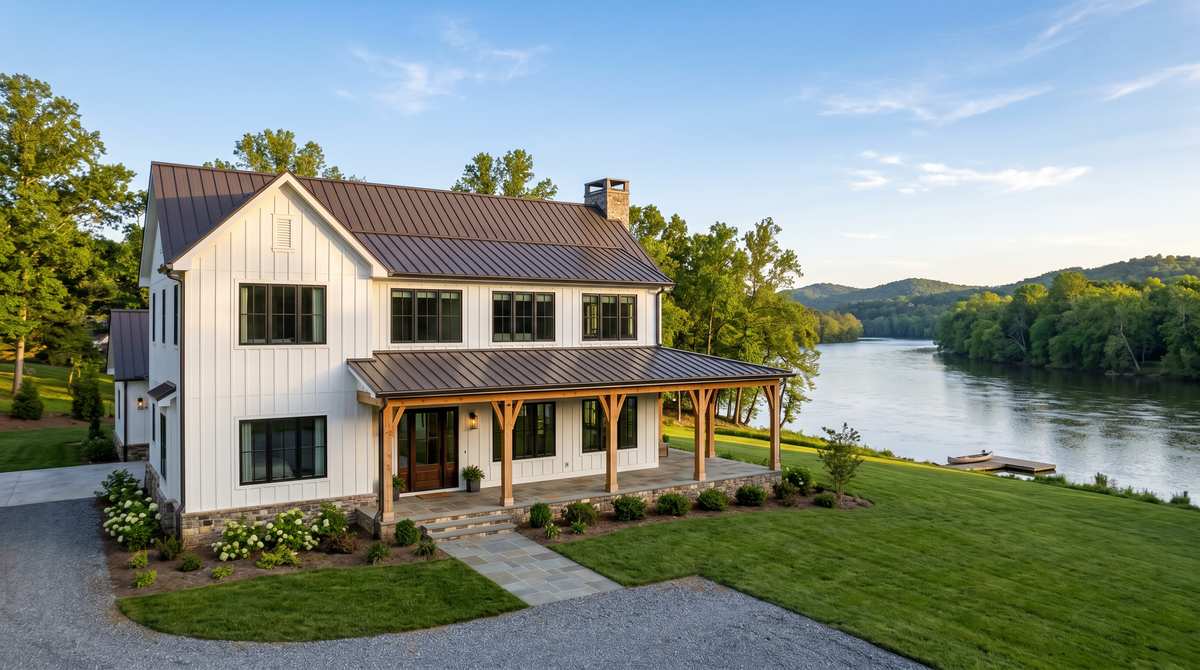
If you are planning a custom home builder Belmont NC project, you are choosing one of the most distinctive building environments in the Charlotte metro. Between the Catawba River frontage, the walkable historic core around Main Street and Belmont Abbey, and the newer riverfront neighborhoods, the lot you pick will shape nearly every design decision that follows. We have been building and remodeling across Gaston County and the greater Charlotte region for more than thirty years, and Belmont, NC is one of the clearest examples of why local experience matters.
This guide walks through what makes Belmont, NC different, how the Gaston County permit process actually works, what riverfront and historic-district construction requires, and the costs and timelines you should plan for in 2026.
Why Belmont, NC Is a Distinctive Place to Build
Belmont sits on a peninsula between the Catawba River and the South Fork Catawba, roughly twelve miles west of uptown Charlotte via I-85. That geography matters for three reasons. First, it means a significant share of the most desirable lots are waterfront or water-view, which introduces shoreline setbacks, tree-save requirements, and stormwater considerations you do not face inland. Second, the town grew up around the Stowe family mills and Belmont Abbey, so the historic core has a very different design language than the newer subdivisions east of NC-273. Third, the commute profile puts Belmont, NC inside the reasonable drive time to both Charlotte Douglas International and uptown employers, which has pulled significant demand into neighborhoods like The Conservancy at Reflection Pointe, McLean, River Run, and the infill lots around Cramer Mountain.
For our clients, that translates into three common build scenarios: a modern-farmhouse or transitional new build on a wooded riverfront lot, a period-appropriate infill home in or adjacent to the historic district, and a tear-down-and-rebuild on an older Cramer Mountain or mid-century parcel. Each of these needs a different approach, and we design the entire engagement around that distinction from the first site walk.
- Belmont sits between the Catawba River and South Fork, inside Gaston County, twelve miles from uptown Charlotte.
- Waterfront lots carry shoreline setbacks, tree-save rules, and stormwater design that inland lots do not.
- The historic core has a different architectural language than newer subdivisions east of NC-273.
- Demand is concentrated in Reflection Pointe, McLean, River Run, and Cramer Mountain.
- Most Belmont, NC builds fall into riverfront new construction, historic-district infill, or tear-down-and-rebuild.
Gaston County Permits and the Belmont Review Process
If you are building a detached single-family home inside Belmont city limits, your primary permit authority is Gaston County, working in coordination with the City of Belmont Planning and Zoning office. The typical sequence starts with a zoning review to confirm use, setbacks, and any overlay districts that apply to your parcel. From there, you submit a building permit application with stamped construction drawings, site plan, grading and erosion control plan, and any required stormwater documentation. Inspections run through the Gaston County Building Inspections team for footing, foundation, framing, rough mechanicals, insulation, and final.
Historic District Considerations
Belmont has a defined historic overlay that affects buildings inside and directly adjacent to downtown. If your lot touches that overlay, exterior materials, roof pitch, window proportions, and even paint color can fall under additional review. We front-load that conversation with the City of Belmont before we finalize exterior drawings, because reworking an already-permitted elevation is always more expensive than getting it right the first time. The City of Belmont publishes current zoning and historic-district guidance, and we pair that with an on-site meeting whenever an overlay is in play.
Shoreline and Stormwater Rules
For riverfront and lake-adjacent lots, Duke Energy shoreline rules, state-delegated stormwater requirements, and Gaston County tree-save ordinances all apply in parallel. None of these are optional, and all of them influence where the house can actually sit on the lot. We handle the coordination for you, but the earlier we have a survey and a soils report, the smoother it runs.
- Permit authority inside Belmont city limits is Gaston County with City of Belmont zoning review.
- Sequence: zoning review, building permit submission with stamped drawings, construction, inspections, final.
- Downtown historic overlay adds exterior material, roof pitch, and window review.
- Riverfront lots layer Duke Energy shoreline rules, state stormwater, and tree-save on top of standard permits.
- Early survey plus soils report shortens the entire front-end timeline.
Riverfront and Water-View Construction in Belmont
Catawba riverfront construction in Belmont, NC is its own discipline. The shoreline is classified and regulated by Duke Energy, so any structure, dock, or grading within the shoreline zone needs to match that classification. Setback from the full-pond line, the amount of existing vegetation you can remove, and even the driveway path down to the house are all constrained by the shoreline designation. On top of that, Gaston County enforces tree-save and buffer requirements that further reduce the disturbed-area envelope.
Practically, that means a riverfront Belmont home usually sits further from the water than the owner initially pictures, with a longer approach drive and a lower-impact landscape plan. We frequently recommend a walkout lower level oriented toward the water, a covered rear porch wide enough to use in shoulder seasons, and a hardscape path to a future dock location that stays outside the protected buffer. Clients who want the lake-plus-river lifestyle often also look at our Lake Wylie custom home guide and land-selection advice because the same waterfront rules and site-planning principles apply across the Catawba chain.
- Duke Energy shoreline classification controls where and what you can build near the water.
- Gaston County tree-save and buffer rules further reduce the disturbed-area envelope.
- Most riverfront Belmont homes sit further from the water than clients initially picture.
- Walkout lower levels and wide rear porches make the most of the riverfront orientation.
- Dock and pathway locations should be planned from day one, not after the house is framed.
Historic District and Infill New Construction
Building inside or next to Belmont historic overlay looks very different from building on a five-acre riverfront lot. The parcels are smaller, setbacks are tighter, mature trees are often protected, and neighbors are close enough that construction logistics need to be planned on day one. Exterior decisions are also not purely aesthetic, they are regulatory. Horizontal lap siding, wood or fiber-cement in historically correct profiles, a front porch that matches the street rhythm, and window proportions that read as traditional are typical requirements.
We have walked enough Belmont historic lots to know where the pressure points are: narrow alley access, limited staging area, older utilities, and existing trees right on the buildable envelope. Our answer is a tight site logistics plan, a construction schedule that minimizes disruption to neighbors, and an exterior package that passes review the first time. For clients coming from a tear-down or major remodel scenario, our home remodeling guide and historic renovations service page explain how we handle period detailing and structural upgrades together.
- Historic overlay lots have tighter setbacks, protected trees, and stricter exterior review.
- Siding profile, porch rhythm, and window proportion are regulated, not just decorative.
- Narrow alleys and limited staging require a detailed site-logistics plan from day one.
- Neighbor communication and schedule control are part of a successful historic-district build.
- Tear-down-and-rebuild inside the overlay typically needs a hybrid permit approach.
Design Trends We Are Seeing in Belmont, NC Right Now
Across the Belmont builds we have priced and started in late 2025 and early 2026, a few patterns are clear. Modern farmhouse remains the dominant exterior vocabulary for new riverfront construction, usually in a board-and-batten plus stone water-table combination with standing-seam metal roof accents. Transitional and low-country influences are common on the larger estate lots. Inside the historic overlay, we see more Craftsman, American Foursquare, and Colonial Revival forms because they integrate with the existing streetscape.
On the inside, the consistent requests are a dedicated home office wired for video, a true primary-suite on main, a scullery or back-prep kitchen off the main kitchen, and a screened porch with an outdoor fireplace that extends the useful outdoor season from March through November. Energy-efficient envelope choices, heat-pump HVAC, and solar-ready electrical are now the default rather than the upgrade, consistent with guidance from energy.gov. Our luxury features guide, smart home features, and energy-efficient homes pages go deeper on these decisions.
- Modern farmhouse with board-and-batten and stone is the dominant riverfront exterior style.
- Historic-overlay new builds trend Craftsman, Foursquare, and Colonial Revival.
- Primary-on-main, scullery kitchens, and dedicated home offices are nearly universal.
- Screened porches with outdoor fireplaces extend usable outdoor time across three seasons.
- Heat-pump HVAC and solar-ready electrical are now baseline, not upgrades.
Costs and Timelines for a Belmont, NC Custom Build in 2026
Honest cost ranges matter more than a single headline number. As of 2026, a turn-key custom build in the Belmont, NC market typically runs in the range of $325 to $500 per square foot for standard custom construction, and $500 to $800 per square foot or more for riverfront, architecturally complex, or high-specification builds. That range reflects finish level, lot complexity, site work, and whether the lot is already improved. It is a typical range, not a guarantee, and every project is priced off its own scope, site conditions, and specifications.
Timelines run in parallel categories. Pre-construction, which covers design, engineering, pricing, and permitting, is usually three to six months. Construction itself is typically ten to fourteen months for a true custom home in this market, longer for riverfront sites with significant site work. We build detailed, week-by-week schedules and review them with clients every two weeks so there are no timeline surprises.
- Standard Belmont custom construction in 2026 typically runs $325 to $500 per square foot.
- Riverfront or high-specification builds typically run $500 to $800 per square foot or more.
- Pre-construction, design, engineering, and permitting typically take three to six months.
- Construction for a true custom home in Belmont typically runs ten to fourteen months.
- Every range above is a typical 2026 range, priced to scope, site, and specifications.
Frequently Asked Questions
Do I need a special permit to build on a Belmont riverfront lot?
You need your standard Gaston County building permit plus City of Belmont zoning review, and if the lot falls inside the Duke Energy shoreline classification, you also need to meet shoreline setback and buffer rules. State-delegated stormwater requirements may also apply. We handle this coordination, but the earlier we start, the faster it moves.
Can I build a modern design inside the Belmont historic district?
Sometimes, but the exterior has to respect the historic overlay standards for form, scale, siding, and window proportions. Modern interiors are not restricted. We have delivered projects that feel contemporary inside while reading as period-appropriate from the street, and that is the right path for most historic-overlay infill.
How long does the permit process take in Gaston County?
Straightforward Belmont permits, once drawings and site plans are complete and stormwater is resolved, typically clear in four to eight weeks. Projects with historic-overlay review, shoreline coordination, or unusual site conditions can take longer. We build realistic buffer into every schedule rather than promising a best case that rarely holds.
Do you build outside of Belmont city limits as well?
Yes. We serve the greater Charlotte metro including Gaston County, Mecklenburg County, Union County, and York County, SC (Lake Wylie, Fort Mill, Rock Hill). The process and standards differ by jurisdiction, which is exactly why a local builder matters.
Ready to Start a Belmont, NC Custom Home?
If you are ready to talk through a specific lot, a tear-down scenario, or a historic-district build, we would like to walk the site with you. Call us at (704) 619-6293 or use our contact page to schedule an introductory conversation. We will give you an honest read on feasibility, likely timeline, and realistic 2026 cost ranges before you commit to anything.