
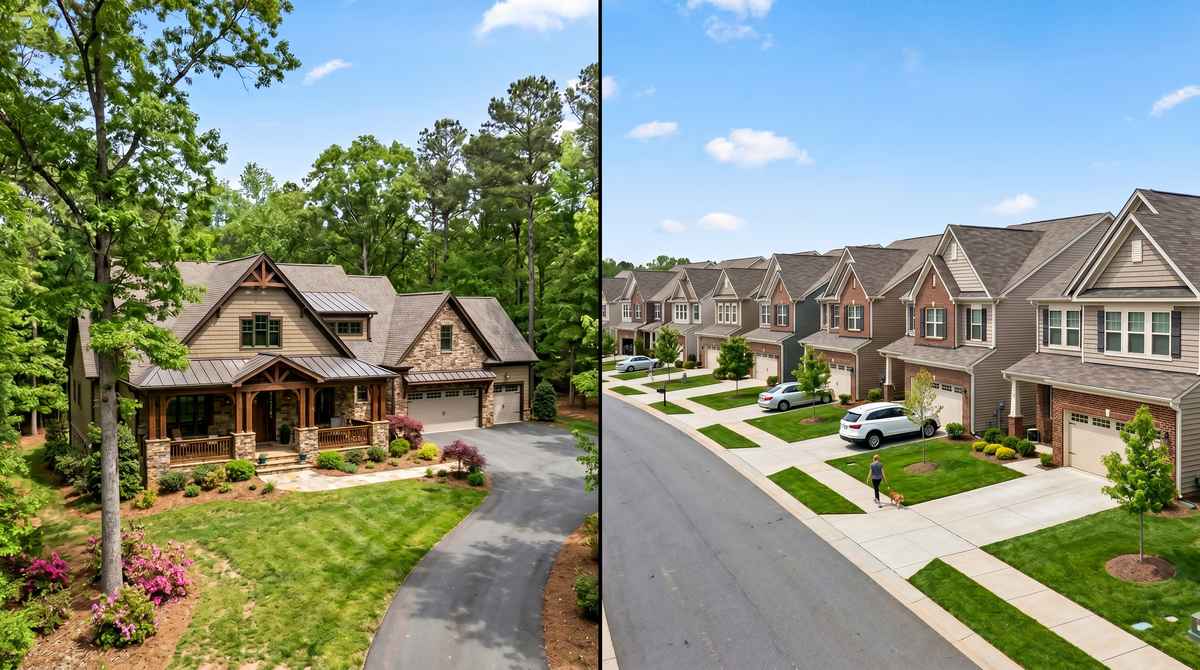
The custom home vs production home Charlotte decision sounds like it is mostly about budget, and that is the wrong frame. Both paths can land at very similar all-in numbers in the Charlotte, NC market in 2026. The real difference is design control, lot quality, schedule predictability, and how the home performs five and ten years out. We have built across the Charlotte metro for more than three decades, and the families who pick the right path almost always start with the right diagnostic questions.
This guide walks through how custom and production homes actually compare in Charlotte, NC: timelines, total cost, design control, build quality, lot inventory, resale, and the buyer profiles where each path makes the most sense. Every range below is a typical range as of 2026, drawn from active Charlotte and York County, SC projects.
What Counts as a Custom Home Versus a Production Home
A custom home is built to a specific client on a specific lot, with the architectural plan, materials, and finishes selected by that client. The builder runs a single project at a time per project lead, and the floor plan is either drawn from scratch or heavily modified from an existing baseline. A production home, sometimes called a tract home or spec home, is built by a national or regional builder from a small library of pre-engineered floor plans on lots the builder has already secured inside a planned community. Buyers select from option packages rather than designing from a blank sheet.
The Charlotte, NC metro has a particularly active production-builder market because of the volume of new community development on the south and east sides — Indian Trail, Waxhaw, Tega Cay, Fort Mill, Rock Hill, and parts of Lake Wylie all have meaningful production inventory. Custom builds in the same submarkets generally happen on individual lots clients buy themselves or through builder-controlled lot programs. Both paths produce new construction; they are just very different products and very different processes.
- A custom home is built to one client on a chosen lot with bespoke plans and selections.
- A production home is built from a pre-engineered plan library on builder-controlled subdivision lots.
- Charlotte’s south and east submarkets have especially active production inventory in 2026.
- Custom builds happen on individual lots; production builds happen inside planned communities.
Total Cost: Where the Two Paths Actually Land
The honest cost comparison surprises most clients. A well-optioned production home in a desirable Charlotte-metro community in 2026 frequently lands at a similar total dollar figure to a comparable-square-footage custom home on a buyer-owned lot, especially once buyers add the option packages they actually want. The difference is what each dollar buys.
For vertical construction on a true custom home, the typical range in Charlotte, NC is 350 to 600 dollars per square foot as of 2026. Production builders typically advertise 250 to 350 base, but the as-delivered price including options, lot premiums, and structural upgrades commonly lands 300 to 425. Production communities also charge HOA dues, sometimes a club initiation fee, and in some neighborhoods a transfer fee at resale. Custom builds outside a planned community generally have no HOA exposure but do carry land cost.
Land is the variable that flips the comparison. A buyable infill lot in Mecklenburg County can run 400,000 to 1,500,000 dollars; a production lot premium inside a community typically runs 5,000 to 75,000 over base. Our published custom home cost framework walks through the same math we run on every parcel. The right answer depends on which submarket the family is choosing and what trade-offs are acceptable.
- Custom vertical construction in Charlotte typically runs 350 to 600 dollars per square foot as of 2026.
- Production base prices advertise 250 to 350 but as-delivered pricing commonly lands 300 to 425.
- Production communities carry HOA dues, possible initiation, and sometimes a resale transfer fee.
- Land cost is the variable that decides which path is cheaper for a given family.
Timeline and Predictability
Production homes are faster from contract to move-in. A typical Charlotte production build runs 6 to 9 months once construction starts, and inventory homes that are already framed can close in 60 to 120 days. A true custom home runs 11 to 16 months from contract to certificate of occupancy in 2026, including 8 to 14 weeks of plan development and permitting plus 9 to 12 months of vertical construction. For families on a hard relocation deadline, that timeline difference is real and worth pricing in. Our framework on custom home construction timelines covers what drives each window.
Schedule predictability is a different question. Production builders are working many homes at the same time per superintendent, which means their schedules are vulnerable to subcontractor sequencing across the whole community. Custom builders running one project per project lead generally hit contract dates more reliably because the schedule is not competing with thirty other lots in the same neighborhood.
The tradeoff is straightforward. Production wins on raw speed for an in-stock or recently-started home. Custom wins on schedule reliability for a planned move-in date that is more than a year out, especially for families coordinating school transitions or a sold home.
- Production builds in Charlotte, NC typically run 6 to 9 months from start; inventory homes close in 60 to 120 days.
- Custom builds run 11 to 16 months from contract to certificate of occupancy as of 2026.
- Production schedules are vulnerable to subcontractor sequencing across an entire community.
- Custom schedules are typically more predictable to a stated contract date.
Design Control and Floor Plan Fit
Design control is where the two paths diverge most sharply. Production builders offer a small set of pre-engineered plans with limited modifications. Some production lines do not allow structural changes at all; others permit a defined option list — a bonus room, a gourmet kitchen package, a sunroom — but the plan footprint is fixed. That is fine when a stock plan happens to fit a family well, and many do.
Custom design starts from a clean sheet or a heavily modified baseline. We run a structured design process that surfaces how a family actually lives — primary suite locations, school-year mudroom flow, work-from-home requirements, multigenerational living, outdoor connections — and translates that into a floor plan that fits this house, not a generic one. Our overview of popular floor plan families shows the baselines we adapt from.
Material and finish control is similarly different. Production option packages bundle materials together for cost efficiency, which means upgrading one element can force upgrades in adjacent ones. Custom selections are a la carte: a quartzite primary bath with stock secondary baths is straightforward, and so is full custom inset cabinetry with mid-tier appliances. Our breakdown of luxury custom home features details how those decisions show up in the budget.
- Production builders work from a small library of plans with limited or zero structural modifications.
- Custom design starts from a clean sheet or a heavily modified baseline tailored to one family.
- Production option packages bundle materials, forcing cascading upgrades on a single change.
- Custom selections are a la carte: any element can be upgraded independently.
Build Quality, Spec, and Long-Run Performance
This is the section that usually decides the path. Production homes are built to the same NC State Building Code that custom homes follow, and both pass the same inspection sequence: footings, foundation, framing, mechanicals, insulation, drywall, and final. The code floor is the same.
The spec, however, is not. Production homes are built to a target margin across a community, which means framing schedules, insulation packages, window specs, and HVAC sizing are typically built to the lower end of code. Custom homes are spec’d to a brief: tighter framing, upgraded insulation and air sealing, often higher-spec windows, and heating and cooling sized to the actual envelope rather than a generic load calc. The federal Energy Saver guidance and the National Association of Home Builders both publish detail on how spec choices affect long-run performance and operating cost.
Long-run, the homes diverge. A custom home with a quality envelope and right-sized mechanicals tends to operate more cheaply, hold finishes longer, and have fewer warranty issues in years three through ten than a production home built to a community margin. That is a generalization, not a guarantee, but it lines up with what we see across our own portfolio and warranty book.
- Production and custom homes meet the same NC State Building Code minimum.
- Production spec is generally built to the lower end of code; custom spec is built to a brief.
- Custom envelope and mechanical decisions usually translate to lower operating cost long-run.
- Year three to ten warranty exposure is typically lower on custom than on production builds.
Lot Quality, Resale, and the Right Buyer Profile
Lot quality is the variable that quietly compounds over a decade. Production communities deliver consistent neighborhoods with HOA-controlled curb appeal, and the lots inside are by definition similar. That uniformity is a strength for some buyers and a constraint for others. Custom builds happen on individual lots — wooded interior parcels, lakefront, larger acreage, infill in established neighborhoods — that production builders cannot or will not work in.
For resale, both paths can perform well in Charlotte’s market, and neither is universally a better investment. Production homes have the advantage of comparable sales inside the same community, which makes appraisal and pricing predictable. Custom homes on distinctive lots in established neighborhoods like Eastover, Myers Park, or established Lake Wylie peninsulas often command premiums but sit longer because the buyer pool is narrower.
The right buyer profile usually decides cleanly. Custom is the right path for families with a specific lot they love, a non-standard floor plan need, an interest in long-run performance, or a schedule of more than a year. Production is the right path for families on a fast timeline, comfortable with a stock floor plan, and interested in a planned-community lifestyle. Our deeper write-up on whether a custom home pencils works through the financial side of that decision.
- Production communities deliver consistent, HOA-controlled neighborhoods with similar lots.
- Custom builds happen on lots production builders cannot or will not work in.
- Production resale is predictable; custom resale on distinctive lots can command premiums.
- The right buyer profile is usually obvious once schedule, lot, and floor plan needs are clear.
How CDG Carolinas Approaches a Custom Build
We run a front-loaded process: lot evaluation, fixed-budget development, architectural coordination, full selection narrative, then ground-break. We serve Lake Norman, NC, the broader Charlotte metro, and York County, SC with the same project leads from lot review through the one-year warranty walk. Our budget transparency framework shows how the contract is structured.
We hold a fixed contract price after construction documents and selections are finalized. Allowances are tracked transparently, change orders are documented in writing with a price and schedule impact, and the client gets a published schedule with weekly walkthroughs. That structure is the reason our Charlotte projects come in on the contract date and within the contract budget, which is the central reliability question on the custom side of this comparison.
- We front-load lot evaluation, budget, design, and selections before breaking ground.
- Same project leads from lot review through the one-year warranty walk.
- Fixed contract price after construction documents and selections are locked.
- Documented schedule, weekly walkthroughs, and transparent allowance tracking.
Frequently Asked Questions
Is a custom home more expensive than a production home in Charlotte, NC?
Not always. A well-optioned production home in a desirable Charlotte-metro community in 2026 frequently lands at a similar total dollar figure to a comparable-square-footage custom home on a buyer-owned lot. The difference is what each dollar buys: design control, lot quality, and spec on the custom side; speed and a planned-community lifestyle on the production side.
How long does a custom home take versus a production home?
A production home in Charlotte, NC typically runs 6 to 9 months from start of construction, and inventory homes that are already framed can close in 60 to 120 days. A true custom home runs 11 to 16 months from contract to certificate of occupancy as of 2026, including 8 to 14 weeks of plan development and permitting.
Do custom homes hold their value better than production homes in Charlotte?
Both can perform well in Charlotte’s market and neither is universally a better investment. Production homes have predictable resale because of comparable sales inside the same community. Custom homes on distinctive lots in established neighborhoods often command premiums but sit longer because the buyer pool is narrower.
Can I customize a production home in Charlotte?
Within the option list the production builder offers, yes. Most production lines allow finish-package selections, a defined structural option list — bonus room, gourmet kitchen, sunroom — and a small number of modifications. The footprint is generally fixed, and structural changes outside the option list are typically not permitted.
Talk to Us About Your Charlotte Build
If you are weighing a custom home vs production home in Charlotte, the cleanest way to decide is to put both options against your real lot, floor plan, and schedule needs. We will walk through the math honestly, including when production is the right answer for a family. Call us at (704) 619-6293 or reach out through our contact page and we will set up a working session.