
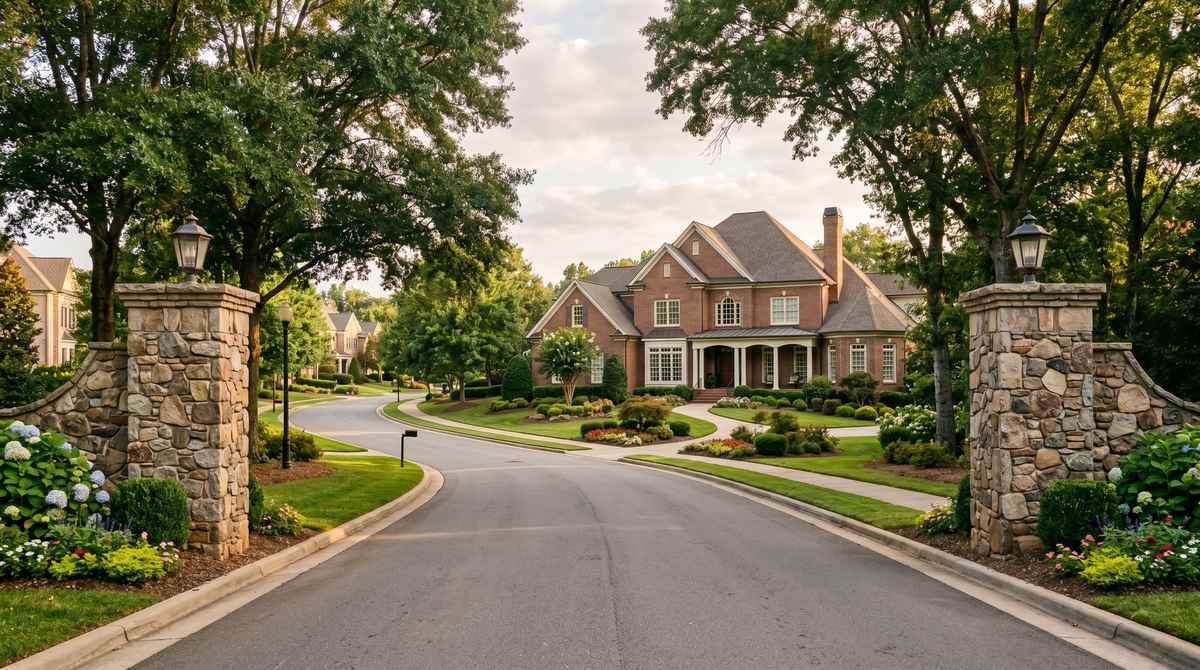
The HOA approval process for a custom home in Charlotte is the difference between breaking ground on schedule and watching your project stall for months over a roof color or window pattern. The architectural review board (ARB) at most Charlotte-area HOAs sees dozens of submissions a quarter, and the ones that move fast are complete, dimensioned, and aligned to the covenants. Whether you are building in Ballantyne, Eastover, Myers Park, or a gated community in Lake Wylie, SC, the playbook is the same: read the covenants first, build the package right, and respond to revisions inside the window the board gives you.
We have walked clients through the HOA approval process for custom homes across dozens of Charlotte-region neighborhoods over the last 30 years. This guide breaks down what the ARB wants, how long the review window runs, the common denial reasons, and how to fold approval timelines into your construction schedule.
How the HOA Approval Process Works in Charlotte
Most planned communities in the Charlotte metro and York County, SC operate under recorded covenants, conditions, and restrictions (CC&Rs). The architectural review board enforces those CC&Rs against any new construction, addition, or material change. If you are buying a lot in a covenanted community, your closing documents reference the architectural guidelines and require ARB approval before any building permit is issued.
The mechanics vary but the structure is consistent: you submit a complete design package, the ARB reviews it on a posted schedule (often monthly), and they return a decision letter approving, conditionally approving with revisions, or denying. In Charlotte, NC, this runs parallel with Mecklenburg County or City of Charlotte permit review. In York County, SC communities like Lake Wylie and Tega Cay, ARB approval typically must precede the county permit application.
Typical ARB Review Bodies
The ARB usually consists of 3-5 volunteer board members appointed by the HOA, sometimes assisted by a paid management company. In larger master-planned communities, the developer retains ARB authority for a defined period before turning it over to the homeowner-elected board.
- Charlotte-area HOAs almost universally require ARB approval before any custom home construction begins.
- Review boards meet on posted schedules — typically monthly — so missing a deadline can push your timeline by 4-6 weeks.
- York County, SC communities generally require ARB approval before the county will issue a building permit.
- Larger developers retain ARB authority during the initial build-out phase, then transfer it to homeowners.
Documents the ARB Will Demand for Your Custom Home
Submission packages are where most projects bog down. The ARB wants construction-ready documents that prove your home meets the covenants. We coordinate the full package with our clients during design and planning services so nothing surprises the board.
Standard ARB submissions for Charlotte custom home approvals include a site plan showing setbacks, driveway, drainage, and tree preservation; architectural elevations of all four sides; dimensioned floor plans; roofing and siding material and color samples; window and door schedules; landscape plan; and exterior light fixtures. Some Charlotte and Lake Wylie, SC communities also require 3D renderings showing the home in context with neighboring properties.
Material and Color Specifications
This is where boards spend the most time. Brick blends, stone veneer, mortar color, paint manufacturer numbers, shingle profiles, and trim details all need to be locked down before submission. Most boards reject “to be determined” entries outright. Bring physical samples to in-person review meetings when allowed.
- Site plans must show setbacks, drainage, driveway location, and any tree preservation requirements.
- Elevations are required for all four sides — partial sets are typically returned for revision.
- Material samples (brick, stone, shingle, siding) need manufacturer specifications and color codes.
- Landscape plans and exterior lighting fixtures are part of most full submissions, not afterthoughts.
- Vague “TBD” entries are the fastest path to a denial or conditional approval requiring resubmission.
Typical HOA Approval Timeframes in the Charlotte Region
The official review window in most Charlotte-area covenants runs 30 to 45 days from submission to decision, but the practical timeline depends on board meeting frequency, package completeness, and whether the design hits any sensitive areas. A clean package submitted to a well-run ARB in Eastover, Foxcroft, or a Lake Wylie, SC waterfront community can clear in two weeks. A package with missing elevations or designs that push covenants on height or massing can push 60-90 days through revisions.
We build a 45-60 day ARB window into our overall custom home builder schedule in Charlotte, with submission timed to the next available board meeting. Conditional approvals can usually be cleared in a single resubmission cycle if the changes are bounded.
Coordinating ARB Review with County Permits
In Mecklenburg County, you can technically apply for permits before ARB approval is final, but most builders wait. The risk is that the ARB requires a design change that invalidates your already-permitted plans. In York County, SC, ARB approval is typically a hard prerequisite before the county accepts your permit application.
- Standard ARB review windows in Charlotte and surrounding communities run 30-45 days for clean submissions.
- Build 45-60 days of ARB time into your overall construction schedule, including buffer for revisions.
- Conditional approvals are common and usually resolvable in a single resubmission cycle.
- Submit ARB packages timed to the next board meeting — boards rarely approve out of cycle.
- In York County, SC, ARB approval typically must precede the county building permit application.
Most Common Reasons HOAs Deny or Conditionally Approve Custom Home Submissions
After 30+ years in this market, denial reasons cluster around the same handful of issues. Knowing them upfront shortens your approval cycle dramatically.
Off-palette roofing and exterior colors. Most Charlotte HOAs publish approved palettes of paint manufacturer numbers, shingle colors, and brick blends. A custom color outside the palette is often denied even with strong justification.
Setback or footprint encroachments. Even a six-inch encroachment on a side-yard setback is a common denial trigger. Lake Wylie, SC waterfront communities often have additional shoreline buffers that catch first-time submitters.
Roof pitch and massing inconsistent with the neighborhood. If covenants specify a minimum 8:12 roof pitch and your plans show 6:12, or your footprint dwarfs neighboring homes, expect a denial. Floor plan customization needs to respect the neighborhood’s architectural character.
Tree removal and garage orientation. Many covenanted communities cap mature tree removals and require tree preservation plans. Front-loading garages, garage dimensions, and detached structure placements are also frequent denial points — some communities require side-load or court-yard garages.
- Off-palette exterior colors are the single most common revision request from Charlotte-area ARBs.
- Setback and shoreline buffer encroachments cause hard denials, not conditional approvals.
- Roof pitch and massing that conflicts with neighborhood character is a frequent rejection point.
- Tree removal limits and preservation plans are increasingly enforced, especially in older Charlotte neighborhoods.
- Garage orientation and accessory structure placement need to match covenant requirements precisely.
How to Build a Submission Package That Gets Approved on the First Pass
A clean first-pass approval saves 4-8 weeks compared to a revision cycle. The pattern: read the covenants line by line before any design work begins, design to the strictest interpretation, and present a complete package with no gaps.
Start by ordering the full covenant document and architectural guidelines from the HOA management company. Many boards publish a submission checklist and recent meeting minutes — read both. The minutes show what the board has approved and denied recently, which is the best signal for what they will accept on yours. We pull these documents at the start of every Charlotte custom home project as part of our site planning phase.
Engage your architect or builder to design within the covenants from day one — not freely and then “see what fits.” Cost estimates, floor plans, and material selections all hang on covenant compliance. Reference materials from authorities like NAHB can help frame industry-standard practices when discussing tradeoffs.
Pre-Submission Walkthroughs
Many ARBs allow informal pre-submission consultations. These are gold. A 30-minute conversation with one or two board members before the formal package is filed can flag issues that would otherwise produce a denial letter. We always ask and take advantage when offered.
- Read the full covenant document and architectural guidelines before any design work begins.
- Pull recent ARB meeting minutes to see what the board has approved and denied lately.
- Design within the strictest interpretation of the covenants from the start.
- Use pre-submission consultations when offered — they often surface issues the board would deny.
- Submit a complete package with no “TBD” entries, vague specs, or partial elevations.
Handling Conditional Approvals and Denials
Even with a strong submission, conditional approvals are common. The board issues a decision letter listing required revisions — paint color change, additional landscape buffer, fenestration adjustment — and requires a resubmission. Most resubmissions are reviewed at the next board meeting, so a clean turnaround on revisions can keep your overall timeline intact. We can manage this for clients through our HOA approval services.
Outright denials are different. A denial letter cites specific covenant sections the design violates. The path forward is either a substantive redesign or, if the board misapplied the covenants, a written appeal. Appeals add 30-60 days, and we rarely recommend them unless the covenant interpretation is clearly wrong — redesign is usually faster.
If you are buying a lot specifically to build, make the offer contingent on ARB pre-approval of a conceptual design. This protects you from buying into a covenant interpretation that makes your planned home impossible.
- Conditional approvals are common — most resubmissions clear in a single revision cycle.
- Outright denials require either a substantive redesign or a written appeal to the full HOA board.
- Appeals add 30-60 days; we usually recommend redesign over appeal unless the interpretation is clearly wrong.
- For lot purchases, make the offer contingent on ARB pre-approval of a conceptual design.
- Track the resubmission window — most boards have a hard deadline before the original approval lapses.
HOA Approval in Lake Wylie, SC and Other Waterfront Communities
Waterfront communities — Lake Wylie, SC, Lake Norman, and parts of Tega Cay — layer additional review on top of the standard HOA process. Shoreline buffer requirements, dock placement, septic constraints, and stormwater management plans are all in play. The Catawba River and Lake Wylie are managed by Duke Energy under a federal license, which adds another reviewer for work within the project boundary.
For Lake Wylie waterfront builds, expect 60-90 days for complete approval with HOA, county, and Duke Energy reviews running in parallel. The York County shoreline buffer is typically 25-50 feet from the waterline depending on lot specifics, and the HOA may stack additional landscape or tree buffer on top. We coordinate all three reviews simultaneously on Lake Wylie projects to compress the overall window.
- Lake Wylie, SC waterfront builds add Duke Energy shoreline review on top of HOA and county.
- York County shoreline buffers run 25-50 feet from waterline depending on lot conditions.
- Septic and stormwater constraints get scrutinized harder near water than on inland lots.
- Plan 60-90 days for complete approval on Lake Wylie waterfront custom home submissions.
- Run HOA, county, and Duke reviews in parallel rather than sequentially when possible.
Frequently Asked Questions About HOA Approval for Custom Homes in Charlotte
How long does HOA approval take for a custom home in Charlotte?
The typical window runs 30-45 days from submission to decision for a complete package, with boards meeting monthly. Submissions with missing materials or covenant conflicts can extend to 60-90 days through revision cycles. Lake Wylie, SC waterfront builds typically run 60-90 days because of the layered shoreline review.
Can I start building before HOA approval is final?
No. In Mecklenburg County and most surrounding jurisdictions, the building permit process either requires HOA sign-off as a prerequisite or strongly recommends it. Starting without ARB approval risks stop-work orders, mandatory removal of unapproved features, and HOA fines that can exceed the cost of redoing the work.
What happens if the HOA denies my custom home plans?
A denial letter cites the specific covenant sections your design violates. You can revise and resubmit at the next board meeting, or file a written appeal to the full HOA board. Most denials resolve faster through redesign — appeals add 30-60 days and rarely overturn the ARB.
Do all Charlotte neighborhoods require HOA approval for custom homes?
No. Established neighborhoods without active HOAs and many older Charlotte areas have no architectural review process — only Mecklenburg County permit review. Newer master-planned communities, gated developments, and most waterfront communities in Lake Wylie, SC and Lake Norman do require ARB approval. Always check the recorded covenants on the lot before you commit.
Build With a Charlotte Custom Home Builder Who Knows the ARBs
Our team has submitted ARB packages to most major Charlotte-area HOAs and York County, SC waterfront communities. We know which boards review fast, which palettes are tightest, and where the common denial points are. If you are starting a custom home in Charlotte, Lake Wylie, Fort Mill, or Huntersville, call us at (704) 619-6293 or use our contact page to schedule a free pre-design consultation. We will pull your covenants, walk the ARB process for your community, and lay out a realistic timeline before any design dollars are spent.