Custom home financing in Charlotte, NC is rarely the bottleneck people expect, but the loan structure dictates almost everything else: your draw schedule, your closing timeline, the size of your contingency, and which lots and architects you can pursue. Most clients finance with a construction-to-permanent loan, but that is one of three viable paths, and the right choice depends on equity, build cost, and how long you plan to stay in the home.
This is the playbook we walk every Charlotte custom home client through during pre-construction. It covers how construction loans actually disburse, what local lenders want to see, what the draw process looks like during the build, and how to structure a contingency so a budget surprise does not stall the project.
The Three Main Ways to Finance a Custom Home in Charlotte
Custom home financing in Charlotte falls into three buckets: construction-to-permanent loans, stand-alone construction loans paired with a separate end mortgage, and cash-out or HELOC funding for clients with significant existing equity. Most of our clients use option one because it is simpler and only requires one closing, but the others have specific use cases.
Construction-to-Permanent Loans
A construction-to-perm loan combines the construction phase and the long-term mortgage into one product with a single closing. During construction (typically 9-12 months), you pay interest only on the funds drawn. When the home is finished, the loan converts automatically to a fixed or adjustable mortgage at a rate locked at the original closing or at conversion, depending on the lender.
Stand-Alone Construction Loans
A stand-alone construction loan is a short-term product (usually 12 months) that funds the build only. When the home is complete, you refinance into a separate permanent mortgage. This requires two closings and two sets of fees, but it can offer better permanent rates if rates drop during your build, and it lets you shop the permanent loan separately for best terms.
Cash-Out or HELOC on an Existing Property
Clients with substantial equity in a paid-off or low-balance home sometimes use a cash-out refinance or HELOC to fund all or part of the build. This avoids construction-loan complexity entirely but caps the build at the equity available, and it puts the existing home at risk if the project runs long.
- Construction-to-perm loans are the most common Charlotte custom home financing path: one closing, interest-only during the build, automatic conversion to a permanent mortgage.
- Stand-alone construction loans require two closings but allow separate shopping for the permanent mortgage at completion.
- HELOC and cash-out refinance work for clients with strong existing equity but cap the project at available equity.
- The right structure depends on your equity, build cost, intended length of stay, and rate outlook.
What Charlotte Lenders Require for a Construction Loan
Construction loan underwriting is materially stricter than a standard purchase mortgage. Lenders are funding an asset that does not yet exist, so they need confidence in the builder, the plans, the budget, and your ability to close any cost gaps.
Standard Charlotte construction loan documentation includes a fixed-price contract or detailed cost-plus agreement with your builder; full architectural plans and specifications; a line-item budget broken out by trade; a builder resume, license verification, and references; and proof of builder’s insurance. We provide our clients with a complete lender package as part of budget development and cost estimating so the lender review moves quickly.
Borrower Requirements
On the borrower side, expect down payment requirements of 20-25% of total project cost (land plus construction), credit scores of 680+ for most local lenders and 700+ for the best rates, debt-to-income ratios under 43% counting the future permanent payment, and verifiable income documentation through tax returns and recent pay stubs. Self-employed borrowers should expect to provide two years of business tax returns plus a year-to-date P&L.
Your land value can count toward the down payment if you already own the lot. Most Charlotte construction loans treat lot equity as cash equivalent, so a $200,000 lot purchased two years ago at $150,000 contributes $200,000 toward the equity calculation at current appraised value.
- Construction loans require a fixed-price or cost-plus contract, full plans, line-item budget, and builder credentials.
- Down payment requirements typically run 20-25% of total project cost (land plus build).
- Credit scores of 680+ qualify; 700+ unlocks the best rates.
- Lot equity counts toward the down payment at current appraised value, not original purchase price.
- Debt-to-income ratios must include the future permanent mortgage payment, not just current obligations.
How Draw Schedules Work During the Build
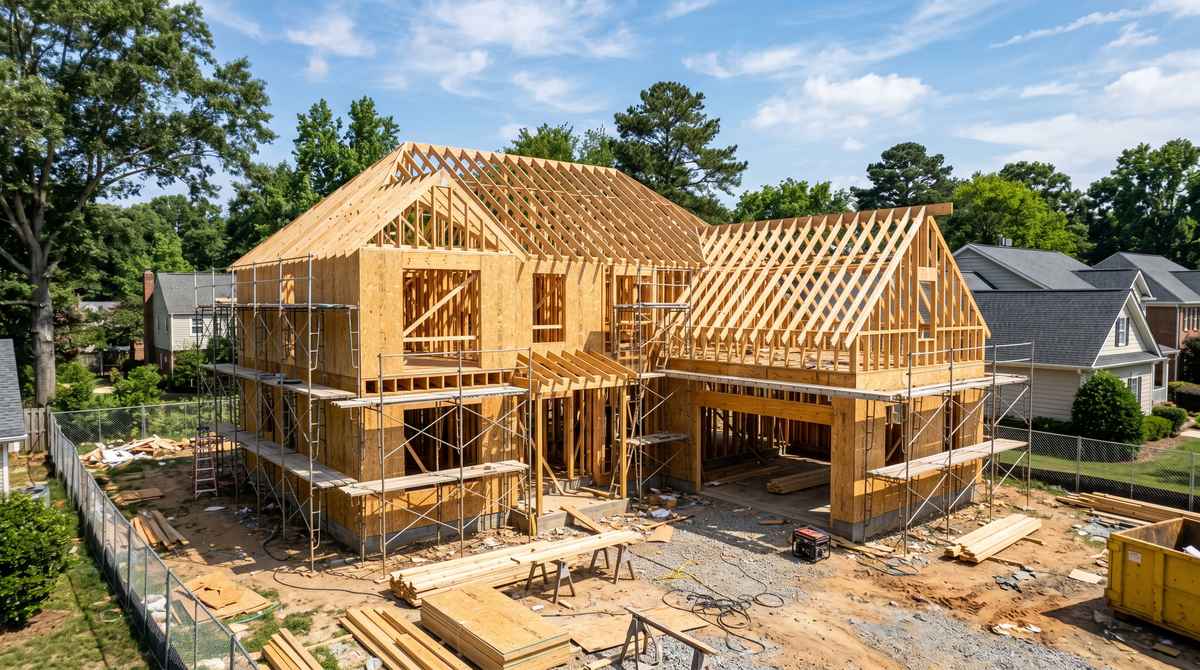
Construction loans do not disburse all at once. Funds are released in stages tied to verifiable construction milestones, usually 5-7 draws over the life of the build. Each draw requires an inspection by the lender’s appraiser or a third-party inspector to confirm the work is actually complete before funds release.
A typical Charlotte custom home draw schedule looks like: foundation pour and waterproofing (10-15% of loan); framing and roof dry-in (20-25%); rough mechanical, electrical, and plumbing (15-20%); insulation and drywall (10-15%); cabinetry and interior trim (15%); and final completion with certificate of occupancy (15-20%). The exact percentages vary by lender and contract structure.
Managing Cash Flow Between Draws
The gap between when a builder pays subcontractors and when the lender releases the next draw can stretch 2-4 weeks. Builders typically carry this float on their balance sheet, but smaller builders may require deposits or progress payments outside the draw schedule. We coordinate this directly with our clients during budget tracking and transparency so there are no surprise out-of-pocket requests mid-build.
Interest during construction is paid monthly on the outstanding draw balance only — not on the full loan amount. As more draws release, your monthly interest payment grows. Most clients budget 1-2% of the total loan as interest expense over a 12-month build at current rates.
- Construction loans disburse in 5-7 stages tied to verifiable milestones, each requiring inspection.
- Foundation, framing, MEP rough, drywall, trim, and final completion are the standard draw triggers.
- Interest is paid monthly on outstanding draw balance only, not the full approved loan amount.
- Plan for a 2-4 week gap between subcontractor payment and draw release; the builder typically floats this.
- Total interest expense during a 12-month Charlotte build typically runs 1-2% of total loan amount.
Local Charlotte Lenders With Strong Construction Loan Programs
Construction loans in Charlotte are best served by local and regional lenders who underwrite based on the local market. National banks have construction products, but their underwriting is often more rigid and their inspections slower. We have seen consistently strong execution from regional banks with offices in Charlotte, Mooresville, and Lake Wylie, SC, plus several credit unions that serve the Charlotte metro.
The lender selection conversation usually centers on three things: rate (locked or floating during build), draw turnaround time (some lenders fund within 5 business days, others take 15+), and conversion terms (one-time close vs. requiring a second underwriting at completion). Our project financing coordination service helps clients shortlist lenders that fit their specific build profile.
Construction Loan Rate Environment as of 2026
Construction loan rates as of 2026 in the Charlotte market typically run 0.5-1% above standard purchase mortgage rates. The premium reflects the higher risk profile during construction. Once the loan converts to permanent at completion, rates drop into the standard market range. We do not quote specific rates because they move weekly — the right move is a fresh quote from 2-3 lenders within 60 days of your planned closing.
- Local and regional lenders generally outperform national banks on construction loan execution in Charlotte.
- Lender selection criteria: rate structure, draw turnaround speed, and conversion terms.
- Construction loan rates run 0.5-1% above standard purchase rates during the build phase.
- Conversion to permanent typically reverts to standard market rates at completion.
- Get fresh quotes from 2-3 lenders within 60 days of planned closing — rates move weekly.
Building a Realistic Construction Budget and Contingency
The single biggest financing failure mode we see is an undersized contingency. Lenders typically require 5-10% contingency built into the construction loan, but for a complex custom build in Charlotte’s market, we recommend 10-15%. The extra cushion absorbs change orders, supply chain hiccups, and the kinds of soil or permitting surprises that show up after framing.
A realistic 2026 Charlotte custom home budget breakdown looks roughly like: site work and foundation (8-12% of budget); framing and rough MEP (25-30%); exterior envelope including roof, siding, and windows (15-20%); interior finishes including cabinetry, flooring, and millwork (20-25%); fixtures and appliances (8-12%); and soft costs including permits, design, and engineering (5-8%). The remainder is contingency and builder overhead. These ranges shift with the level of finish and lot complexity, so treat them as a starting framework, not a quote.
Cost-Per-Square-Foot Reality Check
Custom home cost-per-square-foot in the Charlotte metro typically ranges from $250-$400 per finished square foot for mid-tier builds, $400-$600+ for high-end finishes and custom millwork, and higher for waterfront builds in Lake Wylie, SC or Lake Norman where shoreline work, septic, and dock construction add significant cost. These ranges are starting points only — the actual number depends on lot conditions, design complexity, and finish selections. Our Charlotte custom home cost guide covers the regional pricing landscape in more detail.
- Lender-required contingency is 5-10%; we recommend 10-15% for complex Charlotte custom builds.
- Site and foundation typically consume 8-12% of total budget; framing and MEP another 25-30%.
- Cost-per-square-foot in Charlotte runs $250-$400 mid-tier, $400-$600+ for high-end finishes.
- Waterfront builds in Lake Wylie, SC carry premium costs due to shoreline, septic, and dock work.
- Soft costs (permits, design, engineering) absorb 5-8% of the total project budget.
How Long the Financing Process Takes Before Construction Starts
Custom home financing in Charlotte typically takes 60-90 days from initial application to closing on the construction loan. The timeline depends on appraisal speed, builder package completeness, and how quickly you can produce income documentation. Self-employed borrowers should add 2-4 weeks for additional underwriting.
The critical path inside that window is the appraisal. Construction loan appraisals are based on plans and specifications rather than an existing structure, and they require a comparable-sales analysis of similar custom homes in the area. In neighborhoods with limited recent custom-home sales — common in newer Lake Wylie, SC and Fort Mill, SC subdivisions — appraisals can take 3-4 weeks because the appraiser has to expand the search radius for comps.
We coordinate the financing timeline with the overall custom home builder schedule so the loan closes the week before site mobilization. Closing too early wastes interest expense on undrawn funds; closing too late stalls the build. Industry guidance from the Consumer Financial Protection Bureau covers borrower protections during the construction loan process.
- Charlotte construction loan timelines run 60-90 days from application to closing.
- Self-employed borrowers should add 2-4 weeks for additional income underwriting.
- Appraisals are the most common bottleneck, especially in areas with thin custom-home comp sales.
- Time the loan closing to land within a week of site mobilization.
- Appraisals on Lake Wylie, SC and Fort Mill, SC builds often take longer due to limited recent comps.
Frequently Asked Questions About Custom Home Financing in Charlotte
How much down payment do I need for a custom home construction loan in Charlotte?
Most Charlotte lenders require 20-25% of total project cost — land plus construction. If you already own the lot, current appraised value counts toward the down payment, which often satisfies most or all of the equity requirement.
Can I lock my mortgage rate during the construction phase?
Yes, most construction-to-permanent loan products offer a rate lock at the original closing that holds through conversion. Some lenders charge a fee for extended locks beyond 12 months. Stand-alone construction loans require a separate rate lock when you refinance into the permanent mortgage at completion.
What happens if my construction loan amount is not enough to finish the home?
This is exactly what the contingency is for. If the contingency is exhausted and you still need more funds, options include borrower out-of-pocket payment, a small loan modification (rare and slow), or scope reduction on remaining work. The strongest defense is sizing the contingency at 10-15% upfront for complex Charlotte custom builds.
Are construction loan interest payments tax deductible?
Construction loan interest can be tax deductible as mortgage interest if the loan is secured by the home and the build completes within 24 months of loan origination. Consult a tax advisor on your specific situation — the rules vary based on use of the home and loan structure.
Build With a Charlotte Custom Home Builder Who Knows Local Lenders
Our team has worked with most major construction lenders serving Charlotte, NC, Lake Wylie, SC, Fort Mill, SC, and Huntersville, NC. We help clients shortlist lenders, build the package the lender wants, and time financing to the construction schedule so neither side waits on the other. If you are starting a custom home in the Charlotte metro and want to walk through financing options before you commit, call us at (704) 619-6293 or use our contact page to schedule a pre-design consultation. We will pull together a realistic budget framework, walk through construction loan structures, and lay out a financing timeline that fits your build.