
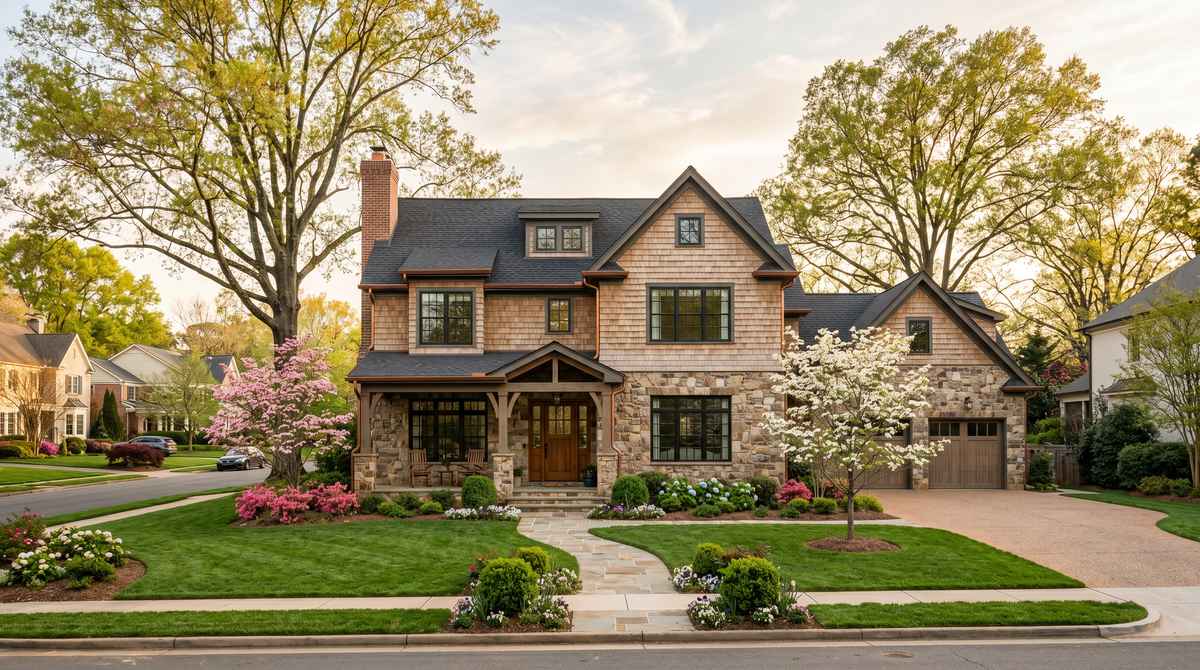
The honest answer to is a custom home worth it Charlotte homeowners ask us almost weekly is: it depends on three things — your timeline, your lot, and how long you plan to stay. For the right buyer in the right Charlotte submarket, a custom home easily outperforms spec or resale on cost-of-ownership, design value, and long-term appreciation. For the wrong buyer, the same path can become an expensive lesson. We build custom homes across Charlotte, Mecklenburg County, and the Lake Norman and Lake Wylie corridors, and we’ve seen both outcomes.
This guide is a clear-headed look at whether a custom home actually makes financial and lifestyle sense in the 2026 Charlotte market. We cover where custom outperforms spec and resale, where it does not, the cost-of-ownership math that most articles skip, and how Charlotte’s neighborhood-by-neighborhood reality changes the calculus.
What “worth it” actually means in the Charlotte custom market
Worth-it analysis lives at the intersection of three numbers — total cost-to-build, finished appraised value, and projected cost of ownership over your hold period. A custom home is worth it financially when the appraised value at completion plus the discounted future value of long-term ownership benefits (lower maintenance, better mechanical efficiency, higher resale) exceeds your all-in cost.
Lifestyle worth-it is a different calculation. A custom home is worth it experientially when the floor plan, finish quality, and design fit your family’s actual life better than any spec or resale option in your budget. Both calculations matter, and serious buyers run both before signing a construction contract. Our budget development and cost estimating work runs the cost side; the lifestyle side requires honest conversation.
The hold-period factor
Hold period is the variable most buyers underweight. Custom homes typically need a 7-to-10-year hold for the design premium and quality premium to fully materialize at resale. Buyers planning a 3-to-5-year hold often see better returns from a well-bought spec home in a strong submarket.
- Worth-it has a financial answer and a lifestyle answer — run both
- Total cost-to-build vs. finished appraised value is the core financial test
- Hold period under 5 years usually favors spec or resale over custom
- Hold period over 7 years usually favors custom in established Charlotte submarkets
- Lifestyle fit is the variable that closes the gap when the math is close
Where custom outperforms in the 2026 Charlotte market
Custom outperforms most clearly in three Charlotte scenarios. First, on premium lots — Myers Park, Eastover, Foxcroft, Dilworth, the Lake Norman waterfront, and the Lake Wylie peninsula — where lot value is high enough that production builders simply don’t compete. Second, in established neighborhoods where comparable custom resales support strong appraisals: Plaza-Midwood, NoDa-adjacent infill, Quail Hollow. Third, for buyers with specific functional needs that production builders can’t deliver — multi-generational layouts, accessibility requirements, large dedicated home offices, or significant indoor-outdoor integration.
In those scenarios, our clients regularly see appraised values 8% to 18% above all-in cost-to-build, depending on lot, finish tier, and design quality. That spread is the financial worth-it case in plain numbers. The National Association of Home Builders publishes annual data confirming that pattern at the national level, and our Charlotte-specific data follows the same shape.
Premium lots are the single biggest factor
If the lot is premium, custom usually wins. If the lot is interchangeable with hundreds of others in a tract subdivision, the math gets harder. We always start a worth-it conversation with a lot review through our project feasibility analysis service.
- Premium lots in established Charlotte neighborhoods consistently favor custom
- Lake Norman and Lake Wylie waterfront overwhelmingly favor custom
- Buyers with specific functional programs almost always benefit from custom
- Appraised value typically runs 8–18% above all-in build cost on quality custom projects
- Lot quality is the single largest variable in the worth-it calculation
Where custom does not outperform
Custom is rarely the right answer in master-planned communities where production builders dominate inventory. In neighborhoods like Cureton, Belmeade, Highland Creek, and many newer subdivisions in Indian Trail, Waxhaw, and the Fort Mill, SC area, spec homes from national builders are priced aggressively, comp evenly, and resell quickly. Custom homes on similar lots in those neighborhoods often appraise at-cost or slightly below, which kills the financial worth-it case.
Custom is also rarely worth it for buyers on a 3-to-5-year hold, buyers with limited tolerance for decision-making across a 12-to-18 month process, or buyers whose budget would force them to cut quality rather than scope to land within a custom builder’s minimum. We tell those clients honestly and we point them toward spec home builder services or semi-custom builds instead.
The decision-fatigue factor
A typical custom home requires 200+ design and selection decisions across 12 to 18 months. For some clients that’s energizing; for others it’s exhausting. Worth-it analysis has to factor decision fatigue, because a tired client who rushes the back half of selections often ends up with a home that doesn’t reflect the design quality they paid for.
- Master-planned subdivisions with strong production-builder inventory rarely favor custom
- 3-to-5-year holds rarely justify custom on financial grounds alone
- Buyers who would have to cut quality to fit budget should choose spec or semi-custom
- Decision fatigue is a real cost — under-estimated by most first-time custom buyers
- Honest builders steer clients away from custom when it’s not the right fit
The cost-of-ownership math most analyses skip
Stick-built spec homes in production communities are typically built to code, not above it. Custom homes built to a quality spec routinely have meaningfully lower long-term operating costs — better envelope sealing, higher-grade mechanical systems, properly sized HVAC, real flashing details, premium roofing, and durable finishes that don’t need replacement at year 8.
Over a 10-year hold, those differences add up. We see typical operating-cost spreads of $300 to $700 per month in favor of well-built custom homes versus comparable production homes in the same neighborhoods, driven mostly by HVAC efficiency, water-heater sizing, envelope performance, and reduced repair frequency. Add in lower turnover on appliances and finishes that were specified properly the first time, and the cost-of-ownership case strengthens further.
Energy efficiency is a real financial line item
The U.S. Department of Energy’s home energy guidance consistently shows that envelope and mechanical decisions made at construction are 3 to 5 times more cost-effective than retrofits. Custom builders price those decisions into the original budget; production builders typically don’t. Our quality control protocols on custom builds explicitly verify envelope performance before drywall.
- Custom homes typically run 10–20% lower in operating cost over a 10-year hold
- HVAC sizing and envelope sealing are the single biggest efficiency variables
- Construction-stage envelope decisions are 3–5x more cost-effective than retrofits
- Quality finishes specified once typically last twice as long as builder-grade replacements
- Cost-of-ownership math should always be run on a 10-year, not 1-year, basis
Charlotte neighborhoods where custom worth-it math is strongest in 2026
The clearest worth-it cases in Charlotte right now sit in three categories. Established walkable neighborhoods — Myers Park, Eastover, Foxcroft, Dilworth, Plaza-Midwood — where premium lots support strong appraisals and resale demand from move-up buyers stays consistent. Lake Norman waterfront — Cornelius, Davidson, the Peninsula, and parts of Mooresville — where lot premiums and view-driven design routinely produce 12% to 22% spreads between cost and finished value. Lake Wylie, SC peninsula and waterfront — where York County’s lower property tax structure plus lake access creates a unique value proposition for Charlotte buyers crossing the state line.
Suburban infill in Mint Hill, Matthews, and parts of Indian Trail can also support custom worth-it math when the lot is genuinely larger or better positioned than typical tract inventory. Our custom home builder services work in all of these submarkets, and the conversation always starts with the lot.
Lake Wylie, SC and the cross-border buyer
Lake Wylie continues to attract Charlotte buyers seeking lake access, lower property taxes, and a more residential pace. Our custom home work in Lake Wylie, SC consistently shows strong cost-to-value spreads, especially on peninsula and waterfront lots.
- Established walkable Charlotte neighborhoods support consistent custom worth-it math
- Lake Norman waterfront produces 12–22% cost-to-finished-value spreads on quality builds
- Lake Wylie, SC adds property-tax advantages to the cross-border buyer’s calculation
- Suburban infill works when the lot is genuinely better than typical tract inventory
- Always start the worth-it conversation with the lot, not the floor plan
How to actually decide if it’s worth it for you
The simplest framework we use with clients is a four-question test. First, do you plan to stay 7+ years? Second, is your lot premium or plan-to-purchase a premium lot? Third, do you have specific functional needs that production builders cannot deliver? Fourth, can you sustain the design and selection process over 12+ months without cutting quality? If you answer yes to three of four, custom is almost always worth it. Two of four is a coin flip — semi-custom is often the better path. One of four means spec or resale is the more rational choice.
We share that framework with prospective clients during a free discovery conversation. If the math doesn’t work, we say so. Worth-it analysis is not a sales pitch — it’s the foundation of every successful custom build we have ever delivered.
Frequently Asked Questions
Is a custom home worth it in Charlotte if I’m only staying 5 years?
Usually no, on a purely financial basis. Five-year holds rarely capture the full custom premium at resale. The exception is a premium lot in an established Charlotte neighborhood — Myers Park, Eastover, Lake Norman or Lake Wylie waterfront — where appraised value at completion already exceeds cost. If lifestyle fit is the dominant driver, the math can still work even on shorter holds.
How much more does a custom home cost than a comparable spec home in Charlotte in 2026?
Typical range as of 2026: custom homes in the Charlotte metro run 15% to 35% more per square foot than equivalent spec inventory, depending on lot, finish tier, and design complexity. That premium is partly recovered at appraisal and partly recovered through lower 10-year operating cost.
Will a custom home actually appraise above what I paid to build it?
On well-located Charlotte lots with quality builders, custom homes regularly appraise 8% to 18% above all-in cost-to-build. On weaker lots or in production-builder-dominant submarkets, appraisals tend to come in at-cost or below, which is why lot selection matters more than any other variable in the worth-it analysis.
What’s the biggest mistake buyers make when evaluating whether custom is worth it?
Skipping the cost-of-ownership math. Most buyers compare upfront cost only and miss the 10-year operating-cost spread, which often equals the entire custom premium when the build quality is genuinely higher than production grade.
If you’re weighing whether a custom home build is actually worth it for your situation in the Charlotte metro, we’re glad to walk through the numbers honestly with you. Call us at (704) 619-6293 or reach out through our contact page for a free discovery conversation, lot review, and a real cost-versus-value snapshot for your specific project — no pressure, no sales pitch.