
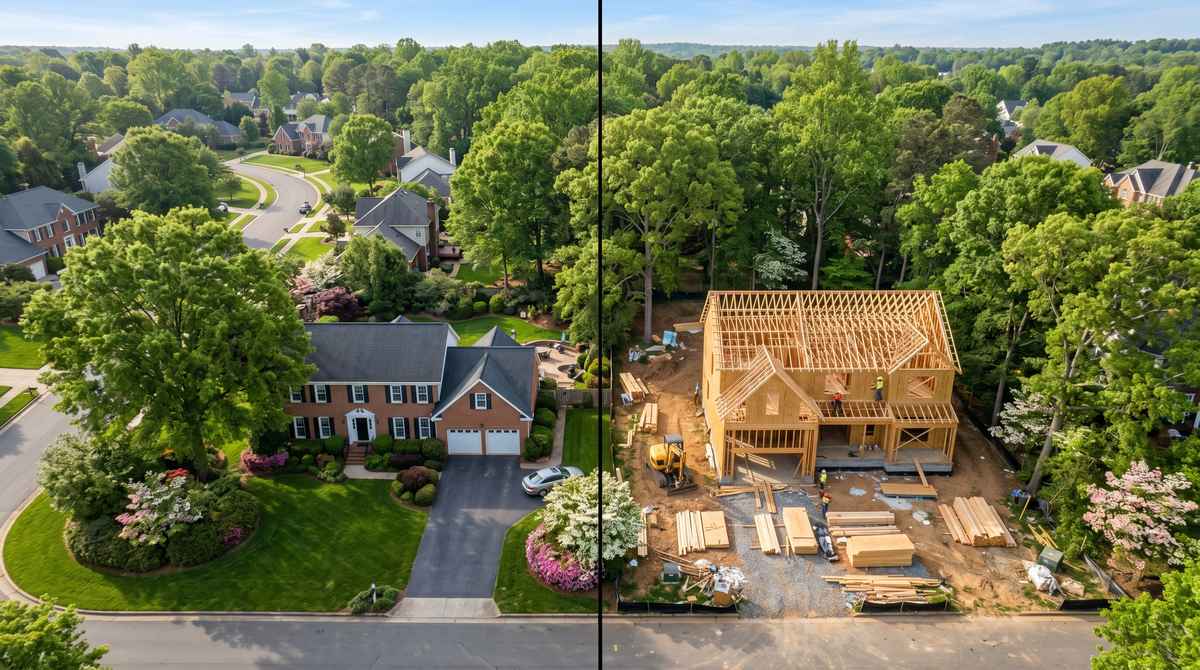
The custom home vs buy existing Charlotte question rarely gets answered honestly because most people running the comparison only count the upfront purchase price. The real answer requires comparing all-in cost, hidden ownership costs, customization value, and timeline — across the same hold period. We’ve helped Charlotte buyers run that math both ways and come down on either side, depending on the lot, the buyer’s needs, and the existing inventory available in their target neighborhood.
This guide breaks down the true cost comparison between building a custom home and buying an existing home in the Charlotte metro in 2026. We cover the upfront math, the deferred maintenance bill almost no one calculates correctly, the customization premium, and the realistic timeline trade-off. Where prices appear, they reflect typical ranges as of 2026 — your specific situation will move the numbers.
The honest upfront cost comparison
An existing home in a comparable Charlotte neighborhood will almost always have a lower listed price than a comparable custom build. That’s the easy part of the math. Where buyers go wrong is stopping there. Once you add inspection findings, immediate updates, deferred maintenance, and the cost of bringing finishes up to current taste, the gap closes — and on older inventory in established neighborhoods, the gap can close completely.
For a 4,000 to 5,000 square foot home in a strong Charlotte submarket as of 2026: an existing home in good condition typically lists in the $850K to $1.5M range depending on neighborhood, age, and finish updates. A new custom build of comparable size on a comparable lot typically runs $1.1M to $2.0M all-in including land, finishes, and soft costs. The custom premium looks like 25 to 30 percent on paper. After five years of ownership, that paper premium narrows considerably.
What gets missed in the listing-price comparison
Three things consistently get under-counted on existing homes: HVAC replacement age, roof remaining life, and finish-update cost. Roofs in Charlotte typically need replacement every 22 to 28 years; HVAC systems every 12 to 18 years; kitchens and baths get refreshed every 12 to 20 years to stay marketable. Our budget development and cost estimating work helps buyers run that math against existing-home alternatives before they commit.
- Existing-home list prices typically run 25–30% below comparable custom builds upfront
- Inspection findings, immediate updates, and deferred maintenance close the gap meaningfully
- HVAC, roof, and finish updates are the three most under-counted costs on older inventory
- The gap narrows further over a 5–10 year hold
- Always compare on an all-in, multi-year basis, not on listing price alone
Hidden costs of buying existing in Charlotte
An older home almost always carries deferred maintenance regardless of how well it shows. Charlotte’s clay-heavy soils stress foundations on homes built before improved drainage practices became standard. Older roofs miss modern flashing details. Insulation in homes built before 2005 is usually under-spec by today’s standards. Original windows on homes built before about 2010 often need full replacement to control humidity, energy bills, and noise.
The deferred-maintenance backlog on a typical 25-year-old Charlotte home runs $35,000 to $90,000 in 2026 dollars, spread across the first 5 to 8 years of ownership. That’s not catastrophe — it’s normal — but it has to be in the math when comparing against a custom build where everything is new and properly specified from day one. Our quality control protocols specifically address envelope, mechanical, and structural decisions that older homes often got wrong.
The renovation tax
Buyers who plan to renovate an existing home into something close to custom-quality almost always under-budget. Major Charlotte renovations in 2026 commonly run $250 to $500 per square foot for the renovated areas, and they take 6 to 12 months while displacing the household. Our whole home remodel work walks clients through what renovation actually costs vs. what the social-media version of renovation suggests it costs.
- Older Charlotte homes carry $35K–$90K in typical deferred-maintenance over the first 5–8 years
- Clay soils, older flashing, under-spec insulation, and original windows are the most common issues
- Renovating an existing home to custom-quality typically runs $250–$500/sf as of 2026
- Renovation timelines often run 6–12 months with household displacement
- Hidden costs are real, not theoretical — they show up in inspection reports every week
What customization is actually worth in dollars
Customization gets dismissed as a soft, lifestyle benefit. It isn’t. Floor plan fit, mechanical sizing, storage layout, primary-suite location, and outdoor connection all have measurable financial value at resale. Homes that don’t fit modern buyer expectations — small kitchens, isolated primary suites, no flex space, poor indoor-outdoor flow — sit on the market longer and trade at lower prices per square foot.
Building custom lets you specify those layout decisions correctly the first time. Charlotte buyers in 2026 strongly favor open-but-defined kitchens, primary suites with private entries to outdoor living, dedicated home offices with privacy, and oversized garages — none of which can be reliably retrofitted into an existing home without major structural work. Our design and planning team prices that scope properly into the budget.
Where customization premium is highest
Customization premium is highest on premium lots, in established neighborhoods, and for buyers with specific functional needs (multi-generational, accessibility, large home offices). Customization premium is lowest in master-planned communities where buyer expectations align tightly with the production-builder template.
- Customization is a measurable financial benefit, not just a lifestyle benefit
- Layout misfits in existing homes cost money at resale, not just comfort during ownership
- Modern Charlotte buyers favor open kitchens, private primary suites, dedicated offices, oversized garages
- Custom premium is highest on premium lots and for buyers with specific functional needs
- Customization premium is lowest in production-dominant subdivisions
The Charlotte timeline trade-off, honestly
An existing home is a faster path to keys. Closing on an existing Charlotte home typically takes 30 to 45 days from accepted offer to closing — fast enough that buyers with school deadlines, relocation timelines, or expiring leases often have no real alternative.
A custom home in the Charlotte metro runs 13 to 19 months from contract to certificate of occupancy. That’s 2 to 4 months of design and engineering, 1 to 3 months of permitting through Mecklenburg County or the relevant municipality, and 8 to 12 months of vertical construction. Buyers who can’t accommodate that timeline shouldn’t try to force the comparison — they should buy existing and renovate later if needed.
The renovation alternative
Some buyers split the difference: buy existing now, then renovate within 2 to 3 years. That works financially when the existing home is well-priced and the lot is good. It works less well when the existing home is overpriced or when the renovation scope creeps toward whole-house. The Consumer Financial Protection Bureau has solid, free guidance on financing renovations vs. construction loans for buyers running this analysis.
- Existing-home closing: typically 30–45 days from accepted offer
- Custom home build: 13–19 months from contract to certificate of occupancy
- Buyers with hard deadlines should buy existing and consider renovating later
- Buy-then-renovate works when lot is strong and existing house is well-priced
- Whole-house renovation usually costs as much as custom — without the design freedom
Charlotte neighborhoods where existing wins, and where it doesn’t
Existing wins in neighborhoods with strong, well-maintained mid-life inventory: SouthPark, parts of Ballantyne, Highland Creek, and master-planned subdivisions in Indian Trail, Waxhaw, and the Fort Mill, SC area. In those neighborhoods, you can find homes in their 10-to-25-year window where major systems are still healthy, finishes have been updated, and the price reflects the home’s current state.
Existing wins less reliably in older neighborhoods like Myers Park, Eastover, and parts of Dilworth where inventory often dates pre-1980, deferred maintenance is significant, and buyers end up either over-paying for cosmetic updates that haven’t addressed real issues, or paying twice — once at purchase, again at renovation. In those neighborhoods, a teardown-and-rebuild custom approach often wins the long-term math, especially for buyers planning a 10+ year hold. Our custom home work in those established neighborhoods consistently outperforms comparable renovation projects on cost-per-finished-quality.
Lake Norman and Lake Wylie are different markets
On the lakes — Lake Norman in Huntersville, NC and the Mooresville corridor, and Lake Wylie’s peninsula in York County, SC — custom routinely outperforms because the lot itself is the asset. Existing waterfront homes are rare, often outdated, and almost always priced above their cost-to-replace.
- Existing wins in healthy mid-life inventory neighborhoods (SouthPark, Ballantyne, Highland Creek, Fort Mill)
- Existing wins less reliably in older Charlotte neighborhoods with significant deferred maintenance
- Teardown-and-rebuild custom often wins the long-term math on Myers Park, Eastover, Dilworth lots
- Lake Norman and Lake Wylie waterfront overwhelmingly favor custom builds
- Lot quality and existing-inventory health drive the neighborhood-level decision
How to make the call for your situation
The framework we use with clients is simple. First, what’s your hold period? Under 5 years and existing usually wins on cash flow alone. Second, how does the lot inventory look in your target neighborhood? If great existing inventory exists in your price range, that’s your answer. Third, do you have specific functional needs that no existing home can deliver? If yes, custom wins regardless of cost differential. Fourth, what’s your timeline tolerance? Hard deadline shorter than 12 months means existing.
If you answer those four questions honestly, the path is usually obvious within an hour. We’re glad to walk through them with prospective clients in a free discovery conversation, including a real all-in cost model so you’re not deciding on instinct.
Frequently Asked Questions
Is it actually cheaper to buy an existing home in Charlotte than to build custom?
Upfront, yes — typically 25 to 30 percent less on listing price for comparable size and neighborhood. After 5 to 10 years of ownership, factoring deferred maintenance, updates, and operating costs, the gap typically narrows to 5 to 15 percent and sometimes disappears entirely on older inventory.
How long does it take to buy an existing home vs. build custom in the Charlotte metro?
Existing closings typically run 30 to 45 days from accepted offer. Custom builds typically run 13 to 19 months from contract to certificate of occupancy in the Charlotte metro. The timeline gap is the single most decisive factor for buyers with hard deadlines.
What hidden costs should I expect when buying an existing home in Charlotte?
Plan for $35,000 to $90,000 in deferred maintenance over the first 5 to 8 years on a typical 25-year-old Charlotte home. Common items include HVAC replacement, roof replacement, window replacement, insulation upgrades, and finish updates. Always run a thorough pre-purchase inspection and budget realistically.
When does a custom build clearly beat buying existing in the Charlotte market?
Custom clearly wins for 7-plus year holds on premium lots, for buyers with specific functional needs (multi-generational, accessibility, large home offices), and on Lake Norman or Lake Wylie waterfront where the lot itself is the asset. Custom also wins in older Charlotte neighborhoods where teardown-and-rebuild outperforms whole-house renovation.
If you’re weighing build custom vs. buy existing in the Charlotte metro and want a clear, honest read on the true cost comparison for your specific lot and budget, we’re glad to walk through it with you. Call us at (704) 619-6293 or reach out through our contact page — we’ll lay out both paths with real 2026 numbers, no pressure, no sales pitch.