The home builder process Charlotte homeowners actually experience is rarely the smooth, linear chart shown on builder websites. The real process has clear phases, hard decision deadlines, and specific points where money moves — and understanding all three before you sign anything is the difference between a smooth 14-month build and an expensive 22-month one. We have walked Charlotte and Lake Norman families through this process for over 30 years, and the pattern is consistent.
This guide breaks down every phase of building a custom home in the Charlotte metro in 2026, the typical decisions at each stage, when those decisions become irreversible, and who pays what when. We’re writing it from inside the process, not from a marketing brochure. Where we cite costs or timelines, they reflect typical ranges as of 2026 — your specific lot, lender, and finish package will move the numbers.
Phase 1: Lot purchase and feasibility (Months -2 to 0)
Every successful Charlotte custom build starts with the lot. Before any architectural drawings, before any deposit, the lot itself has to be evaluated for buildability — soils, slope, setbacks, tree-protection requirements, utility availability, and any HOA architectural review constraints. We see roughly 1 in 5 lots brought to us as “perfect” carry a hidden issue that adds $50K to $200K to the build, and feasibility analysis surfaces those issues before a contract gets signed.
Lot purchase typically funds through a separate land loan or cash purchase, not through the construction loan. Charlotte buyers often own the lot for 2 to 6 months before construction begins, which means carrying property taxes and any land-loan interest during pre-construction. Our project feasibility analysis work formalizes the lot review before any meaningful spend.
Decisions that lock in this phase
Decisions that become permanent at lot closing: the lot itself, neighborhood and HOA constraints, school assignment, and basic utility availability. Decisions that stay flexible: home size, exterior style, floor plan, and finish tier — those get refined in Phase 2.
- Feasibility analysis reveals hidden lot costs before contract signing
- Lot is typically purchased separately from construction financing
- Carrying costs accrue during the 2–6 month pre-construction window
- Lot decisions are permanent; design decisions remain flexible at this stage
- HOA architectural review constraints should be confirmed in writing before closing
Phase 2: Design and engineering (Months 0 to 4)
Phase 2 is where the home actually takes shape. Schematic design, design development, construction documents, and structural engineering all happen here, typically over 3 to 5 months for a 4,000 to 6,500 square foot custom home. This phase produces the permit set — the engineered, fully drawn package that municipalities review.
Critical decisions during Phase 2: floor plan and square footage, structural system (slab, crawl, basement), exterior style and materials, mechanical zoning, roof design, primary suite location, garage configuration, and any unique program elements (in-law suites, dedicated offices, theater rooms, multi-generational layouts). Our design and planning process structures these decisions into 4 to 6 working sessions so clients aren’t asked to make all of them at once.
Money flow in Phase 2
Pre-construction services and design work are typically billed against the Phase 1 deposit (5 to 10 percent of contract value). Engineering fees, surveying, soils testing, and any specialty consultants (energy modeling, structural specials) are usually charged at cost or with modest markup. Total Phase 2 spend typically runs 4 to 8 percent of total project budget for a Charlotte custom build.
- Phase 2 produces the engineered permit set, not just architectural sketches
- Floor plan, square footage, and structural system are locked at end of Phase 2
- Exterior style and roof design also become irreversible after permit submission
- Phase 2 spend typically runs 4–8% of total project budget
- Phased decision sessions prevent decision fatigue and rework
Phase 3: Permitting and pre-construction logistics (Months 4 to 6)
Permits in the Charlotte metro go through Mecklenburg County’s Code Enforcement Department for unincorporated and most municipal projects, with parallel reviews by the relevant town planning departments. Lots in Lake Wylie, SC, Fort Mill, SC, and Rock Hill, SC route through York County. Lake Norman waterfront adds Duke Energy’s Lake Management Group as a third reviewer.
Permit-to-issue typically runs 30 to 75 days for a fully drawn custom home in 2026. We coordinate the full submittal package and respond to comments through our permit acquisition and coordination service. The Mecklenburg County Code Enforcement portal is the system of record for inspection scheduling once permits issue.
Selections during the permit window
Smart builders use the permit-review window for finish selections — flooring, cabinetry, plumbing, lighting, appliances, tile. Selections typically take 6 to 10 working sessions and must be locked before vertical framing or before the long-lead items they depend on. Allowance budgets set in the contract carry through this phase, so understanding allowance numbers in Phase 1 prevents Phase 3 surprises.
- Permit timelines: 30–75 days for a fully drawn Charlotte custom home in 2026
- Mecklenburg County, the Town, and Duke Energy each have separate reviews where applicable
- Finish selections complete during the permit window — 6–10 working sessions
- Long-lead items (windows, appliances, specialty tile) order before framing
- Allowance discipline in Phase 1 prevents budget pressure in Phase 3
Phase 4: Site work and foundation (Months 6 to 8)
Once permits issue and the construction loan funds, vertical work begins with site work, excavation, footing, and foundation. In the Charlotte metro, clay-heavy soils slow excavation after extended wet stretches in late winter and early spring. We schedule site work into dry windows when possible and budget weather-day contingency accordingly.
Foundation choice depends on lot conditions and design — slab on grade for many suburban builds, crawl space for traditional Carolinas style, full or partial basement on sloped lots, especially in Lake Norman and Lake Wylie waterfront builds. Each choice has cost, timeline, and design implications that should already be locked from Phase 2.
Money flow in Phase 4
The construction loan begins drawing during this phase, with typical first draws covering site work, footing, foundation, and slab/floor system. Lender inspections verify completion before each draw releases. Our budget tracking and transparency dashboards show every draw against the planned schedule weekly so clients see where the money is moving in real time.
- Site work and foundation typically run 6–10 weeks for Charlotte custom builds
- Charlotte clay soils slow excavation after wet stretches — schedule for weather days
- Foundation type is locked from Phase 2 design decisions, not chosen here
- Construction loan first draws fund site work, footing, and foundation
- Lender inspections verify completion before each draw releases
Phase 5: Framing through dry-in (Months 8 to 11)
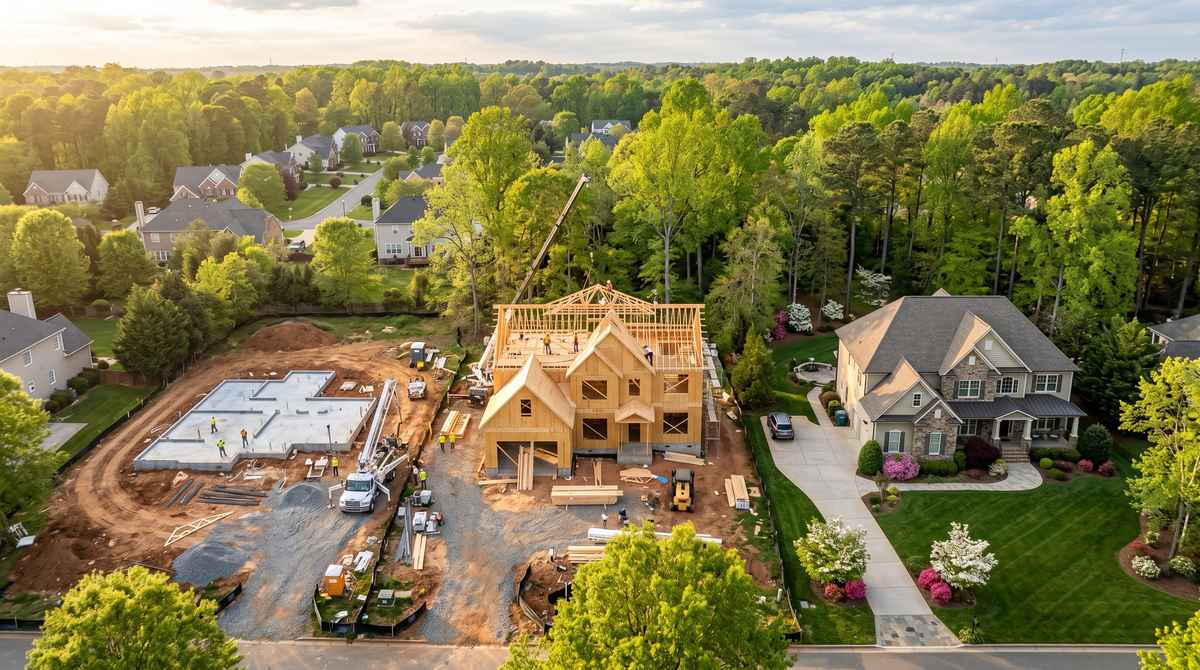
Framing is the most visible phase — this is when your home goes from a slab or foundation to a recognizable building. Floor systems, exterior wall framing, second-floor structure, roof trusses, and roof sheathing typically take 6 to 10 weeks. Once roof underlayment and exterior dry-in (windows, exterior doors, weather barrier) complete, the home is “dried in” and interior work can proceed regardless of weather.
Critical decisions that finalize during framing: any final structural changes, mechanical rough-in routing, electrical and low-voltage layout, and plumbing rough-in placement. Smart builders walk the home with clients between framing and drywall to confirm switch and outlet locations, mechanical run paths, and any last layout adjustments. Our full custom home construction process schedules a formal pre-drywall walk so changes happen when they’re cheap, not after they’re permanent.
The pre-drywall walk matters
The pre-drywall walk is the last cheap-change moment in the build. After drywall closes the walls, every change becomes a demolition. Take the walk seriously: bring spouse, designer, and any future occupant; verify outlet count and location; confirm mechanical access points; check height of TV blocking, vanity rough-ins, and anything dimensional. Client experience protocols at this stage save real money.
- Framing through dry-in: 6–10 weeks for typical 4,000–6,500 sf Charlotte builds
- Pre-drywall walk is the last low-cost-change opportunity in the build
- Mechanical, electrical, and plumbing rough-in finalize during framing
- Long-lead exterior items (windows, doors) must arrive before dry-in
- Construction loan draws step through framing milestones
Phase 6: Finishes, mechanicals, and substantial completion (Months 11 to 16)
The back half of construction covers insulation, drywall, interior trim, cabinetry, flooring, tile, paint, plumbing fixtures, lighting, appliances, mechanical trim-out, and final exterior work. This phase is the longest in calendar time but the smoothest if Phase 3 selections were disciplined and long-lead items arrived on schedule.
Substantial completion happens when the home is functionally finished — Certificate of Occupancy issued, final inspections passed, punch list items minor enough that move-in is reasonable. Final close-out and the construction-loan-to-permanent-mortgage conversion happen in the 30 to 45 days after substantial completion. The Consumer Financial Protection Bureau has clear plain-English guidance on how the construction-to-permanent conversion works for first-time custom buyers.
The punch list and warranty handoff
A real punch list is generated during the pre-occupancy walk and resolved within 30 to 60 days after move-in. Warranty terms vary by builder; we document warranty coverage and contact paths in the closing package so clients aren’t tracking down email threads to resolve a year-three sprinkler-line question.
- Phase 6 covers all interior finishes and mechanical trim-out
- Substantial completion = Certificate of Occupancy + livable conditions
- Construction loan converts to permanent mortgage 30–45 days after substantial completion
- Punch list typically resolves in 30–60 days post-move-in
- Warranty terms and contact paths should be documented in the closing package
Phase 7: Move-in, year-one items, and ongoing relationship
Move-in isn’t the end — it’s the start of a 12-month break-in window. New homes settle, mechanical systems calibrate, and small issues surface. A real builder responds to year-one items quickly, schedules a 30/90/365-day check-in, and stands behind the work past the warranty cliff. We schedule formal year-one walks for every Charlotte custom we deliver because they catch issues before they become problems.
Ongoing relationship matters more than most clients realize at move-in. Builders who disappear after closing rarely have repeat clients. Builders who stay engaged get referrals, return projects, and long-term reputation that outlasts any single market cycle.
Frequently Asked Questions
How long does the entire custom home building process take in Charlotte in 2026?
Typical range: 13 to 19 months from contract execution to certificate of occupancy. Pre-construction (Phases 1 to 3) takes 4 to 7 months. Vertical construction (Phases 4 to 6) takes 9 to 12 months. Add 2 to 6 months on the front end for lot search, feasibility, and design refinement before contract signing.
When during the Charlotte custom home process do I actually pay for things?
Lot is purchased separately, often months before construction. Pre-construction deposit (5–10 percent of contract value) at contract signing. Construction loan draws fund Phases 4 through 6 in milestone-tied installments verified by lender inspection. Final payment and warranty retention close out at substantial completion.
What’s the single most important decision in the Charlotte custom home building process?
The lot. Every cost, design, and timeline decision downstream is shaped by what the lot will actually allow. Skipping or rushing feasibility analysis is the most common expensive mistake we see Charlotte families make.
Can I make changes mid-build, and what does that actually cost?
Yes, through a formal change-order process. Cost depends on stage — pre-permit changes are inexpensive, post-framing changes are moderate, post-drywall changes are expensive, post-trim changes are very expensive. The pre-drywall walk is the last cheap-change moment, which is why it matters so much.
If you’re starting to map out a custom home build in the Charlotte metro and want a clear, phase-by-phase walk-through of what to expect — including what gets decided when and where the money moves — we’re glad to talk. Call us at (704) 619-6293 or reach out through our contact page for a no-cost discovery conversation and lot review.