Choosing to build on your lot Charlotte NC instead of buying in a developer subdivision can give you a better lot, better privacy, and a fully custom home, but it also moves a stack of decisions onto your shoulders that subdivision builders normally handle behind the scenes. After 30+ years of build-on-your-lot work across Charlotte, NC, Lake Wylie, SC, Fort Mill, SC, and Huntersville, NC, we know exactly which lot conditions kill projects, which utility decisions blow budgets, and which permitting steps take longer than buyers expect.
This guide walks through how to evaluate a lot, what to test before you close on it, how to plan utilities and septic, what HOA rules really mean, and what a realistic 2026 timeline looks like for a build-on-your-lot project in the Charlotte metro. Numbers are typical 2026 ranges, not quotes.
Build On Your Lot Charlotte NC: What It Actually Means
“Build on your lot” simply means you (or your buyer) own or have under contract a specific piece of land, and you contract a builder to design and construct a custom home on that lot rather than choosing a model from a developer’s catalog on a developer’s lot. The freedom is real: you can pick the trees you keep, the orientation, the views, the privacy. The tradeoff is that lot diligence, utilities, and HOA work all become your responsibility.
Most clients we work with on build-on-your-lot projects are buying inherited family land, off-market private lots, or in-fill lots in established Charlotte-metro neighborhoods. The right builder will help you stress-test the lot before you close so you do not buy a problem.
- Build-on-your-lot means you control land selection and home design.
- Lot diligence becomes the buyer’s responsibility, not a developer’s.
- Utilities, septic, soils, and HOA rules all need direct evaluation.
- The right builder helps you stress-test a lot before you close.
Lot Evaluation: What to Check Before You Buy
The single biggest mistake we see Charlotte-area buyers make is signing a lot contract without contingencies for soils, utilities, septic, and zoning. A pretty lot can be a buildable lot or a money pit, and the difference is often invisible from the road.
Soils, Slope, and Drainage
Carolina soils vary widely inside the same neighborhood. Some lots are clean compacted clay; others hide rock, expansive soils, or wet pockets that need engineered foundations. A geotechnical (soils) report typically runs $1,500 to $4,000 in 2026 and tells you what your foundation will actually cost. Sloped lots in places like Lake Norman and parts of Lake Wylie, SC can also force walkout basements or stem-wall foundations that change build cost meaningfully.
Survey, Setbacks, and Buildable Area
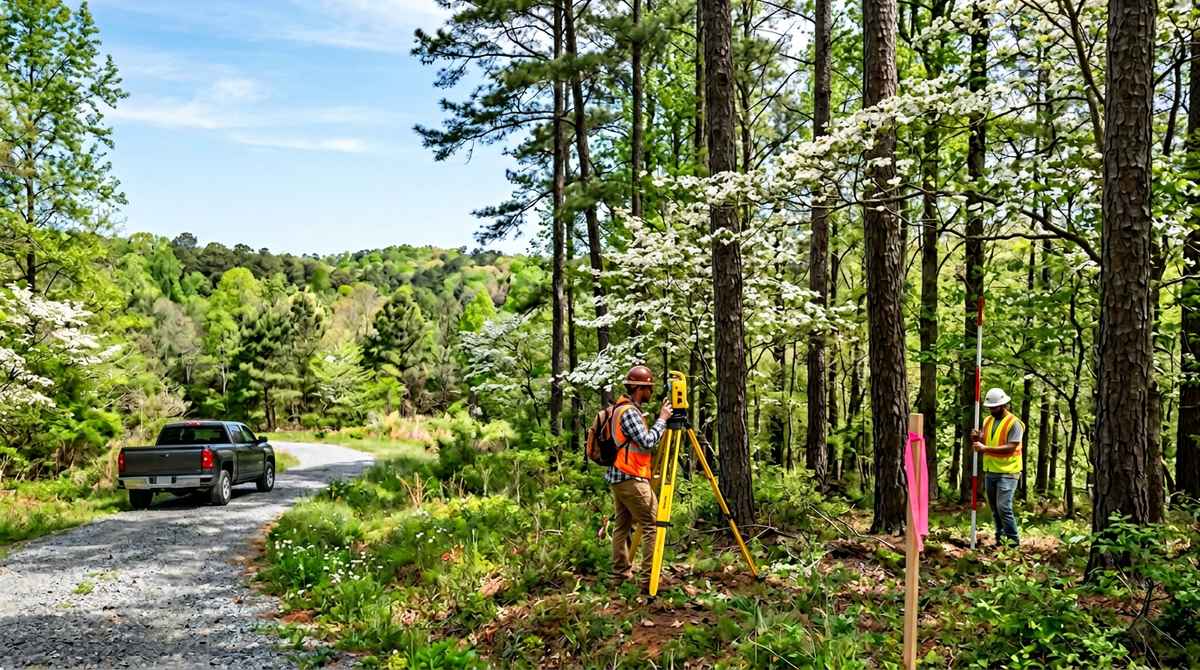
A current boundary and topographic survey shows you the actual buildable footprint after setbacks, easements, stream buffers, and tree-save lines. We have walked clients off lots that looked huge until the riparian buffer along a creek wiped out half the buildable area. Mecklenburg County, NC and York County, SC both publish setback and buffer rules that dictate exactly what you can build where.
Zoning and Use Restrictions
Confirm zoning before you close. Some Charlotte-area lots are zoned for single-family residential but have overlay districts (watershed, historic, conservation) that limit lot coverage, finished square footage, or accessory structures. Our pre-construction services include lot evaluation so we can flag these issues before a contract goes binding.
- Always make a lot offer contingent on soils, survey, utilities, and zoning checks.
- Geotechnical reports typically run $1,500-$4,000 in 2026 and protect your foundation budget.
- Sloped or rocky lots can change foundation cost dramatically.
- Setbacks, easements, and stream buffers shrink the buildable footprint.
- Watershed and overlay zoning limits can cap finished square footage.
Utilities: Municipal vs Well, Septic, and Tie-In Costs
Utilities are where build-on-your-lot budgets get killed quietly. A lot with city water, city sewer, and a power tap at the road is the easy case. Many Charlotte-metro and York County, SC lots are not that case.
Water: Municipal vs Well
Inside Charlotte, NC city limits and most established suburbs, municipal water is standard. On rural lots in Iredell, Union, and York counties, private wells are common. A drilled well with pump, pressure tank, and water-quality treatment typically runs $9,000 to $20,000 in 2026 depending on depth and water quality. Test water yield and quality before you close on a rural lot. Our Charlotte custom home builder team coordinates well drillers and water testing during preconstruction so the numbers land in the budget rather than ambushing you mid-build.
Sewer vs Septic
Where municipal sewer is unavailable, you need a septic system, which requires a percolation (perc) test to confirm the soil can support it. A standard conventional septic system typically runs $9,000 to $18,000 in 2026; sites that fail standard perc may need engineered or low-pressure systems at $20,000 to $45,000+. The North Carolina On-Site Water Protection program publishes the rules and standards.
Power, Gas, and Telecom Tie-Ins
Power tie-ins are usually straightforward when the pole line runs along the property frontage. Long driveway runs and underground service can add $5,000 to $25,000+. Natural gas is available in much of Charlotte, NC, but absent on many rural Carolina lots; propane is the typical alternative. Confirm fiber or broadband availability before assuming you can work from home.
- Drilled wells typically run $9,000-$20,000 installed in 2026.
- Conventional septic typically runs $9,000-$18,000; engineered systems much more.
- Long power runs and underground service can add $5,000-$25,000+.
- Confirm gas availability and fiber service before assuming feasibility.
- Always perc-test a lot before closing if it does not have municipal sewer.
HOA, ARB, and Deed Restrictions on Build-On-Your-Lot Projects
Many Charlotte-metro private lots sit inside HOAs or under deed restrictions that significantly affect what you can build. Some HOAs have minimum and maximum square footage, mandatory exterior material lists (brick, stone, fiber cement only), required architectural styles, and tree-save rules. Lake Wylie, SC, Fort Mill, SC, and Huntersville, NC subdivisions frequently layer ARB approval on top of county permits.
Read the HOA covenants and ARB guidelines before you sign a lot contract. We have seen clients buy lots and then find out their preferred plan exceeds maximum height or violates a setback overlay. Our HOA approval coordination packages ARB submissions to maximize first-cycle approval and minimize wasted design time. For Lake Wylie, SC and Fort Mill, SC buyers especially, we keep current playbooks for the most active Lake Wylie custom home communities.
- HOA covenants can dictate square footage, exterior materials, and architectural style.
- ARB review can run from 2 weeks to 3+ months by community.
- Deed restrictions on private lots can limit accessory structures and outbuildings.
- Always read covenants before you sign a lot contract, not after.
Permitting in Mecklenburg County, NC and York County, SC
Once design is locked, permitting drives the next chunk of the timeline. Build-on-your-lot projects go through the same county building, zoning, and stormwater reviews as subdivision homes, but you do not have a developer’s pre-approved utility and grading plans to ride on.
Mecklenburg County, NC
Residential building permits in Mecklenburg County, NC typically run 30 to 60 business days from complete submission, with stormwater and grading reviews often on parallel tracks. Incomplete submissions or correction cycles routinely double that. The official Mecklenburg County Code Enforcement portal is where we track permit status.
York County, SC: Lake Wylie and Fort Mill
York County, SC permits typically run 4 to 8 weeks for residential. Stormwater review adds time on lots over an acre, and Lake Wylie waterfront work also requires Duke Energy shoreline permits when piers, retaining walls, or shoreline grading are involved. Fort Mill, SC subdivisions sometimes layer ARB review on top of county permits.
- Mecklenburg County, NC: 30-60 business days typical for complete submissions.
- York County, SC: 4-8 weeks typical, longer with stormwater or shoreline work.
- Build-on-your-lot projects do not get to ride on a developer’s pre-approved plans.
- Run ARB and county review in parallel where covenants allow.
Realistic Build On Your Lot Charlotte NC Timeline
A clean build-on-your-lot project in the Charlotte metro typically runs 14 to 22 months from signed builder agreement to keys in hand. Lot diligence happens before that clock starts, and complex lots can add months on top.
Phase Ranges We Plan Around
Lot diligence and design typically run 4 to 6 months. Permitting and HOA review run 1 to 4 months. Sitework and foundation run 4 to 8 weeks once permits issue. Vertical construction through dry-in runs 3 to 4 months. Finish-out and close run 4 to 6 months. We bake a 6 to 10 week weather-and-supply buffer into every schedule. You can review our full custom home construction workflow for the full phase plan.
Where Lots Add Time
Wells, septic, long driveways, sloped foundations, and waterfront permitting all add real schedule. A perc-test failure that forces an engineered septic system can add 6 to 10 weeks. Duke Energy shoreline review on a Lake Wylie waterfront lot can add 8 to 16 weeks. Plan these in from the first conversation rather than discovering them mid-build.
- Total realistic window: 14-22 months from contract to keys.
- Lot diligence and design: 4-6 months.
- Engineered septic systems can add 6-10 weeks vs conventional.
- Duke Energy shoreline permits can add 8-16 weeks on Lake Wylie waterfront.
- Build a 6-10 week weather-and-supply buffer into every build-on-your-lot schedule.
How CDG Carolinas Approaches Build-On-Your-Lot Projects
We start every build-on-your-lot conversation with the lot, not the floor plan. Before we talk square footage, we want to see the survey, the topo, the soils information, the utility availability, and the HOA covenants. From that we build a realistic budget range and timeline, then move into design only after the lot is proven buildable. This is the rhythm of our custom home builder services across the Charlotte metro.
For clients in Lake Wylie, SC, Fort Mill, SC, and Huntersville, NC, we also coordinate ARB submissions, county permits, and utility tie-ins on parallel tracks to compress the calendar without skipping any reviews. The result is a build-on-your-lot project that actually finishes on its planned schedule.
- We start with the lot, not the floor plan.
- Survey, topo, soils, utilities, and HOA review come before design lock.
- ARB and county permitting run in parallel where covenants allow.
- Utility tie-ins are scoped during preconstruction, not after framing.
Frequently Asked Questions
Can any builder build on my lot in the Charlotte metro?
Most reputable Charlotte-area custom builders offer build-on-your-lot programs, but capabilities differ. Some only build their stock plans on your lot; some (like us) handle full custom design plus lot diligence and utility coordination. Ask each builder how they handle wells, septic, ARB, and waterfront review before you sign.
Do I need to own the lot before talking to a builder?
No, and you probably should not. Loop in a builder during your lot diligence so you do not close on a lot that is hard or expensive to build on. Most lot contracts can include a contingency window for soils, perc, and utility verification.
Is build-on-your-lot more expensive than a developer subdivision home?
Sometimes yes, sometimes no. You typically save on land in rural and semi-rural pockets but spend more on utilities, well, and septic. Inside Charlotte, NC city limits, build-on-your-lot is usually similar in total cost to a comparable subdivision build but gives you more design freedom and a better lot.
What is the biggest risk on a build-on-your-lot project in the Carolinas?
Buying a lot that turns out to be hard to build on. Soils, perc-test failures, hidden easements, watershed overlays, and missing utilities are the usual culprits. Run all of those checks before you close on the land.
Plan Your Build-On-Your-Lot Project With CDG Carolinas
If you have a lot in mind in Charlotte, NC, Huntersville, NC, Lake Wylie, SC, or Fort Mill, SC, or you are still shopping, we will walk the lot with you, run the diligence checks, and help you decide whether it is the right place to build on your lot Charlotte NC homeowners can actually finish on schedule and on budget. After 30+ years of custom builds across the Carolinas, we have stress-tested hundreds of lots. Call us at (704) 619-6293 or visit our contact page to start the conversation.