
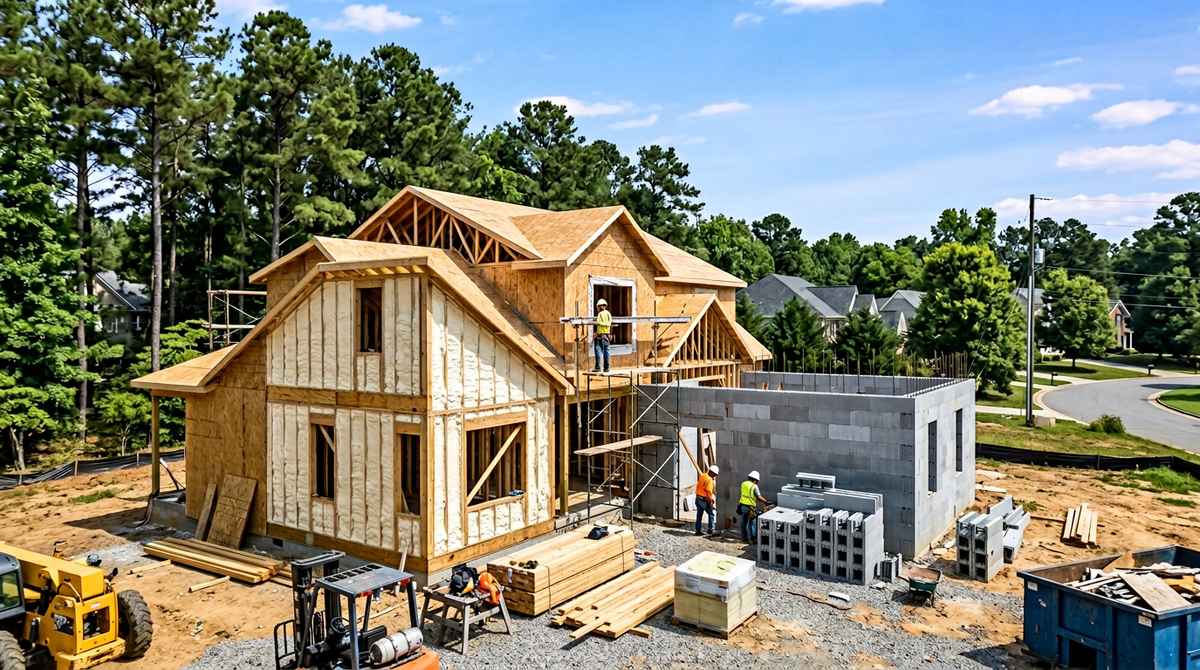
Choosing an energy efficient home builder in Charlotte means more than picking a contractor who installs better insulation. It means hiring a team that designs the entire envelope, mechanical system, and HERS-rated performance target as one integrated build. We have been delivering tight, code-plus homes across Charlotte, Huntersville, Lake Wylie, and Fort Mill for 30+ years, and the gap between a code-minimum house and a properly engineered energy-efficient one shows up every month on the utility bill.
What an Energy Efficient Home Builder Charlotte Clients Hire Actually Does
An energy efficient home builder Charlotte buyers can rely on starts the conversation at the floor plan, not the insulation order. Wall thickness, window-to-wall ratio, roof orientation, mechanical room location, and duct routing all get decided before framing begins. Skip that step and even premium spray foam will underperform because the building science was never coordinated. The builders who advertise efficiency without changing how they design are selling product upgrades, not performance.
Real performance is measured, not promised. We require a HERS rating from a certified RESNET rater on every energy-track build, and we set a target index — typically HERS 55 or lower in the Carolinas — before construction starts. The rater models the home, identifies weak points, and tests the finished build with a blower door and duct leakage test. If the home does not hit the target, we fix it before closing. That accountability is what separates a real energy efficiency build from a marketing one.
Why Charlotte’s Climate Matters
Charlotte sits in IECC Climate Zone 3A — a mixed-humid climate with hot, humid summers and short, mild winters. The dominant load is cooling and dehumidification, not heating, which means moisture control and air sealing matter more than raw R-value. A builder copying envelope details from cold-climate playbooks will trap moisture in your wall assemblies. We design every Charlotte build for vapor flow and dew point first, R-value second.
- Energy-efficient design starts at the floor plan, not the insulation order
- HERS rating with blower door and duct test is the only honest proof
- Target HERS 55 or below for Carolinas energy-track builds
- Charlotte is Climate Zone 3A — cooling and humidity drive the design
- Cold-climate envelope details fail in Carolina humidity
Spray Foam Insulation: Open-Cell vs Closed-Cell
Spray foam is the workhorse of the high-performance wall assembly when used correctly. Open-cell (~0.5 lb/cu ft, R-3.7 per inch) is air-permeable enough to dry but vapor-open enough to cause issues if used wrong in our climate. Closed-cell (~2 lb/cu ft, R-6.5 to R-7 per inch) doubles as an air barrier and a Class II vapor retarder, which is why we specify it for rim joists, below-grade walls, and most exterior wall cavities in Charlotte. The Building Science Corporation has published extensively on which assemblies work in Climate Zone 3A, and our specs follow the conservative recommendations.
Where spray foam goes wrong is application quality. Off-ratio foam, inadequate substrate temperature, and sloppy thickness control produce voids, shrinkage, and odor problems that homeowners discover years later. We require the spray foam contractor to provide a written daily QC log, take core samples at randomized locations, and warranty the application separately from the manufacturer’s product warranty. Our energy-efficient build services include that QC framework on every project.
Where Foam Beats Fiberglass and Where It Does Not
In a tight production-grade wall, dense-pack cellulose or properly installed mineral wool can match foam’s thermal performance at lower cost — but only with a separate continuous air barrier. If the budget will not cover both insulation plus a quality air barrier, closed-cell foam wins because it does both jobs in one pass. In retrofits, we sometimes specify hybrid assemblies — closed-cell at the sheathing for vapor control, mineral wool for the rest of the cavity — to balance cost and performance.
- Closed-cell spray foam: R-6.5+ per inch, doubles as air and vapor barrier
- Open-cell foam: R-3.7 per inch, vapor-open, careful Charlotte use only
- Application QC logs and core samples are non-negotiable
- Hybrid assemblies can match foam at lower cost in tight builds
- Closed-cell is the safest single-product choice for Charlotte exterior walls
ICF Construction: When Insulated Concrete Forms Make Sense
Insulated Concrete Forms (ICF) are stay-in-place expanded polystyrene blocks filled with reinforced concrete. The result is a wall with R-22 to R-25 of continuous insulation, a near-zero air leakage rate, and a thermal mass that smooths out interior temperature swings. For Charlotte custom homes targeting net-zero or storm resilience, ICF is the strongest single envelope decision available. We have built ICF homes in Lake Wylie, Tega Cay, and Huntersville, and the HERS scores routinely come in 15 to 20 points lower than equivalent stick-framed builds.
The trade-offs are real. ICF walls are 11 to 13 inches thick, which costs interior square footage. Material cost runs 5 to 10 percent higher than premium stick framing as of 2026, and the labor pool of skilled ICF crews in the Charlotte region is small. A bad ICF crew can leave bowed walls, cold joints, and rebar miss-placements that compromise the structure. We pre-qualify every ICF subcontractor with a portfolio review, a job-site visit, and a reference check before we put one on a project.
Where ICF Wins for Carolina Builds
Lake Wylie and Lake Norman waterfront homes benefit most because ICF resists wind, flying debris, and lateral hydrostatic pressure better than wood framing. Hillside lots in SouthPark and Myers Park get the most out of ICF’s structural capacity for stepped foundations. Compare the envelope choices in our guide to energy-efficient homes in Lake Wylie, SC and our overview of luxury custom home features to see how the spec maps to the project.
- ICF delivers R-22 to R-25 continuous insulation with near-zero air leakage
- Thermal mass smooths interior temperature swings in Charlotte’s heat
- 5-10% cost premium over premium stick framing as of 2026
- Crew quality is the biggest variable; pre-qualify every ICF sub
- Best fit for waterfront, storm-prone, and hillside Charlotte builds
HERS Scoring: How to Read the Number That Matters
The Home Energy Rating System (HERS) Index is the industry standard for measuring residential energy performance. A score of 100 represents a code-built home circa 2006; lower is better, and a net-zero home scores 0. North Carolina’s current code typically delivers a HERS 70 to 80 with no special design effort. Our energy-track builds target HERS 55 or below, and our top-spec ICF and net-zero builds regularly come in at HERS 35 to 45 with solar.
The HERS report is more than a number — it is a roadmap. The rater models every assembly, mechanical, and lighting choice, then ranks the cost-per-point of every upgrade option. That lets us spend the marginal dollar where it actually moves the score, instead of overspending on showy upgrades that do not pencil out. On a typical Charlotte custom build we present the homeowner with three packages — code-plus, energy-track, and net-zero ready — each with a documented HERS target and a 10-year utility cost projection. See our cost breakdown for custom homes for how those packages map to budget.
Why Lender Tools Like Energy Star Mortgages Matter
A HERS-rated home with a score of 60 or below qualifies for Energy Star certification, which most lenders treat as collateral for a higher debt-to-income ratio. The Energy Star Single-Family New Homes program publishes the certification thresholds, and we coordinate the rater submission so the certificate is in hand before closing. That paperwork is also what unlocks utility rebates from Duke Energy.
- HERS 100 = 2006 code; HERS 0 = net-zero; lower is better
- NC code-built homes typically score HERS 70-80
- Energy-track target is HERS 55 or below
- HERS report ranks upgrades by cost-per-point so dollars are spent well
- HERS 60 or below unlocks Energy Star certification and lender benefits
NC and SC Energy Code, Plus Utility Rebates
North Carolina enforces the 2018 NC Energy Conservation Code with state amendments; South Carolina has adopted the 2021 IECC with its own modifications. Both apply to your project depending on which side of the state line your lot sits. The code numbers — R-13 cavity in walls, R-30 to R-38 ceilings, blower door target around 5 ACH50 in NC and 3 ACH50 in SC — are floors, not goals. Every energy-track home we build comes in well under 2 ACH50.
Duke Energy offers rebates for HVAC upgrades, smart thermostats, and whole-home energy assessments through its residential programs, and the federal Home Energy Rebates program at energy.gov publishes the Inflation Reduction Act rebate framework that has rolled out to NC and SC. We coordinate rebate paperwork so the homeowner does not chase forms after move-in. For local code questions, our permit guide for Lake Wylie and our internal permit acquisition coordination services handle the paperwork in Mecklenburg County, York County SC, Town of Lake Wylie, and Town of Fort Mill.
- NC enforces 2018 NCECC; SC enforces 2021 IECC with state amendments
- Code blower-door targets: roughly 5 ACH50 NC, 3 ACH50 SC
- Energy-track CDG builds come in under 2 ACH50
- Duke Energy rebates apply to HVAC, thermostats, and assessments
- Federal IRA rebates are live in NC and SC and stack with utility rebates
Cost, ROI, and Choosing the Right Energy Package
The honest answer on cost is that an energy-track Charlotte custom home runs about 4 to 8 percent more than a code-minimum equivalent as of 2026, and an ICF or net-zero ready home runs 8 to 15 percent more. That premium typically pays back in 7 to 12 years through lower utility bills, longer HVAC equipment life, and improved resale value. We do not promote efficiency upgrades that fail the math. If the cost-per-HERS-point is bad, we say so and recommend allocating those dollars elsewhere in the spec.
The right package depends on how long the homeowner plans to stay, how the lot exposes the home to sun and wind, and whether the budget supports solar from day one. Buyers planning a 10-plus year stay almost always benefit from at least the energy-track package. Buyers building on Lake Norman or Lake Wylie waterfront should consider ICF for storm resilience even if pure ROI is secondary. Our financing guide for custom homes covers how lenders treat energy-package premiums in the appraisal.
- Energy-track adds about 4-8% to a Charlotte custom home build cost in 2026
- ICF or net-zero ready adds about 8-15%
- Typical payback is 7-12 years on a properly engineered package
- Long-stay owners and waterfront builds benefit most
- Lenders increasingly factor energy-package value into appraisals
Frequently Asked Questions
Does spray foam cause moisture problems in Charlotte?
Only when applied wrong or specified for the wrong assembly. Closed-cell foam in exterior walls is a proven Climate Zone 3A solution. Open-cell in unvented attics requires careful design and a properly sized HVAC system to avoid humidity issues.
Is ICF worth it for a tract-style home?
Usually no. ICF’s economics work best on custom or semi-custom homes where the design uses the structural capacity. For tract production builds the cost premium rarely pencils out unless storm resilience is a primary goal.
What HERS score should I target?
A HERS 55 or below is a defensible target for Charlotte and York County SC builds in 2026. Below HERS 45 starts requiring solar or geothermal to pencil. Below HERS 30 is net-zero territory and requires the entire envelope, mechanicals, and renewables to be designed together.
Do utility rebates require the rebate paperwork to be filed before construction?
Most do. Duke Energy and IRA rebates have pre-construction filing requirements, and missing the deadline means leaving money on the table. We file the paperwork as part of pre-construction so nothing slips.
Hiring a real energy efficient home builder in Charlotte starts with a conversation about HERS targets, climate-appropriate envelope design, and which rebates apply to your lot. We are happy to walk through the package options on your project with no obligation. Call CDG Carolinas at (704) 619-6293 or visit our contact page to schedule a no-pressure consultation. Bring your lot survey and budget; we will send you back a HERS-modeled package comparison within two weeks.