
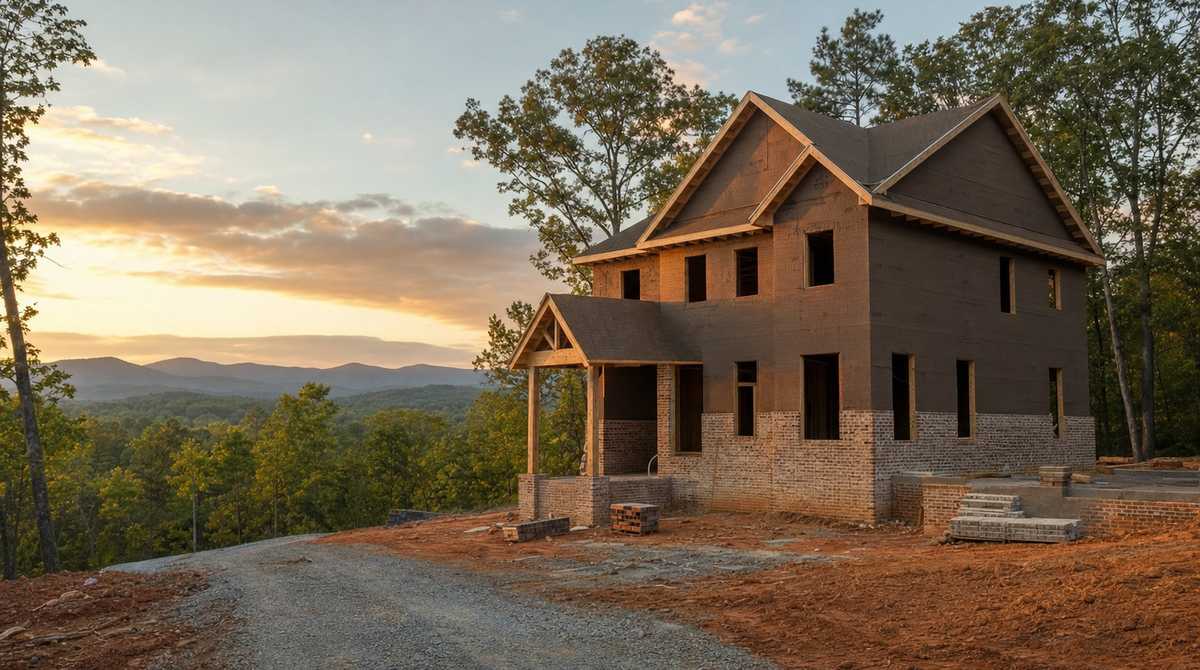
Building west of Charlotte means working in a different market than Mecklenburg or York County. cleveland county nc home construction follows its own cost structure, permitting timeline, and lot-availability story, and homeowners who assume the rules are the same as Charlotte usually find out otherwise the hard way. We have spent more than 30 years building across the Carolinas, and the western Piedmont — Shelby, Kings Mountain, Boiling Springs, Lawndale — has its own rhythm.
This guide covers what makes Cleveland County, NC different on the construction side: realistic 2026 cost ranges, the local permit and inspections process, well and septic considerations on rural lots, the materials and trade-labor differences versus the Charlotte metro, and the practical reasons buyers and homeowners should plan ahead before breaking ground out here. If you are considering a custom home or major renovation in Cleveland County or the surrounding western Piedmont, the differences are worth understanding before contracts are signed.
The Cleveland County, NC Market in 2026
Cleveland County sits at the western edge of the greater Charlotte commute shed, with Shelby as the county seat and Kings Mountain bridging into Gaston County. The market is meaningfully smaller than Mecklenburg or even Gaston, which shapes everything from lot pricing to subcontractor availability. Most new home construction here is on private lots — buyers who own family land, infill in established neighborhoods, or rural acreage purchased for a custom build.
Lot pricing is the single biggest delta versus the Charlotte metro. A buildable acre in rural Cleveland County in 2026 can run a fraction of what equivalent acreage costs in southern Mecklenburg or northern York County, especially outside the Shelby and Kings Mountain limits. That delta is the main reason homeowners with land here often build larger custom homes per dollar than what the same budget produces in Charlotte.
The trade-off is build cost per square foot, which we will break down section by section. Subcontractor density is lower west of Gaston County, and that affects scheduling. We bridge into the western Piedmont from our Gastonia service area, which gives us the closest active subcontractor relationships to Cleveland County.
- Cleveland County is a smaller market than Mecklenburg or Gaston
- Most new builds happen on private rural or infill lots, not subdivisions
- Lot pricing runs a fraction of southern Mecklenburg or York County rates
- Larger custom homes per dollar are common when land is already owned
- Subcontractor density tightens west of Gaston County
Build Costs and Cost Structure as of 2026
Build cost ranges in Cleveland County run differently than the Charlotte metro because of two opposing forces. Labor and overhead trend slightly lower than Mecklenburg, but smaller subcontractor pools mean less competitive bidding on specialty trades. Material costs are essentially the same — lumber, steel, concrete, and finishes price off the same regional supply chain. Rural lot work, however, often adds substantial site preparation cost.
For a true custom home in Cleveland County in 2026, the typical range we see for the build itself is roughly $300 to $450 per square foot, depending on finish level and complexity. That is materially lower than the $400 to $550 range we see in South Charlotte. The catch is site work — clearing, grading, drainage, well, septic, and utility tie-ins on rural lots can add $40,000 to $150,000 or more to the project total before a single stick of framing goes up.
Pre-construction work is where the cost-structure differences show up most clearly. Our project feasibility analysis on rural Cleveland County lots routinely identifies $20,000 to $80,000 in site costs that buyers had not planned for. We always run the feasibility numbers before any client signs a build contract. Skipping that step is the single most common reason rural home projects run over budget.
- Customs typically run $300 to $450 per square foot in Cleveland County in 2026
- Labor and overhead trend slightly below Mecklenburg pricing
- Smaller subcontractor pools tighten bidding on specialty trades
- Site work on rural lots adds $40,000 to $150,000-plus to project totals
- Feasibility analysis before contract prevents most rural cost surprises
Permitting Through Cleveland County Inspections
Cleveland County Inspection Services handles building permits for the unincorporated county. Inside Shelby, Kings Mountain, Boiling Springs, and Lawndale city limits, the municipality typically issues its own permits but routes structural and trade reviews through county or partner inspectors depending on staffing.
The plan review timeline for a complete residential submittal in Cleveland County runs faster than Mecklenburg on average — typically two to three weeks for a clean submittal versus the four-to-six-week range we see in busier metros. The catch is that incomplete submittals get bounced back quickly, and the county is consistent about wanting site plans, structural details, and energy code compliance documents in the first package. Our permit acquisition and coordination service handles the packaging that keeps reviews on the fast track.
Inspections follow the standard North Carolina sequence: footing, foundation, framing, rough-in trades, insulation, drywall, final trades, building final, and certificate of occupancy. The county typically schedules inspections within one to three business days of request, which is meaningfully faster than urban Mecklenburg in peak season. The official Cleveland County Inspection Services page lists current submittal requirements and contact information for each discipline.
- Cleveland County Inspections handles permits for unincorporated areas
- Shelby, Kings Mountain, Boiling Springs, and Lawndale issue city permits
- Plan review averages two to three weeks for complete submittals
- Inspections typically scheduled within one to three business days of request
- Standard NC inspection sequence applies from footing through certificate of occupancy
Well, Septic, and Utility Tie-Ins on Rural Lots
Most new construction in Cleveland County outside city limits is on private well and septic. The North Carolina Department of Environmental Quality and the county Environmental Health office handle well and septic permits, and the process sits on the critical path because the building permit cannot issue until the septic location is approved on private-system lots.
The septic process starts with a soil evaluation by a licensed soil scientist or county field inspector. They evaluate percolation, restrictive layers, and seasonal water table to size the drainfield. Cleveland County soils vary — the Piedmont clay common across the county can drain poorly in some areas and require larger drainfields or alternative systems. Wells are simpler — drillers pull permits and the county verifies setbacks from septic, surface water, and property lines.
Utility tie-ins are a real planning consideration on rural lots. Power tie-ins through Duke Energy or Rutherford EMC can require new pole runs measured in hundreds of feet, and the cost falls on the homeowner past a baseline allowance. Our utility tie-in service coordinates power, water (where municipal lines exist), septic, and telecom, and our team handles land clearing and grading as needed.
- Most rural Cleveland County lots use private well and septic
- Septic permits sit on the critical path before the building permit issues
- Piedmont clay soils can require larger drainfields or alternative systems
- Power tie-ins on rural lots can require new pole runs at homeowner cost
- Coordinated site work prevents multi-week sequencing delays
Materials, Labor, and Subcontractor Realities
Material costs in Cleveland County are essentially identical to Charlotte. Lumberyards and supply houses serve the same regional distribution network, and freight from Charlotte-area distribution centers is short enough that pricing differences are negligible. Where the western Piedmont differs is on labor and specialty subs.
General framing, foundation, and trim labor is widely available locally. Specialty trades — high-end millwork, advanced HVAC zoning, smart home integration, custom metal fabrication — often have to be brought in from Gaston or Mecklenburg County, which adds travel time and sometimes lodging cost on long jobs. The realistic schedule impact is one to three weeks added on a typical custom home compared to the same build inside Charlotte.
For homeowners who want the same finish level common in Charlotte custom builds, planning the trade sequence with this in mind is essential. Our scheduling and timeline development is built around realistic subcontractor windows for the western Piedmont, not assumptions borrowed from urban Mecklenburg.
- Material costs match Charlotte pricing across the regional supply chain
- General framing, foundation, and trim labor is readily available locally
- Specialty trades often travel in from Gaston or Mecklenburg County
- Realistic schedule impact is one to three weeks versus a Charlotte build
- Trade sequencing must account for travel time on specialty work
Lot Selection and Land Diligence in the Western Piedmont
The biggest single decision on a rural Cleveland County build is the lot itself. We tell every client the same thing: do soil, well, and zoning diligence before you close on raw land, not after. Failing soils, restricted access, unbuildable slopes, and right-of-way questions have killed more rural projects than budget overruns.
Cleveland County zoning runs the standard mix of agricultural, rural residential, and residential districts. Most rural lots allow single-family construction, but minimum lot size, setback, and accessory structure rules vary. Floodplain mapping matters — parts of the county along the First Broad River and Buffalo Creek carry flood-zone designations that change foundation and elevation requirements. Topography also matters more here than in flat Charlotte suburbs; foothill lots with significant slope add foundation, retaining-wall, and driveway cost.
For homeowners considering a build in Cleveland County, working with a builder who has run rural Carolina projects matters more than in suburban metros where the lots themselves are already engineered. We have built across the western Piedmont and into the broader Charlotte region, and we coordinate land diligence through the same pre-construction process we use on all our custom builds. The diligence cost is small relative to the project, and it saves projects from expensive surprises.
- Land diligence before closing prevents the most expensive rural surprises
- Zoning, setbacks, and accessory rules vary across the county
- Floodplain mapping along First Broad River and Buffalo Creek changes requirements
- Foothill topography adds foundation, retaining wall, and driveway cost
- Pre-construction diligence is small relative to total project cost
Frequently Asked Questions
Do you build homes in Cleveland County, NC?
We are headquartered in the Charlotte metro and our primary service areas are Charlotte, Huntersville, the Lake Norman corridor, and York County, SC. We extend into Gaston County and selectively into the western Piedmont for custom projects when the scope justifies the travel. Call us with a specific project and lot and we will tell you straight whether it fits.
How much does it cost to build a custom home in Cleveland County?
Build costs as of 2026 typically run $300 to $450 per square foot for a true custom in Cleveland County. Site work on rural lots adds $40,000 to $150,000 or more depending on clearing, grading, well, septic, and utility tie-in needs. Lot pricing is meaningfully lower than southern Mecklenburg or York County for comparable acreage.
How long does the permit process take in Cleveland County?
For a complete residential submittal, plan review usually clears in two to three weeks. Inspections after permit issue are typically scheduled within one to three business days of request. The total permit-cycle window is faster than busy Mecklenburg on most projects, but incomplete submittals still cause the same kind of delays anywhere.
What about wells and septic in rural Cleveland County?
Most rural lots are on private well and septic. The septic permit sits on the critical path and starts with a soil evaluation. Piedmont clay soils sometimes require larger drainfields or alternative systems. Always pull a soil evaluation before closing on raw land — failing soils have killed more rural deals than any other single factor.
If you are planning a custom home or major build in Cleveland County, NC or the western Piedmont, call us at (704) 619-6293 or reach out through our contact page. We will walk through your specific lot, scope, and budget and tell you honestly whether it is a project that fits and what realistic costs and timelines look like.