
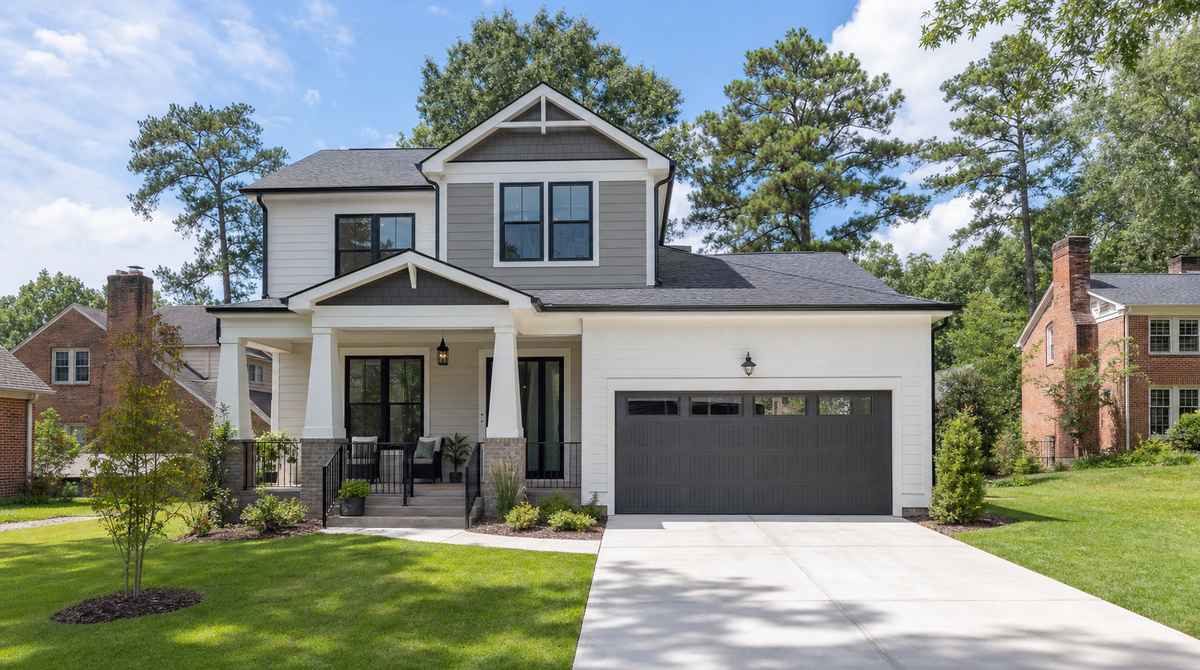
Whether to build spec home charlotte roi math actually justifies in 2026 depends on four moving pieces: land cost, hard build cost, holding cost, and sale price at exit. Get any one of them wrong and a profitable project turns into a break-even one. We work alongside investor-builders across Charlotte, Huntersville, NC, and the York County, SC submarkets, and the spreadsheets we run today look very different from the ones that worked in 2019. This guide walks through every line of a realistic spec-home pro forma for Charlotte, NC and what the numbers actually look like as of 2026.
Charlotte Spec Home ROI: The Headline Numbers
A realistic build spec home charlotte roi target for 2026 sits in the 12 to 22 percent gross margin range on hard project cost, depending on submarket, finish level, lot selection, and how long the home sits between completion and closing. Top-quartile operators in tight submarkets (South End infill, NoDa, Plaza Midwood, Sedgefield) can stretch into the high twenties, while volume builders in outer-ring subdivisions typically run closer to 10 to 15 percent.
The math we see most often on a 2,800 to 3,400 square foot Charlotte spec home runs roughly as follows for 2026: $180,000 to $350,000 in lot acquisition and site development, $450,000 to $700,000 in hard construction cost, $25,000 to $55,000 in carrying costs (interest, taxes, insurance, utilities, HOA), and $40,000 to $75,000 in soft costs (architecture, permits, surveys, brokerage, closing). Total invested capital runs $700,000 to $1.2 million depending on lot and finish level. Sale prices in target submarkets in 2026 run $850,000 to $1.5 million.
Why margins compressed from the 2019-2021 cycle
Two structural shifts drive the compression. Hard build cost rose 28 to 38 percent between 2020 and 2024 and has only partially stabilized. Lot acquisition in desirable Charlotte submarkets also rose sharply as competition between owner-occupier buyers, build-to-rent operators, and spec builders intensified. Realistic underwriting now assumes 12 to 22 percent margin rather than the 25 to 30 percent that was achievable five years ago.
- Realistic Charlotte spec home ROI in 2026 runs 12-22 percent on hard cost
- Total invested capital typically $700,000 to $1.2 million for a 2,800-3,400 sq ft build
- Sale prices in target submarkets typically $850,000 to $1.5 million
- Margins are compressed roughly 8-12 points versus the 2019-2021 cycle
- Lot quality and submarket selection drive the spread more than finish level
Land Cost: Where Most Charlotte Spec Deals Win or Lose
Lot acquisition is where build spec home charlotte roi outcomes are decided long before the first shovel hits dirt. As of 2026, an infill teardown lot in South End or Sedgefield typically runs $250,000 to $450,000. A finished lot in newer Mecklenburg or Union County subdivisions runs $120,000 to $250,000. Raw acreage that requires subdividing or new utility extensions costs less per unit but adds 6 to 18 months of pre-construction time and meaningful development risk.
Our pre-development work usually starts with a feasibility check covering zoning, setbacks, HOA architectural restrictions, utility availability, stormwater and grading requirements, and tree-save ordinances. Charlotte’s tree ordinance and Mecklenburg County’s post-construction stormwater rules can quietly add $20,000 to $80,000 to site cost on a poorly chosen lot. Our project feasibility analysis screens these issues before we close on land.
For investors targeting subdivision-scale development rather than single-lot spec, our lot acquisition services and development services handle assemblage, entitlement, and infrastructure delivery. Subdivision-scale spec typically produces 14 to 20 percent margins at maturity but front-loads risk and capital.
- Charlotte infill teardown lots typically $250,000 to $450,000 as of 2026
- Finished suburban lots typically $120,000 to $250,000
- Tree-save ordinances and stormwater rules can add $20,000 to $80,000 to site cost
- Subdivision-scale spec offers higher margin but longer entitlement risk
- Feasibility screening before closing on land prevents the largest preventable losses
Hard Build Cost: What Charlotte 2026 Numbers Actually Look Like
Hard cost on a Charlotte spec home in 2026 runs $160 to $230 per square foot for production-level spec, $230 to $310 per square foot for upper-mid spec, and $310 to $425+ per square foot for true semi-custom or move-up spec targeting higher submarkets. These ranges include foundation, framing, exterior envelope, MEP rough-in and finish, drywall, paint, flooring, cabinetry, countertops, plumbing fixtures, lighting, appliances, trim, garage, and standard landscaping.
Site work outside the building footprint runs separately and typically adds $35,000 to $120,000 depending on lot conditions. Steep slopes, poor soil, mature trees that must be preserved, or distant utility tie-ins can push site cost higher. Our grading services handle the earthwork side, and our production home building services handle the vertical construction.
Where 2026 cost surprises hit hardest
According to the National Association of Home Builders, residential construction input costs in 2025 stabilized but remained 30 to 38 percent above 2020 baselines. The biggest single-category increases relative to pre-2020 levels are lumber framing packages, structural concrete, electrical materials, and skilled labor for tile, drywall finishing, and trim carpentry. Specifications that looked premium five years ago — engineered hardwoods, quartz countertops, frameless shower enclosures — are now near-baseline expectations in Charlotte’s $900,000+ submarkets.
- Production spec runs $160-$230 per square foot in Charlotte as of 2026
- Upper-mid spec runs $230-$310 per square foot
- Semi-custom and move-up spec runs $310-$425+ per square foot
- Site work outside the footprint typically adds $35,000-$120,000
- Hard costs remain 30-38 percent above pre-2020 baselines
Holding Cost: The Silent ROI Killer
Carrying costs eat margin every month the home sits unsold. A typical Charlotte spec held for nine months from breaking ground to closing accrues construction-loan interest, property tax, builder’s risk insurance, utility hookup and monthly utilities, HOA dues, and ongoing landscape maintenance. As of 2026 we typically see carrying cost run $2,800 to $5,500 per month on a $700,000 to $1.1 million loan balance once the home is mid-construction.
A home that sells the day it lists capitalizes well. A home that sits 60, 90, or 120 days past listing burns margin fast. We’ve watched a perfectly profitable underwrite turn into a 4 percent margin because the home sat 110 days waiting on a buyer in a soft-spring 2024 cycle.
Construction loan structure matters too. Investor-builders we work with typically use a 70 to 80 percent loan-to-cost facility with interest-only draws during construction and a 12 to 18 month term, often with a six-month extension option. Project financing coordination is something we help with regularly — getting the right capital stack lined up before land closes saves both rate and timeline pain later.
- Carrying cost typically $2,800-$5,500 per month at mid-construction in 2026
- Every 30 days unsold past listing burns 0.3-0.6 points of net margin
- Typical construction loan: 70-80 percent LTC, interest-only, 12-18 month term
- Capital-stack planning before land close prevents avoidable rate and timeline pain
- Soft-spring or rate-spike cycles can compress margin by 4-10 points on slow homes
Exit Price: How Charlotte Submarkets Actually Behave
Charlotte’s spec exit market is not monolithic. South End, NoDa, Plaza Midwood, Sedgefield, Dilworth, and Myers Park infill spec routinely commands $400 to $625 per square foot at close in 2026. Ballantyne and South Park resale-zoned product runs $290 to $425 per square foot. University City, outer Steele Creek, and Union County production runs $215 to $310 per square foot.
Lake-adjacent submarkets in York County, SC (Lake Wylie, Fort Mill, Tega Cay) and Lake Norman in Mecklenburg behave differently. Waterfront and water-view lots can support $500 to $700 per square foot on the right home, while non-water-view subdivisions sit closer to Charlotte production pricing. For investors working both sides of the state line, our sister analysis on profit from spec homes in Lake Wylie, SC covers the SC-side submarket in detail.
Pricing strategy for spec exits
We typically price 2 to 4 percent above the most comparable recent close, list on day one of agent-and-buyer-active weeks (Tuesday through Thursday), and arrive at listing with completed staging, polished landscape, and confirmed inspection-ready status. Spec homes that arrive at the market polished and priced realistically routinely sell within 14 to 35 days in healthy Charlotte cycles. Homes priced 5 to 8 percent above comps to “test the market” sit and burn carry, almost without exception.
- South End/NoDa/Plaza Midwood/Sedgefield infill: $400-$625 per sq ft in 2026
- Ballantyne/South Park resale spec: $290-$425 per sq ft
- University City/Steele Creek/Union County production: $215-$310 per sq ft
- Lake Wylie/Lake Norman water-view: $500-$700 per sq ft
- Price 2-4 percent above the latest comparable close, not 5-8 percent
Putting Together a Realistic Pro Forma
A reliable build spec home charlotte roi pro forma includes land cost (with closing), site development, hard construction (with a 5-8 percent contingency), soft costs (architecture, permits, surveys, builder’s risk, brokerage), carrying costs (financing, taxes, utilities, HOA, insurance), and a sale price tied to current verified comps. We run every project through this template before we commit to a lot or sign a construction loan.
Realistic underwriting in 2026 assumes a 6 to 10 month construction window from groundbreaking to certificate of occupancy on a typical Charlotte spec home, plus 1 to 4 months marketing and closing time. Build any deal that pencils only at 4 months on market or less and you are overexposed. We always pencil to 4 months marketing as a conservative case.
Investor-builders who consistently make money in Charlotte build spec home charlotte roi spreadsheets that bake in a 3 percent design-and-construction contingency and a 4-month marketing buffer. Those who do not typically learn the hard way during the first soft cycle they encounter.
- Pro forma must include land, site, hard, soft, carrying, and sale-side costs
- Build 6-10 month construction plus 1-4 months marketing into the schedule
- Use 3 percent design/construction contingency at minimum
- Conservative case: pencil to 4 months on market, not 1 month
- Underwrite to current verified comps, not aspirational pricing
Frequently Asked Questions
What is a realistic Charlotte spec home ROI in 2026?
Realistic build spec home charlotte roi targets in 2026 run 12 to 22 percent gross margin on total project cost, with top-quartile operators in tight infill submarkets reaching the high twenties. Volume builders in outer-ring subdivisions typically run 10 to 15 percent. The spread is driven primarily by lot quality, submarket selection, and how long the home sits between completion and closing.
How much does it cost to build a spec home in Charlotte?
Total invested capital for a typical 2,800 to 3,400 square foot Charlotte spec home in 2026 runs $700,000 to $1.2 million, with hard build cost between $450,000 and $700,000, lot acquisition between $180,000 and $350,000, soft costs of $40,000 to $75,000, and carrying costs of $25,000 to $55,000 over a typical 9-month hold.
How long does a Charlotte spec home take to build?
Typical 2026 timelines run 6 to 10 months from groundbreaking to certificate of occupancy. Permitting through Mecklenburg County typically adds 2 to 3 months on the front end, and marketing and closing typically add another 1 to 4 months on the back end. Realistic underwriting assumes 10 to 15 months total from land closing to sale closing.
Is it better to build spec or production homes in Charlotte?
It depends on capital, risk appetite, and submarket. Single-lot infill spec produces higher per-unit margin but requires premium lot selection and finish work. Production-style spec in outer-ring subdivisions produces lower per-unit margin but scales more reliably. Investor-builders often run both strategies in parallel once they reach scale.
Ready to Underwrite Your Next Charlotte Spec Home?
If you’re an investor-builder working Charlotte, Huntersville, NC, Lake Wylie, SC, Fort Mill, SC, or Rock Hill, SC, we’d be glad to walk a lot, pencil a pro forma, and talk through realistic build spec home charlotte roi math for your project. Call us at (704) 619-6293 or visit our contact page to set up a feasibility conversation. We bring 30+ years of Carolinas building experience and we underwrite every project with the same conservative discipline we’d apply to our own capital.