
Choosing the right porch style is the difference between a space you use eight months a year and one you use twelve. As a porch builder Charlotte homeowners call for screened, covered, and three-season builds, we see the same trade-offs come up in nearly every consultation: budget, climate, view, and how the porch ties back into the rest of the house. This guide breaks down the three most common porch types in the Charlotte metro, what each one actually costs as of 2026, and which is the right fit for typical Mecklenburg County and York County, SC homes.
Why Porch Style Matters in the Charlotte Climate
Before comparing porch types, it helps to understand what a Charlotte-area porch has to handle. Summers in the Charlotte metro routinely hit the low 90s with high humidity, which makes shade and airflow essential. Pollen season — late February through April — coats every exposed surface in yellow dust, and biting insects show up by May. Winters are mild but bring cold snaps into the upper 20s. A porch built only for July evenings will sit empty from November through March, while a three-season porch can pull double duty as a quiet morning workspace in February.
The right answer for any porch builder Charlotte project depends on how the family actually uses outdoor space. A household that grills three nights a week and entertains on weekends wants a different porch than one that values reading time with morning coffee. We work through this scope under our outdoor living spaces service, because the porch decision drives roof line, foundation, and the structural connection back to the existing home.
- Charlotte summers regularly hit the low 90s with high humidity — shade and airflow are non-negotiable.
- Pollen season runs late February through April and rewards screened or enclosed builds.
- Biting insects active May through October push most families toward screened or three-season porches.
- Mild winter cold snaps justify the upgrade from screened to three-season for year-round use.
Screened Porches: The Charlotte Workhorse
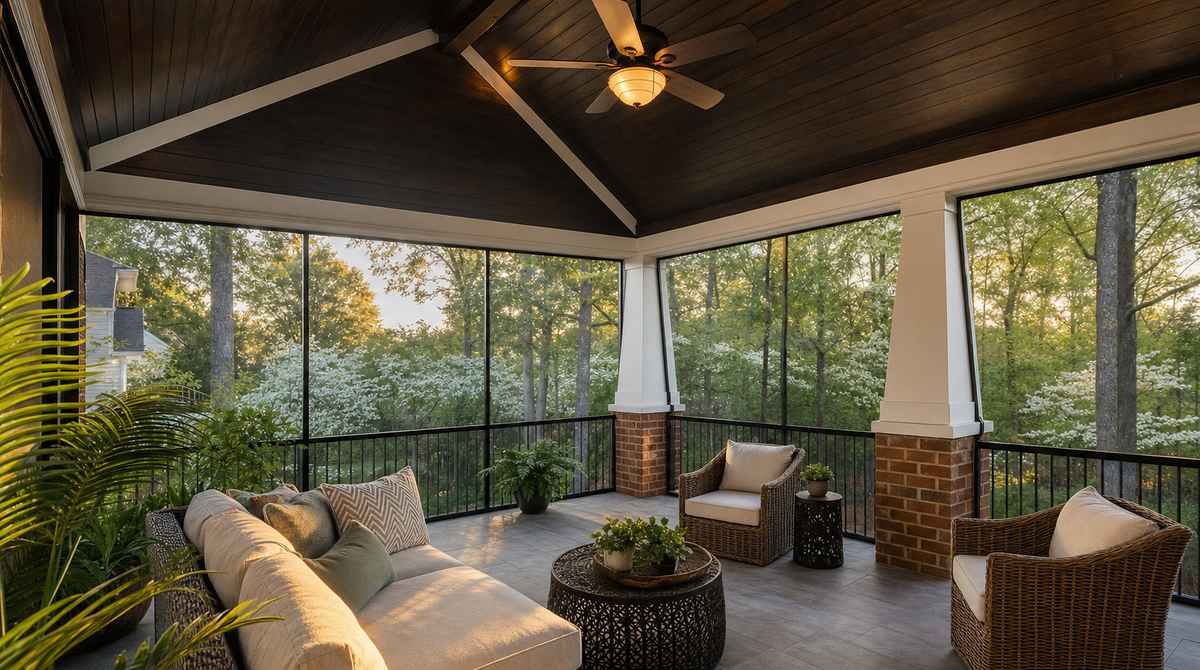
A screened porch is the most popular porch builder Charlotte request we see, and for good reason. It blocks pollen and insects, holds onto evening breezes, and costs less to build than a glazed enclosure. The structure is a covered porch wrapped in tight black or charcoal screen panels mounted in aluminum or wood-clad frames. The roof can match the main home gable, run as a separate shed roof, or sit under a hip framed off a corner.
Material choices drive Charlotte screened porch pricing more than square footage. A standard 14 by 16 screened porch with a treated pine frame, fiberglass screen, asphalt shingle roof, and pressure-treated decking sits in a typical range of $28,000 to $48,000 as of 2026. Upgrade to a tongue-and-groove ceiling with stained wood, composite decking or porcelain tile flooring, screen system with hidden splines, and a paneled gable, and the same footprint moves into a $55,000 to $85,000 range. Cathedral ceilings with exposed rafters and shiplap detailing land in the upper half of that band.
Floor and Ceiling Decisions
Pressure-treated decking is the budget standard. Composite decking adds about $4 to $8 per square foot. Porcelain floor tile installed over a structural slab or framed subfloor pushes another $12 to $20 per square foot, but it solves the most common screened porch failure mode in Charlotte — board cupping and gapping from humidity cycles. We handle the structural decisions under our framing service so the porch carries the floor and roof loads cleanly without retrofit work later.
- Standard 14 by 16 screened porch typical range as of 2026: $28,000 to $48,000.
- Upgraded same footprint with stained ceiling, composite or tile floor, and hidden-spline screens: $55,000 to $85,000.
- Tongue-and-groove ceilings dramatically lift visual quality and resale appeal.
- Porcelain tile flooring solves humidity-driven board cupping common in the Charlotte climate.
Covered Porches: The Open-Air Option
A covered porch is exactly that — a roof, columns, decking, and an open perimeter. No screens, no glass, no walls. It is the simplest of the three porch types to build, the fastest to permit, and the cheapest. It is also the most limited in functional use during Charlotte’s bug season and pollen weeks.
The covered porch wins in two scenarios. First, a small front porch as a curb-appeal entry feature — eight to ten feet deep, full house-front wide, with classic columns and a beadboard ceiling. Second, a rear covered porch where the homeowner explicitly wants the open feel and accepts the mosquito and pollen trade-off. Pricing for a typical 12 by 14 rear covered porch in the Charlotte metro sits in a $18,000 to $36,000 range as of 2026 with treated framing, asphalt or metal roofing, and pressure-treated decking. Brick-pier column wraps, copper roof accents, and outdoor ceiling fans push the upper end.
For homes in Dilworth, Plaza Midwood, and other historic Charlotte neighborhoods, a covered front porch addition almost always triggers design review, so we coordinate that under our permit acquisition and coordination service. York County, SC homes in Lake Wylie and Fort Mill move faster through permitting but still require structural review when tying a new roof into an existing house.
- Covered porches are the fastest and cheapest porch type to build but offer no insect or pollen protection.
- Strongest fit for front entry curb-appeal porches or homeowners who specifically want open-air feel.
- Typical 12 by 14 rear covered porch range as of 2026: $18,000 to $36,000.
- Historic Charlotte neighborhoods require design review for any street-visible front porch addition.
Three-Season Porches: The Year-Round Upgrade
A three-season porch closes the porch off with operable glass panels, vinyl panel windows, or hinged storm panels instead of screens. The result is a space usable in roughly three of four seasons — spring, summer, fall, and most of a Charlotte winter on milder days. Insulation, true HVAC, and a vapor barrier would make it a four-season room, which is structurally and from a permit standpoint a full addition rather than a porch.
The three-season approach is where homeowners who searched for a porch builder Charlotte often end up after walking through their backyard goals. A 14 by 18 three-season porch with stacked sliding panel windows, composite or tile flooring, finished tongue-and-groove ceiling, paddle fans, and ceiling-mounted infrared heaters lands in a typical range of $75,000 to $130,000 as of 2026 in the Charlotte metro. The same room with motorized glass panels, integrated speakers, and a stone-faced fireplace surround can push past $160,000.
The biggest cost driver is the window panel system. Pella, Eze-Breeze, and similar window-and-screen combinations sit at different price points and offer different airflow when open. The second-biggest driver is the floor system, because a three-season porch usually justifies an insulated framed floor over a crawlspace or a structural slab on grade. Our decks and porches service walks each option through under one bid.
- Three-season porches use glass or vinyl panels instead of screens for year-round use on mild Charlotte days.
- True four-season rooms require insulation, HVAC, and a vapor barrier — that is a permitted home addition.
- Typical 14 by 18 three-season porch range as of 2026: $75,000 to $130,000.
- Panel system brand and floor system insulation are the two biggest cost drivers.
Permits, HOA Review, and Structural Tie-In
Every porch type triggers permits in Mecklenburg County and York County, SC. The building permit covers structural framing and footings, and a separate electrical permit is required if outlets, fans, or sconces are installed. Gas line runs for outdoor heaters or fireplaces require a gas permit and inspection. A porch in a flood-prone area near Lake Wylie or along Sugar Creek may also need a flood elevation certificate before the building permit issues.
HOA architectural review applies in most newer Charlotte and Huntersville subdivisions, and the review timeline can run two to four weeks before the county even sees the application. We sequence the HOA submission first, then run the structural drawings, then submit the building permit, so the construction calendar starts from a real ready date rather than a hopeful one. Older neighborhoods inside Charlotte — Dilworth, Myers Park, Plaza Midwood — add historic district review for any change visible from the street, including front porch alterations.
The structural tie-in to the existing home matters more than most homeowners realize. A porch roof attached to a home with a roof eave overhang can create a flat dead valley that holds debris and leaks within two to four years. A proper tie-in either runs the new roof under the existing one with new flashing or rebuilds the eave to integrate the porch ridge. We cover that under our roofing service alongside the porch build. Homeowners in York County looking at outdoor remodeling in Lake Wylie face similar tie-in considerations with lakefront wind loads on the porch roof.
- All three porch types require a building permit in Mecklenburg County and York County, SC.
- Separate electrical and gas permits apply when adding fans, outlets, sconces, heaters, or fireplaces.
- HOA architectural review adds two to four weeks before the county permit application begins.
- Roof tie-in to the existing home must avoid dead valleys that trap debris and cause leaks.
Choosing Between the Three Porch Types
The decision among screened, covered, and three-season comes down to four questions. How many months of the year do you want to use it? What is the realistic budget? Is the porch primarily a curb-appeal feature or a functional living space? And what does the home and lot allow structurally? When a porch builder Charlotte homeowner calls us, we walk through these four together before talking pricing.
For families wanting six to eight months of usable porch time at a manageable budget, the upgraded screened porch is almost always the recommendation. For households that want year-round use and have the budget, three-season makes sense. Covered porches earn their place primarily on the front of the home or when the homeowner has a clear aesthetic reason for an open-air space. For broader scope planning, including porches as part of a bigger renovation, our home additions guide for the Carolinas shows how porch additions fit alongside larger projects. For framing and structural integrity guidance on tying a porch into an existing home, see National Association of Home Builders for industry standards.
- Screened porch is the right fit for six to eight months of porch use at a managed Charlotte budget.
- Three-season porch is the right fit for year-round use when budget supports glass or vinyl panel systems.
- Covered porch is best as a front entry curb-appeal feature or when open-air feel is the explicit goal.
- Always confirm structural tie-in and HOA review timelines before committing to a porch type.
Frequently Asked Questions
What is the typical timeline for a porch builder Charlotte project?
Plan for eight to fourteen weeks from contract signing to final inspection on a typical mid-size porch in the Charlotte metro. HOA review adds two to four weeks up front, building permit issuance takes one to three weeks in Mecklenburg County, demo and footings run one week, framing and roofing two to three weeks, decking and finishes two to four weeks, and final inspection one to two weeks after substantial completion.
Can I convert a covered porch into a screened or three-season porch later?
Yes, and we build for that frequently. The key is making sure the original covered porch was framed to handle the additional dead load of screens, panels, or glass systems and that the floor is rated for an enclosed space. Retrofitting screen frames onto an under-built covered porch usually requires reinforcing the rafters or posts, which adds 15 to 25 percent to a simple screen conversion.
Do screened porches add resale value in the Charlotte market?
Generally yes, particularly on homes between $400,000 and $900,000 in established neighborhoods. Upgraded screened porches with tongue-and-groove ceilings, real flooring, and electrical typically return 60 to 80 percent of cost at sale in the Charlotte metro as of 2026. Cheap budget screened porches with exposed framing and pressure-treated decking return less and sometimes hurt appraisal.
What is the difference between a three-season porch and a four-season room?
A three-season porch is enclosed but uninsulated, with no permanent HVAC and no vapor barrier. It is permitted as a porch, not as conditioned living space. A four-season room is a full home addition with insulation, HVAC integration, a permanent foundation, and finished interior wall and ceiling assemblies. The four-season version is a meaningfully larger project, both in cost and permit scope.
Get a Real Porch Build Quote in the Charlotte Metro
We are a Charlotte-based design-build firm and we bid porches as a structural project, not a kit. If you want a porch builder Charlotte homeowners trust to pull permits, tie cleanly into the existing roof, and stand behind the work, call us at (704) 619-6293 or visit our contact page to schedule an on-site walkthrough. We serve the full Charlotte metro plus Huntersville, Lake Wylie, Fort Mill, and Rock Hill.