
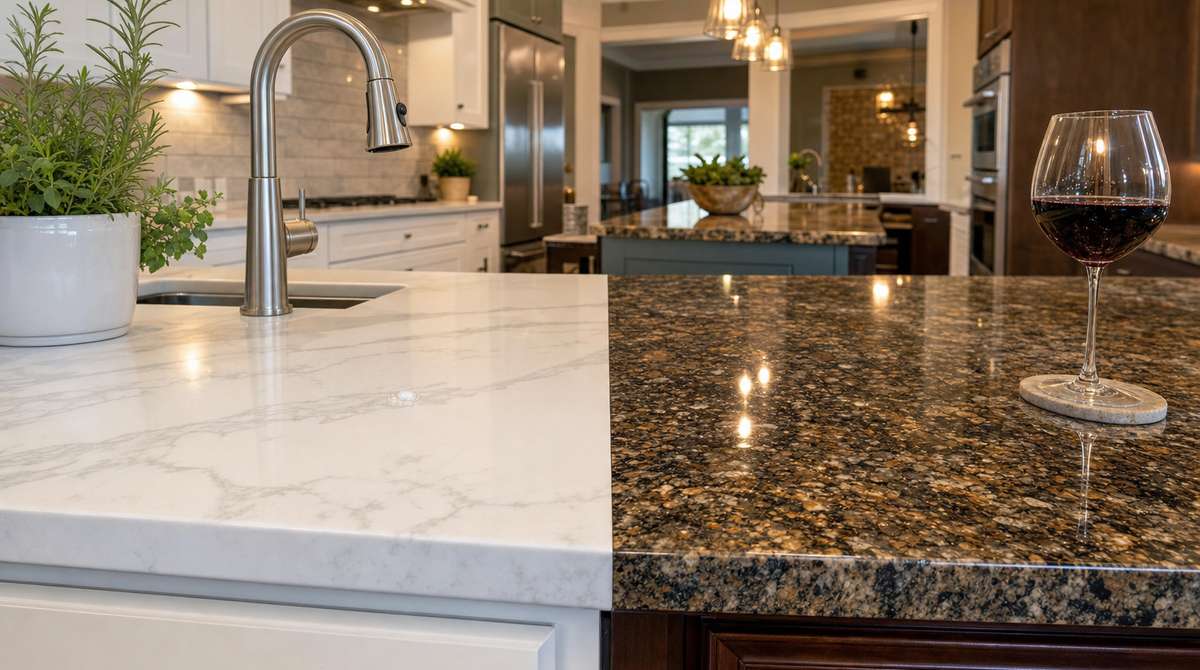
The quartz vs granite countertops Charlotte debate is the single most common material question we get during kitchen consultations, and the honest answer depends on how you actually cook, how much maintenance you want to do, and how long you plan to live with the result. We have installed thousands of square feet of both materials across Charlotte, Huntersville, Lake Wylie, and Fort Mill kitchens, and the trade-offs that matter on Pinterest are not the trade-offs that matter on day three of a busy week. This is what we actually tell clients in 2026.
The Charlotte countertop market has shifted notably since 2020. Quartz has moved from a premium upcharge to the default choice in most mid-range remodels, while natural granite has carved out a defended niche at both the budget end and the high-luxury end. Both materials still belong in Charlotte kitchens — the question is which one belongs in yours.
Quartz vs granite countertops Charlotte: what each material actually is
Before we get into durability and cost, it helps to know what you are actually buying. The two materials look similar on a Houzz board but are completely different products with different supply chains, different fabrication realities, and different long-term behavior.
Engineered quartz
Quartz countertops are roughly 90 to 94 percent ground natural quartz crystals bound with polyester resin and pigments, cast into slabs. Major Charlotte-area brands you will see quoted on real bids include Cambria, Silestone, Caesarstone, MSI Q, Pental, and Vicostone. Slabs are non-porous from the factory, color and pattern are highly consistent slab-to-slab, and seams are usually less visible than in natural stone.
Natural granite
Granite is exactly what it sounds like — igneous rock quarried and cut into slabs, then polished or honed. Every slab is one-of-one. Charlotte fabricators source primarily from Brazil, India, and a smaller volume from domestic quarries in Georgia and the Carolinas. Granite is porous to varying degrees depending on the specific stone and must be sealed at installation and resealed periodically.
Why the difference matters
Quartz is a manufactured product engineered for consistency. Granite is a natural product with personality. On a real Charlotte kitchen remodel that lives through 15 years of family use, those two starting points produce different outcomes — not better or worse, just different. Our installed work on the kitchen remodels service line includes both materials specified to match how the client actually lives.
- Quartz: 90-94% ground quartz bound with resin, non-porous, factory-consistent color
- Granite: natural quarried igneous rock, porous, one-of-one slab character
- Quartz is engineered for predictability; granite is natural and individual
- Both materials belong in 2026 Charlotte kitchens — the use case dictates the pick
Durability in real Charlotte kitchens
This is where the quartz vs granite countertops Charlotte conversation gets interesting, because the marketing on both sides oversells. Quartz is not indestructible. Granite is not high-maintenance. Here is what we actually see across our installed base in Mecklenburg and York County.
Scratch resistance
Granite is slightly harder than quartz on the Mohs scale (around 6-7 versus 7 for the quartz mineral content, but the resin binder in engineered quartz lowers effective hardness). In practice, both materials resist normal kitchen knives easily. Drag a ceramic knife or unglazed pottery across either surface and you will mar both. Use cutting boards regardless of material — not because the counter cannot take it, but because your knife edge needs the wood or poly.
Heat resistance
This one is decisive: granite handles heat dramatically better than quartz. A hot cast-iron pan straight from a 450-degree oven onto a granite counter is generally fine. The same pan on quartz can scorch, discolor, or thermal-shock the resin binder, leaving a permanent white mark. We have replaced more than a few Charlotte quartz slabs from heat damage over the years and zero granite slabs for the same reason. The Natural Stone Institute documents the same thermal-tolerance gap between natural stone and engineered surfaces. If you cook on cast iron daily, this matters.
Stain resistance
Quartz wins here in everyday use. Coffee, wine, oil, and turmeric clean off quartz with soap and water. On unsealed or under-sealed granite, the same spills can absorb into the stone and leave shadows. Properly sealed granite resists most stains, but the seal needs renewal every 1 to 3 years depending on the stone.
Chip and crack resistance
Edges chip on both materials when you slam a heavy pot or cast-iron skillet against them. Quartz repairs are easier because the resin matrix can be filled with color-matched epoxy that disappears better than the patches on natural stone. Granite chips show because the grain pattern is impossible to perfectly match.
- Scratch resistance: roughly even — use cutting boards on either
- Heat resistance: granite wins clearly, especially for cast-iron cooks
- Stain resistance: quartz wins in daily use; sealed granite is close behind
- Chip repairs: quartz hides better than granite due to resin matrix forgiveness
Real Charlotte pricing in 2026
Countertop pricing in Charlotte has stabilized after the 2021-2023 swings. Here are the typical installed ranges we are quoting on real Charlotte and York County jobs as of 2026 — not promotional starter prices, the all-in number after templating, fabrication, edge profile, undermount sink cutout, faucet holes, delivery, and installation.
Quartz installed pricing
Builder-grade entry quartz (basic white solids, simple patterns from MSI or Pental): $58 to $75 per square foot installed. Mid-range branded quartz (most Silestone, Caesarstone standard colors, Cambria entry tier): $80 to $115 per square foot installed. High-end designer quartz (Cambria premium, exotic patterns, marble-look slabs): $120 to $180+ per square foot installed.
Granite installed pricing
Budget granite (level 1 stones, common colors like Uba Tuba, Santa Cecilia, New Venetian Gold): $48 to $68 per square foot installed. Mid-range granite (level 2-3 stones, more dramatic patterns, exotic edges): $75 to $115 per square foot installed. Exotic granite (level 4-7 slabs, rare quarries, book-matched seams): $130 to $250+ per square foot installed.
What the typical Charlotte kitchen actually spends
A typical 45 square foot Charlotte kitchen countertop install (perimeter plus island) runs $3,400 to $5,200 for mid-range quartz or $3,600 to $5,100 for mid-range granite. Materials at the mid-range are nearly priced even — the bigger swing is at the budget end (granite cheaper) and high end (granite uncapped). Our pre-construction budget estimating walks both options on every kitchen remodel.
- Builder-grade quartz: $58-75/sf installed; budget granite: $48-68/sf installed (granite wins)
- Mid-range quartz: $80-115/sf; mid-range granite: $75-115/sf (effectively a tie)
- High-end quartz: $120-180+/sf; exotic granite: $130-250+/sf (granite can go higher)
- Typical 45 sf Charlotte kitchen: $3,400-5,200 mid-range either material
Maintenance reality across 10 years of ownership
Brochure copy makes both materials sound effortless. Real Charlotte households tell a more honest story — what each material actually demands across a decade.
Quartz: very low ongoing maintenance
Daily care is soap and water. No sealing ever. No pH-balanced cleaners required. The two real risks are heat damage (which is preventable with trivets) and UV exposure on outdoor or sun-flooded counters, which can yellow some quartz colors over 10+ years. For interior Charlotte kitchens, neither risk is a serious issue.
Granite: moderate ongoing maintenance
Daily care is also soap and water, but you reseal every 1 to 3 years — a simple wipe-on, wipe-off product available at any home center. The seal renewal takes 30 minutes for a typical kitchen. Some homeowners genuinely forget and the stone is fine for a few extra months; others stay on top of it. If a 30-minute biennial chore feels overwhelming, lean toward quartz.
The honest 10-year picture
We have walked back into Charlotte kitchens we installed 10+ years ago. Properly cared-for quartz still looks roughly like the day we set it. Properly cared-for granite has often developed a tiny bit of patina around the heaviest-use zones but is otherwise indistinguishable from new. Both materials are 15-30+ year products with normal care. The failures we see are almost always heat damage to quartz or neglect-driven stains in granite — both preventable.
- Quartz: soap and water daily, no sealing ever, watch for heat damage
- Granite: soap and water daily, reseal every 1-3 years (30-minute job)
- Both materials are 15-30+ year products with normal care
- Most failures are user error — heat on quartz or skipped sealing on granite
Resale value in the Charlotte market
The quartz vs granite countertops Charlotte resale conversation has flipped in the last 5 years. Through about 2018, granite was the resale-safe pick and quartz was a “trend” buyers occasionally questioned. By 2026, the picture has reversed for most price points.
Under $700K homes
Buyers strongly prefer quartz. White, gray, or marble-look quartz reads as modern and move-in ready. Dated, busy granite (especially the gold-and-brown level-1 stones popular in 2005-2010 builds) actively suppresses offers. We have seen Charlotte and Fort Mill kitchens where simply replacing dated granite with a clean white quartz drove 1 to 3 percent sale-price lift on otherwise unchanged listings.
$700K to $1.5M homes
Quartz still wins on velocity, but high-quality granite (level 3+ in current-trending palettes like leathered black, white-on-white, or soft veined patterns) holds value comparably. Buyer preference is more individual at this tier, especially in Myers Park, Eastover, and SouthPark.
$1.5M+ luxury homes
Here the conversation flips again. Genuine exotic granite, marble, or quartzite (a different natural stone, not to be confused with quartz) signals authenticity and craftsmanship. Engineered quartz at this tier reads as a builder-grade compromise. Our Charlotte luxury custom home builds usually specify natural stone at the primary kitchen.
- Under $700K: quartz strongly preferred, dated granite suppresses offers
- $700K-1.5M: quartz wins velocity, high-quality current-palette granite holds value
- $1.5M+: exotic natural stone signals authenticity, engineered quartz reads down-market
- The “granite is always safe for resale” rule no longer holds in 2026 Charlotte
Decision framework for your specific Charlotte kitchen
After more than 30 years of residential construction across the Charlotte region, we have boiled the choice down to four honest questions. Answer these and the material almost picks itself.
Question 1: do you cook on cast iron or with frequent hot pans?
If yes — daily searing, baking, frying, or anyone who routinely sets a hot pan on the counter — granite is the safer pick. Quartz heat damage is the single most common failure we see, and trivets do not always make it across the kitchen.
Question 2: how disciplined are you on maintenance?
If you struggle to remember scheduled household tasks, quartz removes the sealing chore entirely. If a 30-minute biennial reseal is no problem, that takes granite off the maintenance penalty list.
Question 3: when do you plan to sell?
Selling within 5 years and your home is under $700K? Quartz almost certainly improves resale and time-on-market. Selling in a $1.5M+ home? Natural stone better matches buyer expectations. Common remodel mistakes include over-spec’ing exotic stone in a sub-$700K Charlotte home where it does not return.
Question 4: do you want personality or predictability?
Genuine taste preference matters. Some clients walk into a granite yard, find one specific slab, and fall in love. Others want exact pattern consistency from sample to install. Trust the response — you will live with this counter for a decade. The custom home build process always includes a slab-yard visit before final material lock.
- Cast-iron cook? Lean granite
- Maintenance-averse? Lean quartz
- Selling soon in under-$700K home? Lean quartz
- Want individual character vs predictable pattern? Trust your gut at the slab yard
Charlotte fabrication and installation realities
The slab is half the story — the fabricator is the other half. Charlotte has a healthy mix of established fabricators and pop-ups. The licensing reality matters: any countertop install bundled into a residential remodel over $30,000 in North Carolina falls under the North Carolina Licensing Board for General Contractors requirement for a licensed GC running the project. SC has parallel rules through LLR over $5,000. A standalone countertop swap below those thresholds can be done by a licensed fabricator without a GC.
What good Charlotte fabrication looks like
Field templating with a digital templater (not paper templates) is the 2026 standard — it produces seam locations and edge cuts within 1/16 inch. Seams should be placed at logical breaks (behind sinks, at corners) and color-matched at install. Cooktop and sink cutouts should be reinforced with steel or fiberglass rodding under the slab to prevent stress fractures. Edge profiles should be polished to factory finish, not just chamfered.
Lead times and seasonal pressure
Charlotte countertop lead times in 2026 typically run 2 to 4 weeks from slab selection to install for in-stock domestic materials. Imported exotics can push 6 to 10 weeks. Spring and early fall are the busiest seasons — plan slab selection 4 to 6 weeks ahead of your target install date for any March-May or August-October project.
- NC GC license required on any remodel over $30K; SC LLR over $5K
- Digital templating is the 2026 standard — 1/16-inch precision
- Cutouts should be reinforced with steel or fiberglass rodding
- 2-4 week typical lead time, 6-10 weeks for imported exotic stone
Frequently asked questions
Is quartz or granite better for resale in Charlotte?
Under $700K, quartz wins clearly in 2026. Between $700K and $1.5M, both materials hold value if specified in current-palette colors. Over $1.5M, exotic natural stone (granite or quartzite) signals authenticity better than engineered quartz.
How often do granite countertops need to be sealed in Charlotte?
Every 1 to 3 years for most Charlotte granite kitchens. The exact interval depends on the stone’s porosity and how heavily you use it. A simple water-bead test (water beads up = seal intact; water absorbs = time to reseal) tells you when. Resealing takes about 30 minutes and uses an over-the-counter penetrating sealer.
Can you put hot pans on quartz countertops?
You can briefly, but you should not. Sustained heat above 300 degrees Fahrenheit can scorch quartz, discolor it permanently, or thermal-shock the resin binder and cause cracking. We have seen Charlotte clients lose entire slabs to a cast-iron pan set down for 20 seconds. Always use trivets.
What is the most popular quartz color in Charlotte kitchens right now?
Soft veined white-and-gray patterns (calacatta-look) dominated 2024-2025 and remain the top seller in 2026 Charlotte kitchens. Pure white solids are the strong second. Charcoal and deep-veined dramatic patterns are growing in luxury custom builds and entertainment kitchens.
Talk through your specific Charlotte kitchen with us
The quartz vs granite countertops Charlotte choice deserves more than a sales pitch — it deserves a real conversation about how you cook, how long you will live with the result, and what makes financial sense for your specific home. Call us at (704) 619-6293 or reach us through our contact page. We will walk slab options at the Charlotte-area yards we trust, quote real installed pricing for your actual square footage, and tell you which material we would put in our own kitchen if we were cooking the way you cook.