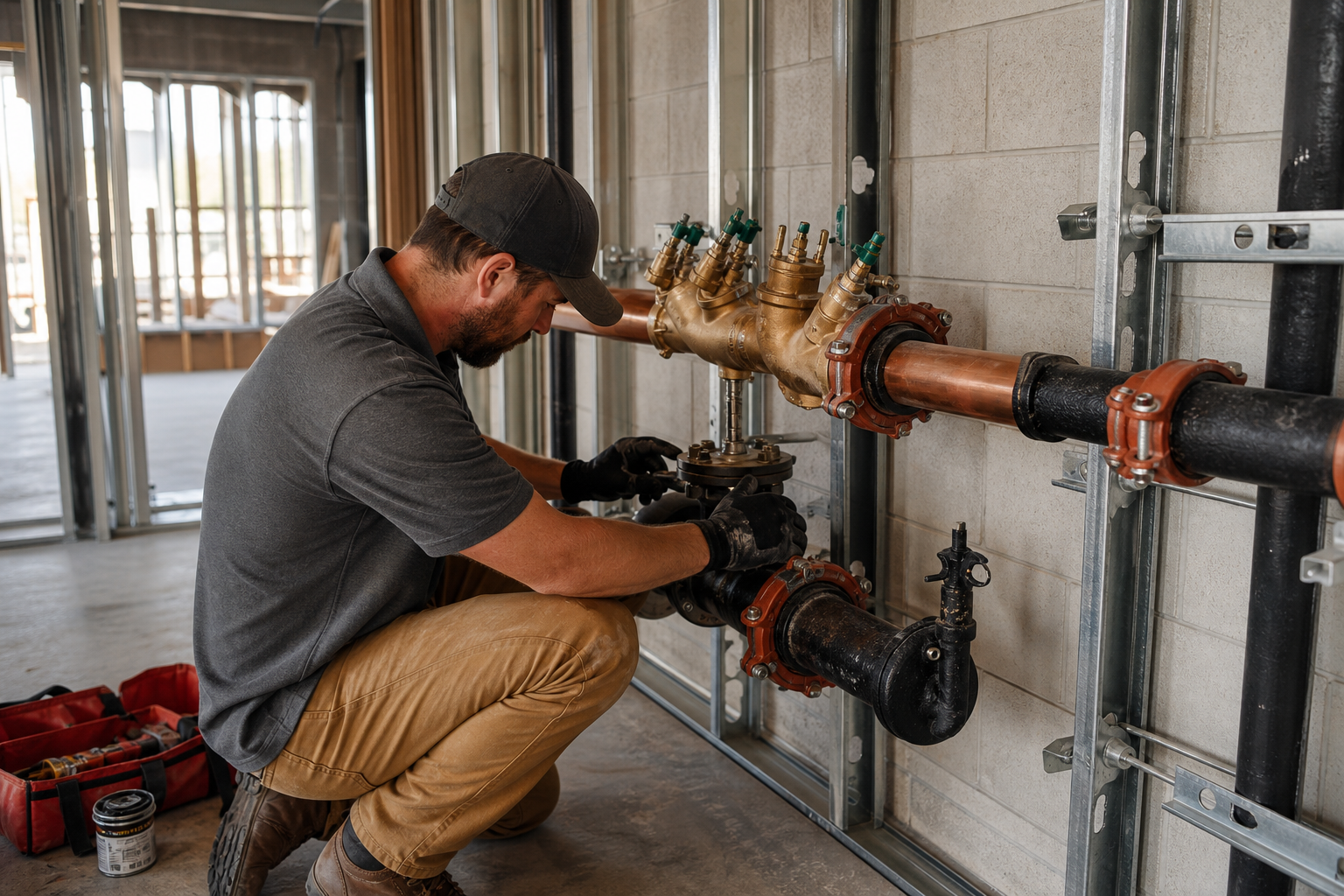
Backflow prevention scope should enter commercial utility planning at the earliest coordination stage, ideally when the project team is still confirming water service size, meter location, and fixture counts, rather than after plumbing drawings are finalized. Charlotte Water treats backflow devices as part of the connection and cross-connection control process tied to the commercial water service, so the assembly type, location, and testing pathway are decisions that affect utility coordination, site plan review, and interior plumbing layout at the same time. Waiting until construction documents are complete often forces rework on meter room sizing, wall penetrations, or equipment clearances.
This article summarizes what Charlotte Water publishes on its Backflow Construction and New Connection Installations pages and translates that into a general coordination workflow for owners and project teams. It does not determine whether a specific address, tenant space, or fixture type requires a particular backflow assembly, testing frequency, or connection process. Every project must confirm current requirements directly with Charlotte Water and any other authority having jurisdiction before design or construction proceeds, because published requirements can change and site-specific conditions vary.
What Current Public Sources Establish
Charlotte Water maintains two pages that are directly relevant to a commercial upfit involving new or modified water service: Backflow Construction and New Connection Installations. The Backflow Construction page addresses cross-connection control and the construction-related steps tied to installing or modifying a backflow prevention assembly on a commercial water service. The New Connection Installations page addresses the process for establishing a new water service connection, which is a common trigger point for backflow review on commercial projects.
Both pages are published and maintained by Charlotte Water, and both are subject to change as the utility updates its procedures, forms, or technical standards. This article treats those two pages as the factual floor for anything stated about Charlotte Water process or terminology. Any detail not found on those pages, including specific device types, specific fees, specific inspection sequencing, or specific timelines, is outside the scope of what this article can responsibly state, and readers should not assume a general workflow description substitutes for the current published requirement.
- Charlotte Water publishes a dedicated Backflow Construction resource covering cross-connection control construction steps for commercial water service.
- Charlotte Water publishes a separate New Connection Installations resource covering the process for establishing new commercial water service connections.
- Both resources can be updated by Charlotte Water at any time, so the version referenced during early planning may not match the version in effect at permitting or construction.
- Neither resource is a substitute for a project-specific determination made by Charlotte Water or another authority having jurisdiction for a particular address and scope of work.
Inputs and Existing Conditions to Document
Before backflow scope can be meaningfully coordinated, the project team generally needs a clear picture of the existing water service conditions at the tenant space or building, along with the proposed use. This includes confirming whether the space already has an active commercial water connection, what size that service is, where the meter and any existing backflow assembly are physically located, and whether the proposed upfit changes water use in a way that could affect the existing connection or assembly.
Documentation gathered at this stage typically supports later conversations with Charlotte Water and with the design team, so it is worth treating this as a discrete planning task rather than something to reconstruct later. Missing or incomplete existing-conditions information is one of the more common reasons early utility coordination stalls, because the project team ends up guessing at conditions that could otherwise have been confirmed with a site visit, as-built drawings, or a direct inquiry to the utility.
- Confirm whether the tenant space or building has an existing commercial water service and, if so, its approximate size and meter location.
- Locate any existing backflow prevention assembly on site and note its apparent condition, accessibility, and any visible tagging or testing information.
- Document the proposed water-using fixtures, equipment, or processes planned for the upfit, since a change in use can affect what the utility requires.
- Identify whether the project involves a new connection, a modification to an existing connection, or no change to the water service at all.
- Note any available as-built plumbing or utility drawings for the building, since these can shorten the time needed to confirm existing conditions.
Step-by-Step Owner and Project-Team Review
A practical review sequence starts with identifying the utility scope questions before architectural or plumbing drawings are locked in. Once the general water service picture is documented, the owner and design team can raise backflow-specific questions directly with Charlotte Water using the Backflow Construction and New Connection Installations resources as a starting reference point, rather than assuming an answer based on a different project or a different jurisdiction.
From there, the review typically moves into design coordination, where the mechanical or plumbing designer incorporates whatever Charlotte Water confirms into the tenant space layout, and then into a verification step before construction documents are finalized. Each of these steps benefits from being treated as a checkpoint rather than a single conversation, since utility responses, site conditions, and design decisions can all shift slightly as the project develops.
- Step one: document existing water service conditions and proposed water use for the tenant space.
- Step two: review the Charlotte Water Backflow Construction and New Connection Installations pages as a starting reference.
- Step three: contact Charlotte Water directly to raise project-specific questions about backflow requirements for the address and scope involved.
- Step four: incorporate whatever Charlotte Water confirms into the plumbing and mechanical design before construction documents are finalized.
- Step five: revisit the confirmation if the scope of work changes significantly, since a change in use or connection size can change the applicable requirement.
Responsibilities, Dependencies, and Hold Points
Backflow coordination on a commercial upfit typically involves several parties whose responsibilities intersect. The owner or tenant generally initiates the utility inquiry and provides the underlying facts about the space and its intended use. The design team, including any licensed engineer or plumbing designer, is generally responsible for translating whatever the utility confirms into compliant construction documents. Charlotte Water is the authority that determines what applies to a given connection and use.
Because these responsibilities depend on each other, certain points in the schedule function as natural hold points, meaning the project should not move forward past that point until the relevant confirmation is in hand. Treating these as informal checkpoints, even on a fast-moving upfit, tends to reduce the chance that construction proceeds on an assumption that later turns out to be incorrect.
- The owner or tenant is generally responsible for initiating contact with Charlotte Water and supplying accurate facts about the space and proposed use.
- The design professional is generally responsible for incorporating confirmed utility requirements into plumbing and mechanical construction documents.
- Charlotte Water is the party that determines applicable backflow and connection requirements for a specific address and scope.
- A natural hold point exists before construction documents are finalized, since backflow assembly type and location can affect equipment room sizing.
- A natural hold point exists before ordering long-lead plumbing equipment, since equipment selection may depend on confirmed backflow requirements.
Common Coordination Failures
Several recurring patterns show up when backflow scope is not integrated early into commercial utility planning. One is treating backflow as a plumbing subcontractor detail to be resolved during construction rather than a utility coordination item that belongs in early design. Another is assuming that a previous tenant's water service configuration remains valid for a new use, when a change in occupancy or fixture count can change what applies.
A third recurring pattern is relying on informal or secondhand information about Charlotte Water requirements instead of confirming directly with the utility using its current published resources. Because requirements and procedures can be updated, information that was accurate on a prior project may not reflect the current published guidance. Building in time for direct confirmation, even when the project timeline feels tight, tends to prevent more significant delays later in construction.
- Deferring backflow scope discussion until plumbing rough-in, after design decisions have already limited the available equipment room space.
- Assuming an existing backflow assembly or connection configuration remains adequate without confirming it against the proposed new use.
- Relying on secondhand or outdated information about Charlotte Water requirements rather than checking current published resources.
- Failing to document existing conditions early, which forces the project team to reconstruct information later under schedule pressure.
- Treating utility confirmation as optional on a small tenant upfit, when a change in use can still trigger a review regardless of project size.
Questions for the Responsible Authority or Qualified Professional
Because this article is limited to describing a coordination workflow rather than making a project-specific determination, the questions below are intended to help owners and project teams prepare for a direct conversation with Charlotte Water or a qualified design professional. These are not answers, and they should not be treated as a substitute for the response Charlotte Water or a licensed professional provides for a specific address and scope of work.
Bringing a written list of questions to that conversation, along with the existing-conditions documentation described earlier, tends to make the exchange more efficient and reduces the chance of a follow-up round of questions after design work has already progressed.
- Does the proposed tenant space have an active commercial water connection, and does the proposed use change how that connection is classified?
- Is a backflow prevention assembly currently installed at this location, and does the current published guidance affect whether it remains adequate for the new use?
- What information does Charlotte Water need from the owner or design team to make a determination for this specific address and scope of work?
- Are there other authorities, such as county health or fire code officials, whose review also affects backflow or connection decisions for this project?
- What is the current process, according to Charlotte Water's published resources, for confirming requirements before construction documents are finalized?
Next Action and Related CDG Service Resource
For an owner planning a Charlotte commercial upfit, the practical next action is to gather existing-conditions documentation early and reach out to Charlotte Water using its Backflow Construction and New Connection Installations pages as the starting reference, well before construction documents are finalized. This sequencing does not remove the need for a project-specific determination, but it does reduce the likelihood that backflow coordination becomes a late-stage surprise that affects equipment room layout or construction scheduling.
Cooper Development Group works with owners on commercial construction planning across the Charlotte region, including coordination tasks that intersect with utility and cross-connection requirements. Readers working on a project outside Charlotte, including in the Lake Wylie, SC area, can review related commercial construction planning information, and readers can also browse general project planning topics on the CDG blog or reach out through the consultation page to discuss a specific upfit.
- Gather existing water service and fixture documentation before contacting Charlotte Water about a commercial upfit.
- Use the Backflow Construction and New Connection Installations pages as the starting reference point for questions to Charlotte Water.
- Confirm requirements directly with Charlotte Water before finalizing plumbing and mechanical construction documents.
- Review related commercial construction planning information for other service areas, such as Lake Wylie, SC, when applicable.
- Visit the CDG blog for additional planning topics, or use the consultation page to discuss a specific project scope.
Questions homeowners ask
When should backflow scope be integrated into commercial utility planning for a Charlotte upfit?
Backflow scope should be raised as early as possible, generally while the project team is still confirming water service size, meter location, and proposed fixture counts, rather than waiting until plumbing drawings are finalized. Early coordination with Charlotte Water using its published Backflow Construction and New Connection Installations resources tends to reduce the chance of late-stage design changes, though the specific requirement for any address and scope must still be confirmed directly with Charlotte Water.
Does this article state whether a specific Charlotte commercial upfit backflow assembly is required for my project?
No. This article describes a general coordination workflow based on what Charlotte Water publishes and does not make a project-specific determination. Whether a particular tenant space, connection, or use requires a specific backflow prevention assembly, and what type, is a determination that Charlotte Water or another authority having jurisdiction must make based on the actual address and scope of work.
Who should confirm Charlotte commercial upfit backflow requirements before construction begins?
Charlotte Water is the authority that determines applicable backflow and connection requirements for a specific commercial water service in Charlotte. Owners and design teams should contact Charlotte Water directly, using its current published Backflow Construction and New Connection Installations pages as a starting reference, and should also involve any other applicable authority having jurisdiction before finalizing construction documents.
What should an owner gather before contacting Charlotte Water about backflow coordination?
It is generally useful to document the existing water service size and meter location, note whether a backflow assembly already exists on site, describe the proposed water-using fixtures or equipment for the upfit, and clarify whether the project involves a new connection or a modification to an existing one. Having this information ready tends to make the conversation with Charlotte Water more efficient, though the utility may request additional project-specific information.
Plan the next step
Use this article as a planning aid, then confirm project-specific requirements with the responsible authority and qualified professionals. Review CDG's related service, construction articles, or consultation page when you are ready to organize the next decision.
Official sources and verification
Authority pages, forms, fees, review steps, and code references can change. Verify the current path for the property and scope before relying on a planning assumption.