
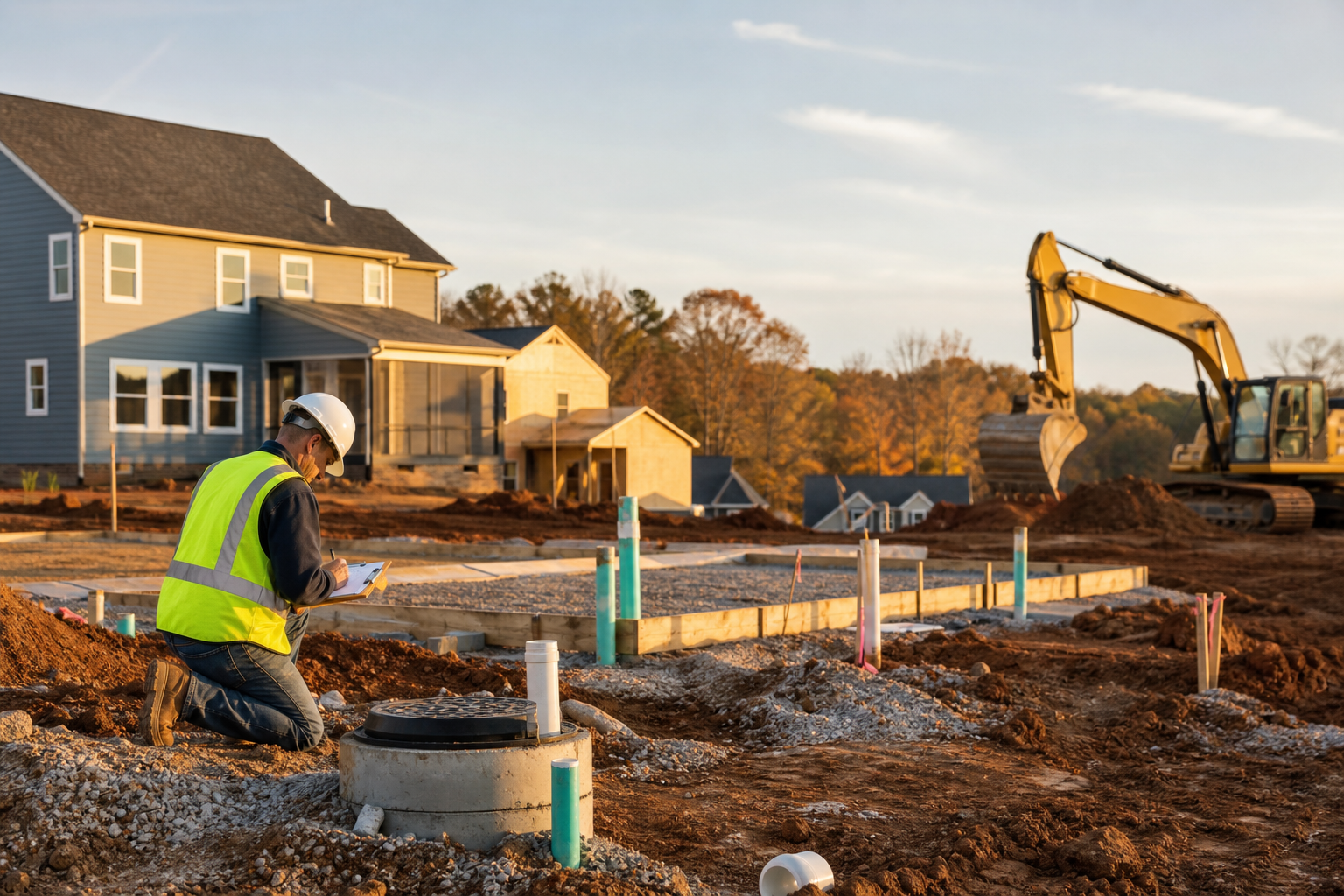
Capacity questions belong in the very first feasibility conversation, before a site plan is drawn or a purchase contract is finalized, because Charlotte Water's capacity assurance review can affect whether a parcel can support the intended use at all. Owners who wait until permitting or civil design is underway often discover that capacity, easement, or connection questions require rework that a earlier inquiry could have surfaced.
The information in this article reflects what Charlotte Water publishes on its Capacity Assurance Program and New Connection Installations pages as of this writing. Charlotte Water's programs, forms, and review steps can change, and this article does not restate every technical detail found on those pages. Property owners and design teams must confirm the current process, required submittals, and timing directly with Charlotte Water and any other authority having jurisdiction before relying on any planning assumption.
What Charlotte Water's Current Public Sources Establish
Charlotte Water maintains two relevant public pages that owners and project teams should review directly rather than relying on summaries. The Capacity Assurance Program page, found under Charlotte Water's Commercial Development and Commercial Customer Services sections, addresses how the utility evaluates capacity for commercial development activity. The New Connection Installations page addresses the separate process of physically connecting a property to Charlotte Water infrastructure.
These two pages are the factual floor for this article. Nothing here should be read as a paraphrase of every requirement, form, fee, or review step Charlotte Water currently publishes. Requirements, contact points, and submittal expectations can change, and Charlotte Water is the only authoritative source for the current version of its own program. Anyone using this article to plan a project should open both pages, read them in full, and note the date they were last reviewed.
- The Capacity Assurance Program page sits within Charlotte Water's Commercial Development section, indicating its relevance to commercial and likely mixed-use projects.
- The New Connection Installations page is presented as a distinct topic, suggesting capacity assurance and physical connection are separate steps with separate expectations.
- Both pages are maintained by Charlotte Water and are subject to change without notice to third-party publishers.
Why Capacity Belongs in the Feasibility Conversation, Not the Permitting Conversation
Many development timelines treat utility coordination as a permitting-stage task, something a civil engineer handles after the site plan is largely settled. Capacity assurance does not fit that sequence well. Because it speaks to whether the water and sewer system can support a proposed development, it is closer to a feasibility question than a construction-document question. An owner evaluating a parcel benefits from knowing early whether capacity concerns exist, even in general terms, so that site selection, use programming, and phasing decisions can account for that information.
This does not mean every capacity question can be fully answered before a site is under contract. Some information may only become available once a project has enough definition for Charlotte Water to review it meaningfully. The practical point is one of sequencing: raise the question as soon as a project has enough shape to describe (proposed use, approximate size, general location) rather than waiting until architectural or civil drawings are complete.
- Feasibility-stage capacity questions can inform site selection before significant design investment occurs.
- Waiting until permitting to ask about capacity risks discovering constraints after budgets and schedules are already set.
- Charlotte Water's own page structure, separating capacity assurance from new connection installation, suggests these are sequential considerations rather than a single combined step.
Existing Conditions and Inputs Owners Should Document Early
Before any conversation with Charlotte Water or a design professional about capacity, it helps to have a clear, honest description of the project as it currently stands. This is not a technical submittal; it is groundwork so that the eventual technical review is based on accurate information rather than assumptions.
Owners should be able to describe the parcel's location, current zoning or land use designation, the general nature of the proposed development, and any known existing utility infrastructure on or near the site. Documentation such as a current survey, any prior utility correspondence, and a description of existing structures or connections (if the parcel is not vacant) all help a design professional or Charlotte Water representative orient the conversation.
- A current or recent survey showing property boundaries and any known utility easements.
- A general description of the proposed use, scale, and any anticipated water or sewer demand characteristics.
- Records of any prior communication with Charlotte Water or other utilities about this parcel.
- Notes on existing structures, wells, septic systems, or connections already present on the site.
A Step-by-Step Owner and Project-Team Review Sequence
The sequence below is offered as practical planning guidance from Cooper Development Group, grounded in the structure of Charlotte Water's published pages. It is not a restatement of Charlotte Water's official process, and it does not replace direct confirmation with Charlotte Water. Every step that touches a regulatory decision should be verified with the authority having jurisdiction before an owner relies on it.
Treat this as a starting checklist for internal planning discussions, not a substitute for Charlotte Water's own guidance.
- Identify whether the project is likely to fall under Charlotte Water's commercial development category based on its published Capacity Assurance Program page, and note this early in feasibility notes.
- Gather the existing-conditions documentation described above before any formal inquiry is made.
- Review both the Capacity Assurance Program page and the New Connection Installations page in full, since they appear to address related but distinct steps.
- Identify which licensed professional, typically a civil engineer, will lead technical communication with Charlotte Water and confirm their familiarity with current program requirements.
- Raise capacity questions with Charlotte Water or the design professional as soon as the project has enough definition to describe, rather than after site plans are finalized.
- Document any responses, reference numbers, or guidance received, and keep this record with other feasibility-stage project files.
- Revisit the capacity question again once the project design is more advanced, since early answers may be preliminary.
Responsibilities, Dependencies, and Hold Points
Utility coordination involves multiple parties, and it helps to be clear about who typically holds which piece of the process, while recognizing that Charlotte Water's current published materials are the authoritative source for any specific division of responsibility.
Owners generally hold responsibility for feasibility-level decisions: whether to pursue a site, how to program its use, and how much schedule contingency to build in around utility coordination. Design professionals, including civil engineers, typically handle the technical submittals and direct correspondence with Charlotte Water regarding capacity assurance and new connection installation. Charlotte Water itself holds the authority to review, respond to, and approve or deny requests related to its own infrastructure and programs.
- Owners: site selection, project programming, and overall schedule and budget decisions that account for utility coordination as one input among several.
- Design professionals: preparing and submitting technical information to Charlotte Water and interpreting the utility's guidance for the specific project.
- Charlotte Water: reviewing submittals, applying its current Capacity Assurance Program and connection processes, and communicating requirements or decisions.
- A useful hold point is any moment when a project moves from concept to committed design; capacity questions should ideally be addressed, at least preliminarily, before that transition.
Common Coordination Failures to Avoid
Several recurring patterns can create friction later in a project, even though none of them involve Charlotte Water's process itself being unclear. Most stem from timing or communication gaps on the project side.
Recognizing these patterns early allows an owner to build a more resilient feasibility review rather than reacting to a problem after design work is complete.
- Assuming capacity is available because a similar project nearby was built successfully in the past, without confirming current conditions.
- Delaying any contact with Charlotte Water until civil drawings are far along, which can compress the time available to respond to any capacity-related feedback.
- Treating capacity assurance and new connection installation as a single combined step rather than reviewing both published pages separately.
- Failing to document early communications with Charlotte Water, which can make it harder to track what was asked and what was answered as a project evolves.
- Not designating a single point of contact on the project team responsible for utility coordination, leading to fragmented or duplicated inquiries.
Questions to Bring to Charlotte Water or a Qualified Professional
Because this article cannot restate every detail of Charlotte Water's current program, the most useful next step for many owners is a focused list of questions to raise directly with Charlocotte Water or with a qualified civil engineer familiar with the utility's current process.
These questions are offered as a starting point for that conversation, not as a checklist that Cooper Development Group can answer on Charlotte Water's behalf.
- Does this project's proposed use and scale place it within the current scope of Charlotte Water's Capacity Assurance Program?
- What documentation does Charlotte Water currently require to begin a capacity review for a project at this stage of definition?
- How does the capacity assurance review relate to the new connection installation process for this specific parcel?
- Are there known capacity constraints in this area of Charlotte Water's service territory that could affect a project at this general location?
- What is the current best practice, according to Charlotte Water, for the timing of a capacity inquiry relative to site plan submittal?
Next Steps for Owners Evaluating a Site
Capacity assurance is one piece of a broader pre-construction planning conversation that also touches zoning, site infrastructure, and overall project feasibility. Owners working through these questions on a parcel served by Charlotte Water should start with the utility's own published pages, then bring a documented feasibility picture to a qualified civil engineer or other design professional for interpretation.
For owners working on infrastructure and building systems questions in the broader Lake Wylie, South Carolina area, Cooper Development Group's related resource page offers additional planning context, and the CDG blog covers related pre-construction planning topics as they are published. Owners who want to talk through where capacity assurance fits into their specific project's feasibility timeline are welcome to reach out through the CDG consultation page to discuss general planning sequencing; property-specific capacity, code, and connection decisions remain the responsibility of Charlotte Water and the appropriate licensed professionals.
- Review Charlotte Water's Capacity Assurance Program and New Connection Installations pages directly before making feasibility assumptions.
- Build a documented existing-conditions file early so any future technical review starts from accurate information.
- Bring capacity questions into the feasibility conversation as soon as a project has enough definition to describe.
- Use the CDG infrastructure and building systems resource for Lake Wylie, SC, and the CDG blog for related pre-construction planning topics.
- Confirm every property-specific requirement with Charlotte Water or the authority having jurisdiction before finalizing project decisions.
Questions homeowners ask
When should Charlotte Water capacity assurance first come up in a project?
It belongs in the earliest feasibility discussion, ideally before a site is under firm contract or before civil design work begins. Charlotte Water's published Capacity Assurance Program materials describe this as a step tied to commercial development activity, so owners considering any nonresidential or mixed-use project should review the current program page and, where appropriate, contact Charlotte Water before finalizing site selection or committing design budget.
Does a capacity assurance review replace the new connection installation process?
No. Charlotte Water publishes capacity assurance and new connection installation as related but distinct topics on separate pages. Capacity assurance concerns whether adequate system capacity exists to serve a proposed development, while new connection installation concerns the physical process of tapping into water and sewer infrastructure. Project teams should read both current pages and confirm with Charlotte Water how the two processes apply to a specific parcel and use.
Who is responsible for confirming capacity assurance requirements, the owner or the design team?
Responsibility is typically shared but the owner carries ultimate accountability for project feasibility decisions. Civil engineers, utility coordinators, and other licensed professionals usually handle technical submittals and direct communication with Charlotte Water, but owners should not assume capacity is available simply because a design has been drafted. Confirming current requirements with Charlotte Water and the responsible design professional is the only reliable path.
What happens if capacity questions are raised late in a project?
Charlotte Water's public pages do not describe project-specific outcomes, so this article cannot state what happens on any particular site. In general terms, raising infrastructure questions after design or permitting is underway can require revisiting decisions that were made without full information. The safest practice is to treat capacity assurance as an early input rather than a late confirmation step, and to verify current expectations directly with Charlotte Water.
Plan the next step
Use this article as a planning aid, then confirm project-specific requirements with the responsible authority and qualified professionals. Review CDG's related service, construction articles, or consultation page when you are ready to organize the next decision.
Official sources and verification
Authority pages, forms, fees, review steps, and code references can change. Verify the current path for the property and scope before relying on a planning assumption.