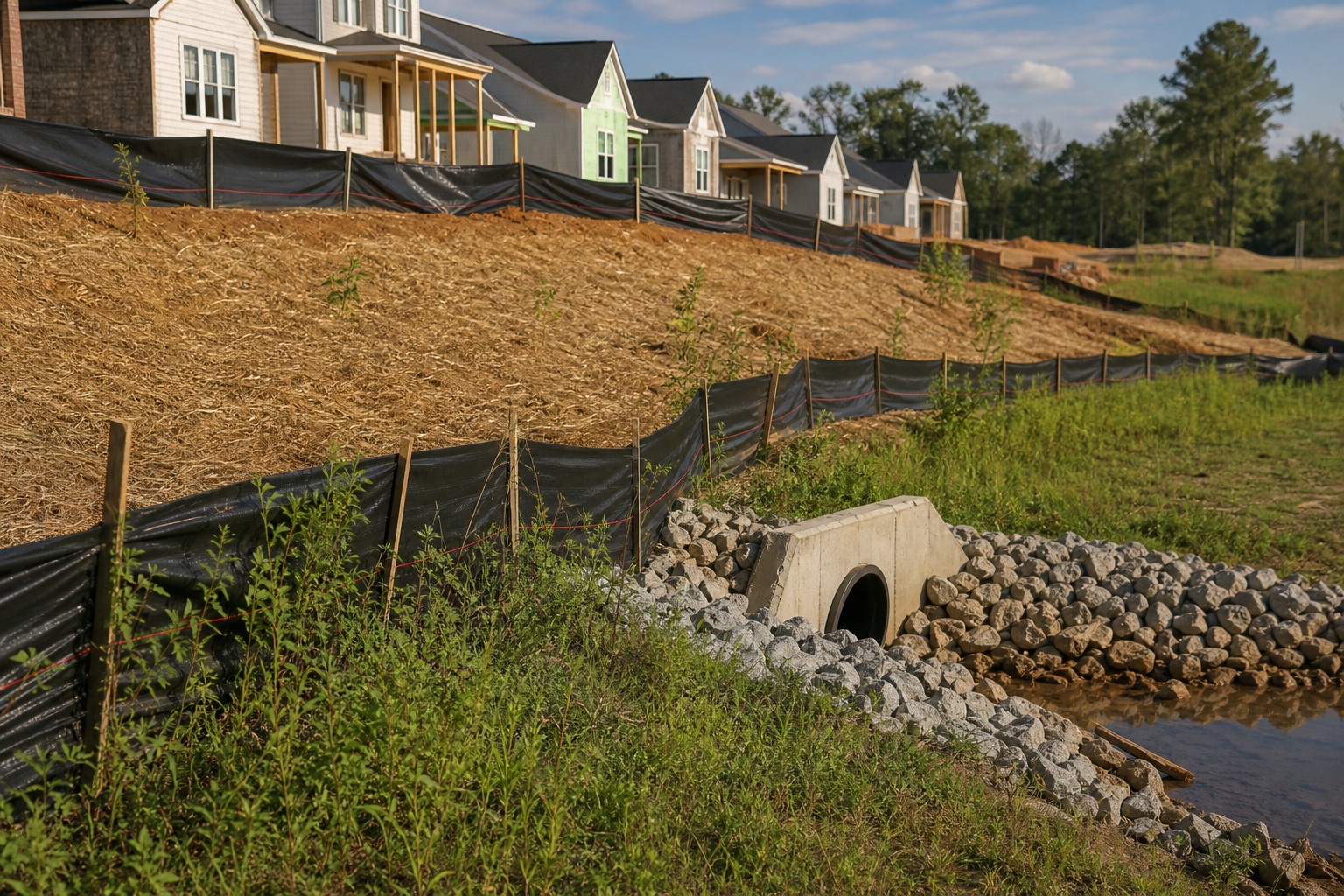
Runoff control responsibility on an active construction site is not fixed to one person. It shifts across the property owner, the general contractor, the site development team, and sometimes a designated inspector, depending on the project phase, the weather, and whether a control has already failed once. A workable approach treats construction runoff control responsibility as a schedule tied to specific triggers rather than a single name on a plan sheet, so that someone is always accountable for checking silt fence, inlet protection, and stabilized areas as conditions on the ground change.
This article uses York County, South Carolina's published Construction Site Runoff Control and Stormwater Plan Review pages as its factual floor. Those pages describe the county's general framework for reviewing stormwater plans and expectations for controlling runoff during construction, but they do not assign day-to-day inspection duties to a specific job title, and they do not set a universal repair timeline that applies to every site. Site-specific obligations, inspection frequency, and enforcement actions are determined by York County and any other authority having jurisdiction over a given parcel, and current requirements should always be verified directly with that authority before design or construction proceeds.
What Current Public Sources Establish
York County's Construction Site Runoff Control page and its Stormwater Plan Review page are the two primary sources this article relies on. Together they describe a county-level framework for reviewing stormwater plans before construction and for expecting runoff controls to be maintained while work is underway. They are administrative and regulatory pages published by the county, not a step-by-step field manual, and they do not name which party on a private project team is responsible for daily inspection or for repairing a failed control.
Because the pages are general in nature, they leave room for a project team to build its own internal responsibility schedule, as long as that schedule still satisfies whatever the county requires for a specific site. Readers should treat the county pages as the floor of what is publicly documented, and should not assume any additional detail, inspection frequency, or repair deadline beyond what is stated on those pages unless it is confirmed directly with York County or the applicable authority having jurisdiction.
- York County publishes a Construction Site Runoff Control page describing its general expectations for controlling runoff during construction.
- York County publishes a separate Stormwater Plan Review page describing how stormwater plans are reviewed before construction begins.
- Neither page substitutes for a project-specific determination made by the county or another authority having jurisdiction.
Inputs and Existing Conditions to Document
Before assigning any inspection or repair task, the project team needs a clear record of what conditions exist on the site right now. This includes the approved stormwater or erosion control plan, the location and type of every installed control such as silt fence, inlet protection, and stabilized construction entrances, and a baseline understanding of drainage patterns across the parcel. Without this documentation, it is difficult to tell whether a control has failed, moved, or simply needs routine maintenance.
Weather history also matters as an input. A record of recent and forecasted rainfall helps the team anticipate when controls are most likely to be stressed and when a follow-up inspection is warranted. Site conditions change constantly during construction, from grading that alters drainage paths to phased land disturbance that exposes new soil, so the documentation used at the start of a project should be treated as a living record that gets updated as work progresses rather than a one-time file that is filed away after permitting.
- Maintain a current copy of the approved plan alongside a map of installed controls and their condition.
- Track recent rainfall and forecasted weather so inspections can be timed around likely stress on controls.
- Update drainage and grading records as site work changes the path water takes across the property.
Step-by-Step Owner and Project-Team Review
A practical review process starts before construction begins and continues through final stabilization. In the early phase, the owner and design or planning team confirm that a stormwater or erosion control plan has been reviewed by the appropriate authority, consistent with the general process described on York County's Stormwater Plan Review page, and that the plan reflects current site conditions rather than an outdated concept.
Once construction starts, the review becomes recurring rather than a single event. The project team should walk the site after installation to confirm controls match the plan, then repeat that walk on a routine basis and again after any significant rain event. Each walk should produce a short written record noting the date, the person who conducted the review, the condition of each control, and any repair or replacement needed. This record becomes useful both for internal tracking and for demonstrating a consistent maintenance pattern if the authority having jurisdiction asks about site conditions.
- Confirm the plan has been reviewed and matches current site conditions before land disturbance begins.
- Walk the site after initial installation to verify controls are placed as designed.
- Repeat inspections on a routine schedule and again after significant rainfall.
- Keep a written record of each inspection, including date, reviewer, and any needed repair.
Responsibilities, Dependencies, and Hold Points
Construction runoff control responsibility works best when it is written down as a schedule tied to project phases rather than left as an assumption. During initial site preparation, the general contractor typically holds day-to-day responsibility for installing and maintaining controls, while the owner retains overall accountability for ensuring the project complies with applicable requirements. As grading progresses and new areas are disturbed, that responsibility should extend to any subcontractor working in a given area, with a clear understanding of who reports observed damage and who authorizes repair.
Hold points are useful tools for keeping this schedule enforceable. A hold point might require that a control be inspected and confirmed functional before the next phase of grading begins, or that stabilization be verified before a temporary control is removed. Building these hold points into the project schedule creates natural checkpoints where responsibility is confirmed rather than assumed, and it reduces the chance that a control sits damaged for an extended period simply because no one was explicitly assigned to check it.
- Assign day-to-day maintenance responsibility to the party actively working in a given area of the site.
- Keep the owner informed of overall compliance status even when a contractor handles daily upkeep.
- Use hold points, such as inspection before the next grading phase, to keep responsibility active rather than assumed.
- Require stabilization to be verified before a temporary control is removed.
Common Coordination Failures
Many runoff control problems on active sites are not caused by a lack of knowledge but by a gap in coordination. A common failure is treating the erosion control plan as a document that only matters at permitting, then never updating the responsibility schedule as the site changes hands between phases or subcontractors. When no one is clearly assigned to check controls after a rain event, damage can go unnoticed until it becomes a larger problem.
Another frequent issue is inconsistent record keeping. If inspections happen but are not documented, there is no way to demonstrate a pattern of maintenance, and it becomes difficult to identify when a control started failing. Handoffs between project phases, such as moving from mass grading to utility installation, are also common points where responsibility can fall through the cracks if the schedule does not explicitly name who takes over inspection duties at each transition.
- Treating the erosion control plan as a one-time permitting document instead of a living reference.
- Failing to reassign inspection responsibility when the site moves between contractors or phases.
- Skipping inspections after rain events because no specific person was assigned to check.
- Inconsistent or missing written records that make it hard to track when a control began failing.
Questions for the Responsible Authority or Qualified Professional
Because construction runoff control requirements are set and enforced locally, the project team should bring a specific list of questions to York County or the applicable authority having jurisdiction rather than relying on general assumptions. These questions should focus on what is required for the specific parcel, the specific phase of work, and the specific controls already shown on the reviewed plan.
A design professional or engineer of record can also help translate general regulatory language into a site-specific maintenance and inspection plan. Bringing a documented responsibility schedule to that conversation, rather than starting from scratch, tends to produce more useful and specific guidance.
- Ask what inspection frequency the authority expects for this specific site and phase of construction.
- Ask how observed control failures should be reported and within what general timeframe repairs are expected.
- Ask whether the reviewed plan needs to be updated as grading or drainage patterns change during construction.
- Ask what records the authority expects the project team to maintain and produce if requested.
Next Action and Related CDG Resource
Building a responsibility schedule for runoff controls works best as part of broader site planning rather than as an afterthought once construction has started. Considering drainage, phasing, and inspection responsibility early, alongside the site's layout and grading strategy, tends to produce a more coordinated approach than adding these considerations after the fact. Homeowners and project owners working through this kind of planning can review general site planning information relevant to the Lake Wylie, South Carolina area on Cooper Development Group's site planning resource page.
For readers who want to see how these ideas connect to broader stormwater review topics, the CDG blog includes related articles that can be browsed for additional context, and the consultation page is available for those who want to discuss a specific property's planning needs directly with the CDG team. As always, any property-specific requirement tied to runoff control, grading, or stormwater review should be confirmed with York County or the applicable authority having jurisdiction before decisions are finalized.
- Review general site planning considerations for the Lake Wylie, South Carolina area through CDG's site planning resource.
- Browse the CDG blog for related stormwater and site planning articles.
- Use the consultation page to start a conversation about a specific property's planning needs.
- Confirm any property-specific runoff control requirement with York County or the applicable authority having jurisdiction.
Questions homeowners ask
Who is ultimately responsible for maintaining runoff controls on a construction site?
Responsibility is generally shared and shifts by phase. The owner typically retains overall accountability for compliance, while the general contractor and active subcontractors usually handle day-to-day installation and maintenance of controls in the areas where they are working. Because requirements vary by jurisdiction and by project, the specific division of responsibility for a given site should be confirmed with York County or the applicable authority having jurisdiction.
How often should runoff controls be inspected during construction?
There is no single frequency that applies to every project, and York County's published pages do not set one universal schedule for all sites. A practical approach is to inspect controls on a routine basis and again after any significant rainfall, with each inspection documented in writing. The exact frequency expected for a specific site should be confirmed directly with the authority having jurisdiction.
What should happen if a runoff control is found damaged or failing?
A damaged or failing control should be documented as soon as it is observed, including the date, location, and nature of the damage, and repair should be arranged promptly. The project's responsibility schedule should identify who is authorized to make that repair and who confirms the repair is complete. Reporting expectations and any required timeframes should be verified with York County or the applicable authority having jurisdiction, since these are not fixed by a single universal standard.
Does a reviewed stormwater plan need to be updated as construction progresses?
Site conditions such as grading, drainage patterns, and phased land disturbance can change after a plan is initially reviewed, so the plan should be treated as a living reference rather than a static document. Whether a formal update or resubmission is required depends on the specific changes and the expectations of York County's Stormwater Plan Review process. Project teams should raise any significant site changes with the authority having jurisdiction to confirm whether further review is needed.
Plan the next step
Use this article as a planning aid, then confirm project-specific requirements with the responsible authority and qualified professionals. Review CDG's related service, construction articles, or consultation page when you are ready to organize the next decision.
Official sources and verification
- York County, South Carolina: Construction Site Runoff Control
- York County, South Carolina: Stormwater Plan Review
Authority pages, forms, fees, review steps, and code references can change. Verify the current path for the property and scope before relying on a planning assumption.