
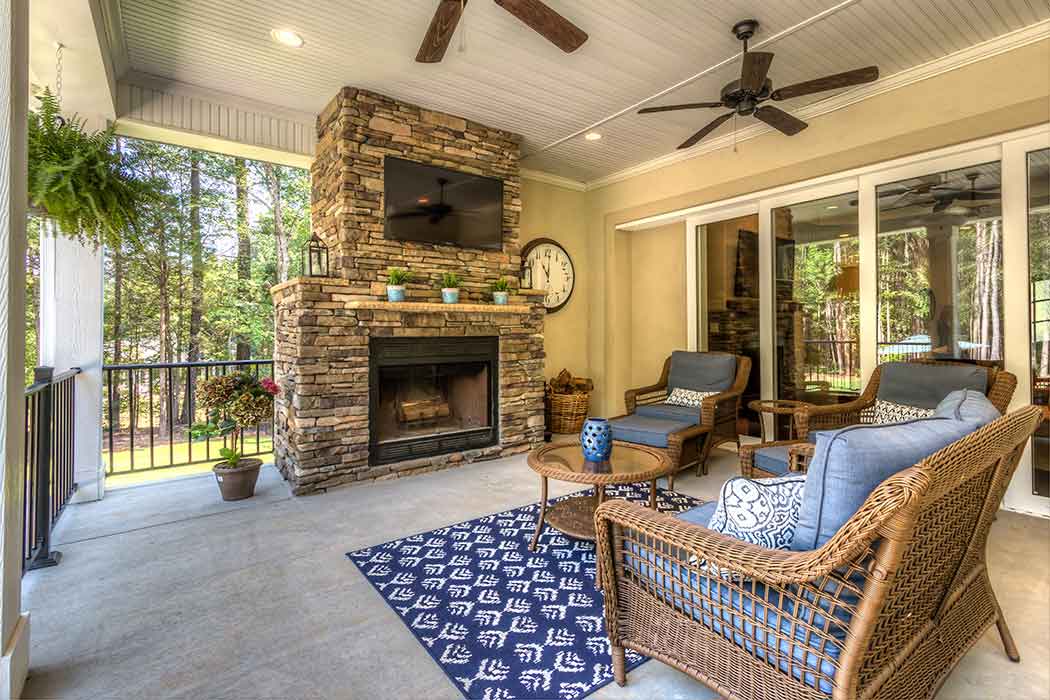
When a homeowner asks about deck builder charlotte cost, the honest answer depends on six variables that move pricing far more than the brand of board on the surface. Footing depth in Piedmont clay, beam spans, code-required guardrails, electrical for lighting and fans, and Mecklenburg County permit pathways usually account for more line-item dollars than the boards themselves.
The deck builder charlotte cost numbers below reflect what we actually quote in 2026.
This guide covers real per-square-foot ranges for pressure-treated, composite, and IPE, the structural costs hiding under every Carolinas deck, permit and HOA timelines, and design choices that quietly double a budget. For a straight conversation on your lot, call us at (704) 619-6293.
What are the 2026 per-square-foot ranges for deck builder Charlotte cost?
In 2026, Charlotte deck pricing installed runs roughly $35 to $55 per square foot for pressure-treated pine, $55 to $110 for composite and capped polymer, and $85 to $135 for IPE and tropical hardwoods. A standard 320-square-foot attached deck lands between $11,200 and $44,800 depending on the surface material chosen, before rail, lighting, or structural upgrades.
The 2026 ranges below assume an attached, single-level deck at standard height, with code-compliant guardrails, stairs to grade, and a permit. Pricing scales up for elevated second-story decks, complex framing, and integrated structures.
Pressure-Treated Pine
Pressure-treated southern yellow pine is still the most common deck surface in the Carolinas — inexpensive up front and easy for any qualified crew. Typical range as of 2026: $35 to $55 per square foot installed, covering framing, decking, standard balusters, stairs, hardware, and labor. A 16 by 20 foot deck (320 SF) lands $11,200 to $17,600.
Composite and Capped Polymer
Composite has overtaken pressure-treated as our most-quoted surface for homeowners staying five-plus years. Capped composite and polymer boards run $55 to $85 per square foot installed in 2026, with premium lines reaching $90 to $110 when paired with hidden fasteners, picture-frame borders, and cable or aluminum rail. A typical 14 by 24 composite quote lands $25,000 to $38,000.
IPE and Tropical Hardwoods
IPE and tropical hardwoods are the premium tier. Material alone is roughly triple pressure-treated, installation requires pre-drilling every fastener, and framing tolerances are tighter. Installed IPE in Charlotte runs $85 to $135 per square foot. We finish only a handful per year, almost all on architect-designed homes in Myers Park, Eastover, and along the Catawba shoreline.
Our decks and porches service covers the surfaces and rail systems.
- Pressure-treated pine: $35 to $55 per square foot installed (typical range as of 2026).
- Capped composite: $55 to $85 per square foot, premium lines $90 to $110.
- IPE and tropical hardwoods: $85 to $135 per square foot installed.
- A standard 320 SF attached deck lands $11,200 to $44,800 depending on surface.
- Material is one variable; footings, rail, and access drive significant cost swings.
What drives deck builder Charlotte cost beyond material choice?
Beyond the decking surface, footings poured in Piedmont clay, beam spans and joist sizing tied to elevation, and site access all move a Charlotte deck budget significantly. Footings alone can add $3,000 to $6,000 on a 14-pier deck, elevated framing adds $15 to $25 per square foot, and tight-access older lots raise labor costs well above open new-construction sites.
Material gets the most attention because it is visible. Four less visible drivers usually move a Charlotte deck budget more than swapping pine for composite — they are the gap between an online estimator and a real deck builder charlotte cost quote.
Footings and Carolinas Clay Soils
Piedmont clay holds water, expands when saturated, and contracts in dry summers. Code in Mecklenburg County and York County requires deck footings to bear below frost line and on undisturbed soil. We pour 12-inch or 16-inch concrete piers at 12 to 16 inches below grade minimum, deeper if backfill is suspected.
Each footing typically adds $200 to $450. A 14-pier deck can carry $3,000 to $6,000 in footing work alone before a board is set. Our concrete and foundations work handles this directly rather than subbing it out blind.
Beam Spans, Joist Sizing, and Elevation
An attached deck under 30 inches above grade does not require a guardrail; one above 30 inches does, and one above 5 to 6 feet typically requires engineered stair geometry. Doubling deck size does not double the price; it can increase it 130 to 160 percent because framing strengthens nonlinearly.
Elevated second-story decks add $15 to $25 per square foot over ground-level. Framing is where deck quality is won or lost.
Access, Demo, and Site Conditions
Tight side yards, mature trees, septic field setbacks, and stormwater easements all add labor. Demolition of an existing deck typically adds $1,500 to $4,000. Hauling debris from a Dilworth or Myers Park lot costs more than from a new-construction Ballantyne lot.
- Footings in Piedmont clay typically cost $200 to $450 each at 12 to 16 inches below grade.
- Elevated decks (over 30 inches) require code guardrails; over 5 to 6 feet often requires engineered stairs.
- Doubling the footprint can increase price 130 to 160 percent.
- Demolition typically adds $1,500 to $4,000.
- Tight-access older Charlotte lots cost more in labor than open new-construction sites.
What permits, inspections, and HOA reviews affect a Charlotte deck project?
Charlotte decks require a Mecklenburg County building permit with footing, framing, and final inspections, typically taking two to four weeks and $200 to $600 in fees; York County review for Lake Wylie and Fort Mill runs one to three weeks. Most HOAs also require architectural review board approval, which can add 10 days to six weeks before permit submission.
A permitted Charlotte deck adds value at resale; an unpermitted deck creates a disclosure problem and often a teardown demand from a buyer’s inspector. Permit and review timelines move deck builder charlotte cost less in dollars than in calendar weeks — but those weeks matter when planning around summer.
Mecklenburg County Code Enforcement
Decks in Charlotte and unincorporated Mecklenburg County require a building permit from Mecklenburg County Code Enforcement. Plan review typically runs two to four weeks for a deck under 600 SF, with footing, framing, and final inspections required during construction. Permit fees commonly run $200 to $600.
Towns inside Mecklenburg — Davidson, Cornelius, Huntersville, Matthews, Mint Hill, Pineville — pull through the county system but layer their own zoning review for setbacks.
York County SC for Lake Wylie and Fort Mill
York County issues residential deck permits through its Planning and Development department. Plan review generally runs one to three weeks. The county is more permissive than Mecklenburg on materials documentation but stricter on impervious surface coverage near the Catawba shoreline buffer. Lake Wylie homes inside the Duke Energy SMP buffer have additional review for any structure affecting the buffer line.
Our permit coordination service handles these pathways routinely.
HOA Review Timing
Most Charlotte HOAs — Ballantyne Country Club, Providence Plantation, the Palisades, NorthStone, Highland Creek — require architectural review board approval before permit submission. ARB cycles run 10 days to six weeks. Single revisions can push schedules out by a month. Submit complete drawings with site plan, elevation, materials list, and color sample on the first try.
- Mecklenburg permit review: 2 to 4 weeks; fees commonly $200 to $600.
- Required inspections: footings, framing, final.
- York County SC review: 1 to 3 weeks; Catawba shoreline buffer triggers additional review.
- HOA ARB cycles run 10 days to 6 weeks; revisions add weeks.
- Submit complete ARB packages on the first pass to avoid schedule slippage.
Composite vs pressure-treated: how does the 15-year cost math compare?
Pressure-treated costs less upfront, but 15-year maintenance — sanding, resealing, and board replacement — typically runs $5,000 to $9,000, closing most of the initial $8,000 price gap with composite. Composite needs only annual washing and appraises modestly higher at resale, though pressure-treated still wins for short hold periods, flips, and tight budgets.
Sticker price is one number; total cost of ownership over 15 years is another. The composite versus pressure-treated decision should be made on 15-year math, not year-one savings alone — it is the single biggest lever on deck builder charlotte cost over time.
Year One Versus Year Fifteen
A 320 SF pressure-treated deck at $45 per square foot installs for around $14,400. A 320 SF mid-grade composite at $70 per square foot installs for around $22,400 — an $8,000 gap on day one. Over 15 years, pressure-treated typically needs sanding and resealing every two to three years ($400 to $900 per cycle), board replacement at year 10 to 12 ($2,500 to $5,000), and rail refinishing twice.
Cumulative maintenance commonly hits $5,000 to $9,000. Composite needs only annual washing. The two often land within $1,500 of each other at year 15.
Resale and When Pressure-Treated Still Wins
Composite decks appraise modestly higher than pressure-treated in the Charlotte market because the maintenance liability is lower for the next owner. Neither is a strong financial play in isolation. For homeowners selling within three to five years, an investor finishing a flip, or a tight budget, pressure-treated still makes sense — boards source same-day and repairs are straightforward.
Our outdoor living spaces work covers both material paths. If you are planning a full custom home build near Lake Norman, our Mooresville, NC custom home builder guide covers permits, 2026 costs, and design guidance for new construction in the Lake Norman area. Families building in Huntersville can use our Huntersville, NC custom home builder guide for the same permit and cost breakdowns on that side of the lake.
- Day-one pressure-treated savings of roughly $8,000 on a 320 SF deck often disappear by year 15.
- Pressure-treated maintenance typically runs $5,000 to $9,000 over 15 years.
- Composite typically needs only annual washing for the same 15-year window.
- Composite appraises modestly higher in Sun Belt resale markets.
- Pressure-treated still wins for short hold periods, flips, rentals, and tight budgets.
What hidden line items move the final deck builder Charlotte cost number?
Rail systems, electrical, and add-ons like pergolas or outdoor kitchens routinely add 10 to 25 percent to a homeowner's initial budget. Rail alone can swing $4,500 to $7,500 between standard balusters and cable on a 60-linear-foot deck, while full lighting packages run $1,800 to $4,500 and roof tie-ins can add $18,000 to $36,000.
Three categories of line items show up after the surface decision is made and routinely add 10 to 25 percent to a homeowner’s first mental deck builder charlotte cost budget. Knowing them up front prevents change orders.
Rail Systems
Rail is the most underestimated line item on a Charlotte deck. Standard pressure-treated balusters run $25 to $40 per linear foot installed. Aluminum baluster rail runs $55 to $90. Cable rail runs $90 to $160. Glass panel rail runs $170 to $280.
On a deck with 60 linear feet of rail, the difference between standard balusters and cable can be $4,500 to $7,500 — often the biggest single hidden swing in deck builder charlotte cost.
Lighting, Fans, and Electrical
Recessed deck-board lighting, post cap lighting, low-voltage stair lights, and ceiling fans on covered sections require a licensed electrician and an electrical permit. Expect $1,800 to $4,500 for a full deck lighting package including transformer, runs, and fixtures. Adding an outlet for a smoker, heater, or sound system adds $400 to $900.
Integrated Pergolas, Outdoor Kitchens, and Roofs
A simple pergola over a deck runs $4,500 to $12,000 installed. A full roof tie-in — making it a covered porch — runs $18,000 to $36,000 and requires structural review where it meets the existing fascia. If a roofed structure is more what you have in mind than an open deck, our comparison of screened and covered porch options breaks down the cost and structural differences in more detail. An outdoor kitchen rough-in (gas, water, electrical, structural pad) runs $6,000 to $18,000 before appliances.
- Cable rail vs standard balusters can add $4,500 to $7,500 to a 60-LF deck.
- Glass rail runs $170 to $280 per linear foot installed.
- Full deck lighting packages commonly cost $1,800 to $4,500.
- Pergolas add $4,500 to $12,000; full roof tie-ins add $18,000 to $36,000.
- Outdoor kitchen rough-in: $6,000 to $18,000 before appliances.
How should you vet a Charlotte deck builder before signing a contract?
Verify the contractor's NC general contractor license for any project over $30,000, request liability and workers' compensation certificates directly from the carrier, and confirm three recently permitted decks through the county portal. A trustworthy quote itemizes board brand, rail system, framing lumber, and footing specs rather than lumping everything into one "decking package" line.
The single best way to control deck builder charlotte cost is to vet contractors before pricing instead of after. Charlotte has good deck builders and crews that do not pull permits, do not detail footings, and do not warranty past 90 days. The checklist below takes 45 minutes and removes most bad outcomes.
License, Insurance, and Permit History
Any deck project exceeding $30,000 in North Carolina requires a licensed general contractor under NC Licensing Board for General Contractors rules. Verify the license on the state lookup. Ask for liability and workers’ compensation certificates directly from the carrier. Then ask the builder for three permitted decks finished in the past 12 months — verify those permits in the Mecklenburg County portal.
Quote Structure and Warranty
A trustworthy quote should specify board brand and color, rail system, fastener system, framing lumber grade and size, footing diameter and depth, stair geometry, and permit allowance. Beware quotes that lump materials into a single “decking package” line. Composite manufacturers typically offer 25 to 50 year fade warranties; the installer’s labor warranty should run minimum one year on workmanship and two to three years on framing.
That framing warranty is what matters fifteen years from now.
- Verify NC GC license at the state board for any project over $30,000.
- Request liability and workers’ compensation certificates directly from the carrier.
- Ask for three recent permitted projects and verify in the county permit portal.
- Demand spec sheets for boards, fasteners, framing lumber, footings, and rail.
- Workmanship warranty minimum 1 year; framing warranty 2 to 3 years.
Frequently Asked Questions
What is a realistic deck builder charlotte cost for a 16 by 20 foot deck in 2026?
A 320 SF attached deck at standard ground-level height typically runs $11,200 to $17,600 in pressure-treated, $17,600 to $27,200 in mid-grade composite, and $27,200 to $43,200 in IPE installed in Charlotte as of 2026. Add 15 to 25 percent for elevated framing over 30 inches, rail upgrades, or HOA design requirements.
Do I need a permit to build a deck in Charlotte?
Yes. Mecklenburg County Code Enforcement requires a building permit for any attached deck. Plan review typically runs two to four weeks with required footing, framing, and final inspections. Unpermitted decks create disclosure issues at resale and are commonly flagged by buyer inspectors.
How long does a deck build take from contract to completion?
A typical attached pressure-treated or composite deck runs four to seven weeks from signed contract to final inspection: one to two weeks for HOA and permit, two to three weeks for footings and framing, and one to two weeks for decking, rail, stairs, and finish work.
Is composite always worth the extra deck builder charlotte cost over pressure-treated?
Not always. For homeowners staying 10 or more years, composite typically beats pressure-treated on total cost of ownership. For short hold periods, flips, rentals, or tight budgets, pressure-treated still makes financial sense. Decide on the 15-year math, not the day-one number.
Ready to Talk About Your Charlotte Deck?
We build decks across Charlotte, Huntersville, Lake Wylie, Fort Mill, and Rock Hill, and we quote honestly on materials, footings, rail, and permit pathways. For a real number rather than a placeholder, call us at (704) 619-6293 or reach out through our contact page.
We serve the Charlotte metro and the Lake Wylie and York County markets with the same crew and permit discipline.