
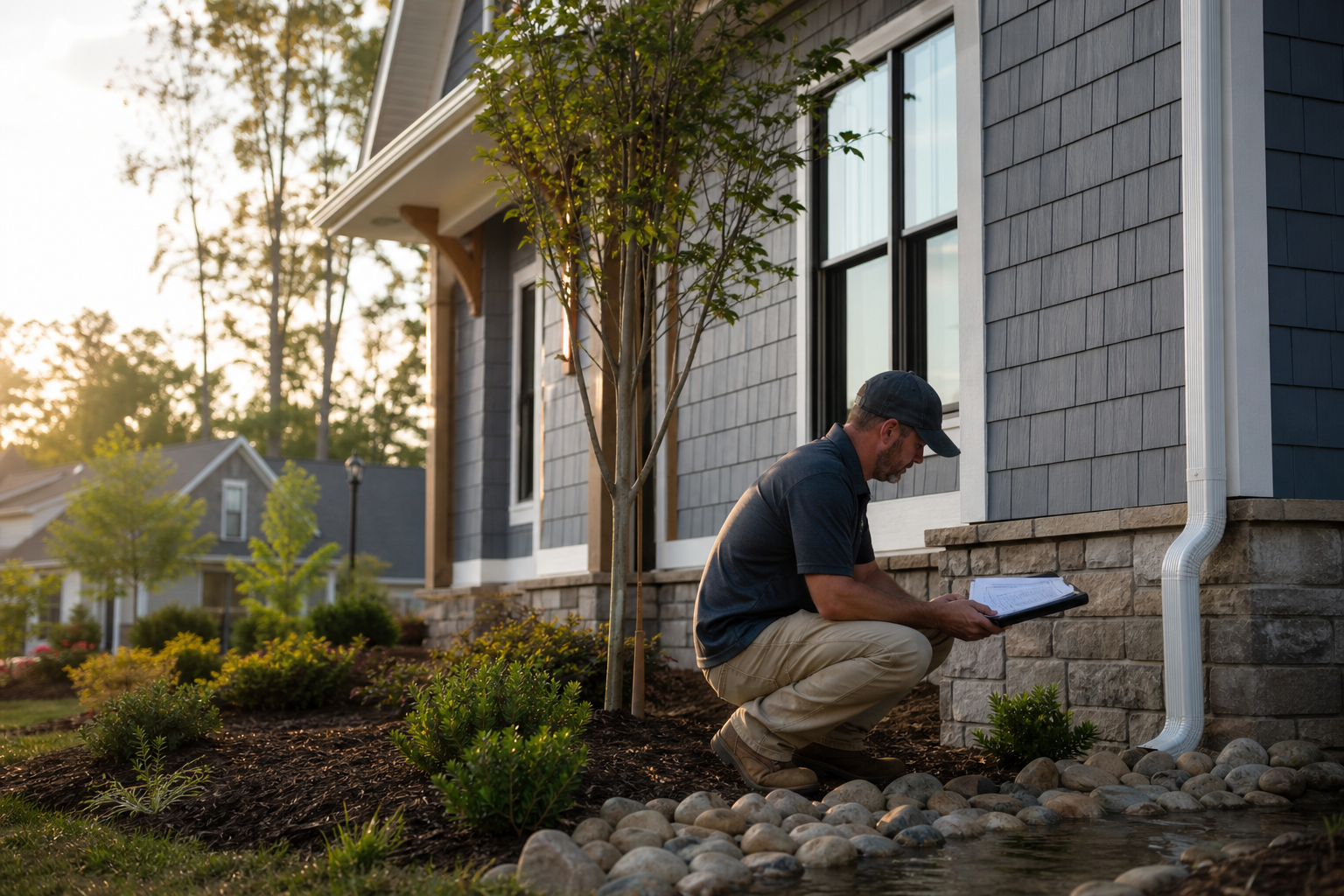
After a rain event, exterior site work is generally not considered closed out until the property has been walked and observed while water is present or immediately after a storm, checking that collection points are working, discharge is going where it was designed to go, no new erosion or ponding has appeared, splash patterns are not damaging finishes or foundations, transitions between surfaces are shedding water correctly, disturbed areas have been restored, and any unresolved issues are documented for continued monitoring rather than assumed to have fixed themselves.
This article summarizes practical closeout observations that homeowners and project teams commonly use during exterior remodeling work in the Charlotte and York County area, and it draws its regulatory framing only from the two official sources listed below. It does not state or imply that any specific inspection, permit, or stormwater review has passed or will pass. Requirements for stormwater management, grading, and drainage vary by jurisdiction and by property, and they can change. Homeowners should confirm current requirements with the City of Charlotte Stormwater Services or York County Stormwater Plan Review, or with the authority having jurisdiction over their specific address, before treating any exterior work as finished.
What Current Public Sources Establish
Two publicly available government resources inform the regulatory backdrop for this topic: the City of Charlotte's Stormwater Regulations page and York County, South Carolina's Stormwater Plan Review page. Both sources describe local government roles in reviewing stormwater management for development activity, and both indicate that specific technical and procedural requirements are set at the jurisdiction level rather than by a single statewide or regional standard.
Neither source provides a universal homeowner checklist for post-rain observation on a residential exterior renovation, and neither substitutes for a site-specific review. What they do establish is that stormwater plan review and stormwater regulation enforcement are active functions of local government in this region, and that property owners undertaking exterior work that affects grading, drainage, or impervious surface should expect that local requirements may apply depending on the scope of work and the jurisdiction. This article treats those two pages as the factual floor and does not add code detail, approval criteria, or inspection outcomes beyond what is stated on those pages.
- The City of Charlotte publishes stormwater regulation information through its Stormwater Services program.
- York County, South Carolina publishes a stormwater plan review process for applicable development activity.
- Specific technical thresholds, submittal requirements, and review timelines are set by each jurisdiction and are subject to change.
- Homeowners should verify which jurisdiction applies to their property and confirm current requirements directly with that authority.
Inputs and Existing Conditions to Document
Before any rain-test walkthrough can be meaningful, it helps to have a baseline understanding of what existed on the property before exterior work began and what changed during the project. This includes the original grading pattern, any existing swales, drains, downspouts, or discharge points, and any known problem areas such as low spots, saturated soil, or erosion that predated the current work. Photographs, notes, or simple sketches made before work started give the closeout walkthrough something to compare against.
It is also useful to document what changed during construction, such as new impervious surface, altered grading, added or relocated downspouts, new hardscape transitions, or disturbed soil that has not yet been restored with vegetation or other stabilization. Without this record, it becomes difficult to distinguish a new problem created by the project from a pre-existing condition that was never resolved. This documentation step is a planning practice, not a regulatory requirement stated in the official sources above, and its value is practical rather than procedural.
- Pre-construction photos or notes of grading, drainage paths, and known problem spots.
- A record of any new impervious surface, regrading, or relocated discharge points.
- Identification of disturbed soil areas that still need restoration or stabilization.
- A simple site sketch showing where water is expected to travel after a rain event.
Step-by-Step Owner and Project-Team Review
A documented walkthrough after a rain event generally moves through a consistent sequence, starting at the points where water enters the system and ending at the points where it leaves the property or infiltrates. Walking the site while it is still raining, or as soon as safely possible afterward, gives the clearest picture of how water actually behaves, rather than relying on assumptions about how it should behave based on the design.
The exterior renovation drainage closeout walkthrough typically covers collection, discharge, erosion, ponding, splash, transitions, and restoration, followed by a written note of anything unresolved. Each of these areas answers a different question about how the site is performing, and skipping any one of them leaves a gap in the record that may not surface until the next significant storm.
Collection refers to gutters, downspouts, area drains, and any structure designed to capture water before it spreads across the ground. Discharge refers to where that collected water is released, whether to a pipe, a swale, a splash block, or a stormwater structure, and whether that release point matches what was planned. Erosion refers to any visible soil movement, rilling, or exposed root systems that appeared or worsened during or after the rain. Ponding refers to standing water that remains longer than expected on paved or landscaped surfaces. Splash refers to water bouncing off hard surfaces onto siding, foundations, or adjacent plantings in a way that could cause staining or long-term moisture exposure. Transitions refers to the joints between different surfaces, such as where a patio meets a lawn or a driveway meets a swale, since these points often reveal design or construction gaps. Restoration refers to whether disturbed soil has been stabilized with seed, sod, mulch, or other cover so it is not actively eroding. Any item that cannot be resolved on the spot should be written down for continued monitoring after future rain events.
- Observe collection points such as gutters, downspouts, and area drains for actual capture during rain.
- Trace discharge points to confirm water is leaving the site or infiltrating where intended.
- Look for new or worsening erosion, including rilling, exposed roots, or undermined edges.
- Note any ponding that persists well after rain has stopped, especially near the foundation.
- Check splash patterns against siding, foundation walls, and planting beds.
- Inspect transitions between hard and soft surfaces for gaps, washout, or uneven settling.
- Confirm that disturbed soil areas have visible restoration or stabilization in progress.
- Write down any unresolved condition and the date it was observed for future comparison.
Responsibilities, Dependencies, and Hold Points
Exterior closeout observations are shared work. The homeowner is often the person present during and after a rain event, since contractors are not typically on site around the clock, and homeowner observation fills that gap. The project team is generally responsible for addressing conditions that stem from construction changes, such as a downspout that was relocated but does not discharge cleanly, or a graded slope that was disturbed and has not yet stabilized.
Some items depend on conditions outside anyone's direct control, such as how quickly new plantings establish root systems or how a particular storm intensity interacts with soil that is still settling. Because of this, it is reasonable to treat some observations as hold points rather than final findings, meaning the item is watched through one or more additional rain events before it is considered resolved. This is a practical planning approach rather than a regulatory requirement, and it does not represent an inspection result or an approval from any authority having jurisdiction.
- Homeowners are often best positioned to observe conditions during or immediately after rain.
- Project teams are generally responsible for construction-related drainage changes and their performance.
- Newly disturbed soil and new plantings may need multiple rain events before stabilization can be judged.
- Treating uncertain items as hold points for continued observation is a planning choice, not a certification of any kind.
Common Coordination Failures
Several recurring gaps show up when exterior work moves toward closeout without a documented rain-test walkthrough. One common failure is closing out work based on a dry-day visual inspection alone, which can look complete even when discharge points, transitions, or ponding areas have never actually been tested under real rainfall. Another is treating restoration as finished once seed or sod is placed, without confirming that it has taken hold enough to resist erosion during a real storm.
Miscommunication between trades is another frequent issue, particularly when grading, hardscape, and downspout work are handled by different crews on different schedules. A downspout extension installed after final grading, for example, may discharge onto a slope that was never designed to carry that volume of water. Similarly, a patio or walkway installed without coordination with the existing swale can create a new low point that was not part of the original drainage design. Documenting the rain-test walkthrough in writing, with dates and specific locations, helps surface these coordination gaps before they become larger problems.
- Closing out based only on a dry-day visual check without observing actual rain performance.
- Assuming restoration is complete once seed or sod is placed, without confirming establishment.
- Downspout or grading changes made by separate trades without coordinating discharge paths.
- New hardscape creating unintended low points or altering existing swale function.
- Failing to write down and date observed issues, making it hard to track whether they recur.
Questions for the Responsible Authority or Qualified Professional
Because stormwater and drainage requirements vary by jurisdiction and by the specific scope of exterior work, homeowners should raise property-specific questions with the authority having jurisdiction or a qualified professional rather than relying on general guidance. The City of Charlotte Stormwater Services program and the York County Stormwater Plan Review process are two starting points for confirming whether a given property or project scope triggers a formal review, and what documentation that review may require.
Useful questions to bring to that authority include whether the current project scope requires a stormwater plan review or permit, whether any changes to grading or impervious surface affect an existing approved drainage design, and what timeframe or method the jurisdiction expects for reporting or correcting a drainage issue discovered after work is substantially complete. A qualified professional, such as a civil engineer or licensed surveyor, may also be appropriate for evaluating erosion, ponding, or discharge concerns that go beyond a visual homeowner walkthrough.
- Ask whether the specific project scope requires a stormwater plan review or permit in the applicable jurisdiction.
- Ask whether grading or impervious surface changes affect any previously approved drainage design.
- Ask what process exists for reporting a drainage concern discovered after work is substantially complete.
- Ask whether a civil engineer, surveyor, or other qualified professional should evaluate a specific erosion, ponding, or discharge condition.
Next Action and Related CDG Service Resource
A documented rain-test walkthrough gives homeowners a clearer, dated record of how a property is actually performing after exterior renovation work, which is more useful over time than a single dry-day visual check. Keeping notes on collection, discharge, erosion, ponding, splash, transitions, and restoration, along with any unresolved items, creates a practical reference for future maintenance and for conversations with the authority having jurisdiction if questions come up later.
For homeowners planning exterior work that touches grading, drainage, or hardscape near a lake lot or any other property, it can help to talk through the project scope before work begins, so that drainage coordination between trades is considered from the start rather than addressed only at closeout. CDG Carolinas offers home remodeling services and general project planning support, and readers can review general remodeling information, browse related articles on the blog, or request a consultation to discuss project-specific questions.
- Keep a dated, written record of rain-test observations for future reference and maintenance planning.
- Review general remodeling planning information before starting exterior work that affects drainage.
- Browse related articles for additional context on exterior and site-related project planning.
- Request a consultation to discuss a specific property's exterior renovation scope and coordination needs.
Questions homeowners ask
How soon after rain should the exterior renovation drainage closeout walkthrough happen?
There is no single fixed timing set by the official sources referenced in this article, since local stormwater regulations generally address plan review and design standards rather than a specific post-rain inspection window. As a practical matter, many homeowners find it useful to walk the site while rain is still falling, if it is safe to do so, and again shortly after the rain stops, since some conditions such as ponding or splash are easiest to observe in the moment while others, like erosion or standing water that lingers, are clearer once the rain has ended. Any specific timing requirement tied to a permit or plan review should be confirmed with the applicable authority having jurisdiction.
What happens if the walkthrough finds an unresolved drainage issue?
An unresolved issue found during a rain-test walkthrough should be documented with a date, a description, and its location on the property, and then watched through at least one additional rain event before drawing further conclusions, since some conditions improve as soil settles or plantings establish. If the issue appears related to construction work that was recently completed, it is reasonable to raise it with the project team responsible for that portion of the work. If the issue may involve a broader drainage design question, grading change, or something that could affect neighboring property, it is appropriate to contact the local stormwater authority, such as the City of Charlotte Stormwater Services program or York County's stormwater plan review contact, to ask how that jurisdiction expects the concern to be handled.
Does passing a rain-test walkthrough mean the project has met local stormwater requirements?
No. A homeowner or project-team walkthrough after rain is a practical observation exercise, not a regulatory inspection, plan review, or approval, and it should not be treated as confirmation that a property meets any specific requirement under the City of Charlotte Stormwater Regulations or the York County Stormwater Plan Review process. Those determinations belong to the applicable authority having jurisdiction, and any project that involved grading, impervious surface changes, or other work potentially subject to stormwater review should be confirmed directly with that authority rather than assumed based on a visual walkthrough alone.
Plan the next step
Use this article as a planning aid, then confirm project-specific requirements with the responsible authority and qualified professionals. Review CDG's related service, construction articles, or consultation page when you are ready to organize the next decision.
Official sources and verification
Authority pages, forms, fees, review steps, and code references can change. Verify the current path for the property and scope before relying on a planning assumption.