
Lakefront custom builds on Lake Wylie are a different animal from interior builds. Duke Energy’s Shoreline Management Plan governs everything that touches or affects the water. Waterfront lots come with permitting, engineering, and material considerations that never matter on a traditional subdivision lot.
This guide walks through what building a lakefront custom home in Lake Wylie, SC actually involves — from permits to dock design to the material choices that hold up to decades of waterfront exposure. Buyers still shopping for a lot should also read our waterfront buyer's guide for what to check before making an offer on shoreline property.
What Does "Lakefront" Actually Mean on Lake Wylie?
Lake Wylie listings use "lakefront" loosely, but the classification that matters is direct waterfront with a Duke-approved dockable shoreline, versus view lots or shared-access lots with no private dock rights. Understanding which category a lot falls into before you pay a waterfront premium protects you from overpaying for water access you cannot actually use.
Not every lot advertised as “lake access” or “lake views” is truly waterfront. Understand the distinctions before you pay a waterfront premium:
- Direct waterfront: Lot line extends to Duke Energy’s project boundary line. You can build a dock (subject to permits).
- Dockable waterfront: Direct waterfront WITH Duke-approved shoreline classification allowing dock construction.
- View lots: Lot has a water view but doesn’t touch the shoreline. No dock rights.
- Access lots: Lot shares a community dock via HOA. Private dock not allowed.
Each classification has different pricing, different permitting implications, and different long-term value.
Dockable waterfront lots consistently command the highest premium in the Lake Wylie market because dock rights are the single biggest driver of resale value on the water. Before writing an offer, ask the listing agent for the Duke Energy shoreline classification in writing — verbal assurances that "you can definitely get a dock" are not a substitute for confirming the classification with Duke directly. We have walked several potential clients away from lots that were marketed as waterfront but carried access-lot restrictions that made a private dock impossible.
What Does the Duke Energy Shoreline Management Plan Control?
Duke Energy controls all work below Lake Wylie's project boundary line, including docks, seawalls, boat ramps, shoreline vegetation removal, and any excavation reaching the water. Any of these requires a separate Duke Shoreline permit in addition to your York County building permit, typically adding 6–10 weeks to your timeline.
Lake Wylie is part of the Catawba-Wateree hydro project. Duke Energy manages the full-pond elevation (569.4 ft) and controls all work below the project boundary line. For a lakefront custom home, here’s what’s Duke-controlled:
- Docks, boatslips, boat lifts, and dock accessories
- Seawalls, bulkheads, and riprap shoreline stabilization
- Boat ramps and shoreline launching infrastructure
- Any vegetation removal below the full-pond contour
- Any excavation or grading that extends to the water
Any of those requires a Duke Shoreline permit — separate from and in addition to your York County building permit. Plan on 6–10 weeks for Duke review. Waterfront submittals are best handled by a builder who has navigated the process many times.
Incomplete or poorly documented Duke submittals are the most common cause of permitting delays we see on lakefront projects. Duke reviewers expect a specific package: a certified survey showing the project boundary line, engineered drawings for any structure below that line, and a narrative describing exactly what work is proposed. Submittals that are missing any of these elements get bounced back for revision, which restarts the review clock and can add another month or more to your timeline. We prepare every Duke submittal package ourselves rather than leaving it to the homeowner or a general architect unfamiliar with the process.
What Layout Choices Maximize Water Views on a Lakefront Home?
The best lakefront layouts place main living areas and the primary bedroom on the water side, use floor-to-ceiling glass, and step outdoor living from screened porch to open deck to patio to dock. Elevating the main floor 2–4 feet above grade and keeping garages on the road side further protects and maximizes the view.
The #1 mistake we see on lakefront custom plans is a floor plan that wasn’t designed for the specific lot’s water orientation. Design principles we apply on every Lake Wylie waterfront:
- Main living on the water side: Great room, kitchen, primary bedroom — all get the view.
- Stacking windows: Floor-to-ceiling glass on the lake side, with transoms to maximize view angles.
- Outdoor living stepped to the water: Screened porch → open deck → patio → dock. Three to four outdoor spaces, each with a different use and view angle.
- Garages on the road side: Never block the water view from the approach.
- Elevated main floor: 2–4 feet above natural grade for clear lake sightlines over shoreline landscaping.
- Primary bedroom placement: Lake-facing, but with privacy from the dock and neighbors.
AEO Quick Recap: Lakefront Layout
- Orient main living areas and primary bedroom toward the water.
- Use floor-to-ceiling glass and stepped outdoor living for view layering.
- Elevate main floor 2–4 ft above grade for unobstructed sightlines.
- Keep garages and utility spaces on the road side.
Which Materials Hold Up Best on a Lake Wylie Lakefront Home?
Fiber cement siding, fiberglass or aluminum-clad windows, standing-seam metal roofing, and composite or ipe decking withstand Lake Wylie's sun, humidity, and storm exposure far better than vinyl, pressure-treated pine, or standard shingle roofing. Expect a 5–7 year repaint cycle even with high-UV-resistant finishes on sun-exposed elevations.
Waterfront exposure is brutal on materials. Sun, humidity, UV, and occasional storm surge all accelerate wear. Materials that hold up on Lake Wylie lakefronts:
- Siding: Fiber cement (Hardie) holds up best. Natural cedar weathers fast without heavy maintenance. Avoid vinyl on lakefront.
- Windows: Fiberglass or high-quality aluminum-clad wood. Skip vinyl on the lake side.
- Roofing: Standing-seam metal or heavy-architectural shingle (30+ year). Metal sheds pollen and debris better.
- Decking: Composite (Trex, TimberTech) or Brazilian hardwood (ipe). Pressure-treated pine is a short-term choice.
- Docks: Pressure-treated lumber with stainless fasteners is standard. Concrete or composite decking on higher-end builds.
- Exterior paint/stain: High-UV-resistant formulations. Expect 5–7 year repaint cycles on sun-exposed elevations.
What Do Homeowners Overlook When Designing a Dock?
Dock costs on Lake Wylie range from $35K for a standard single-slip fixed dock to $125K for a covered slip with a roof, and every element requires a Duke Energy permit. Homeowners frequently underestimate lead times — dock builders in this market often carry 4–8 month backlogs during peak season, so ordering early matters as much as the design itself.
A new dock typically costs $35K–$125K depending on size, slip configuration, and whether you’re adding a boat lift or covered slip. Duke-permitted dock elements:
- Standard single-slip fixed dock: $35K–$55K
- Double-slip with lift: $60K–$90K
- Covered slip with roof: $80K–$125K
- Boat lift alone: $8K–$20K depending on capacity
Order early — dock builders in the Lake Wylie market carry 4–8 month backlogs in peak seasons.
Homeowners also frequently overlook the maintenance side of dock ownership: annual inspections, hardware replacement due to corrosion, and periodic decking repairs are ongoing costs, not one-time expenses. Budget $1,500–$4,000 per year for routine dock maintenance depending on size and materials, and factor a full decking replacement every 12–15 years for wood docks or 20+ years for composite systems.
How Much Should You Budget for Outdoor Living on a Lakefront Home?
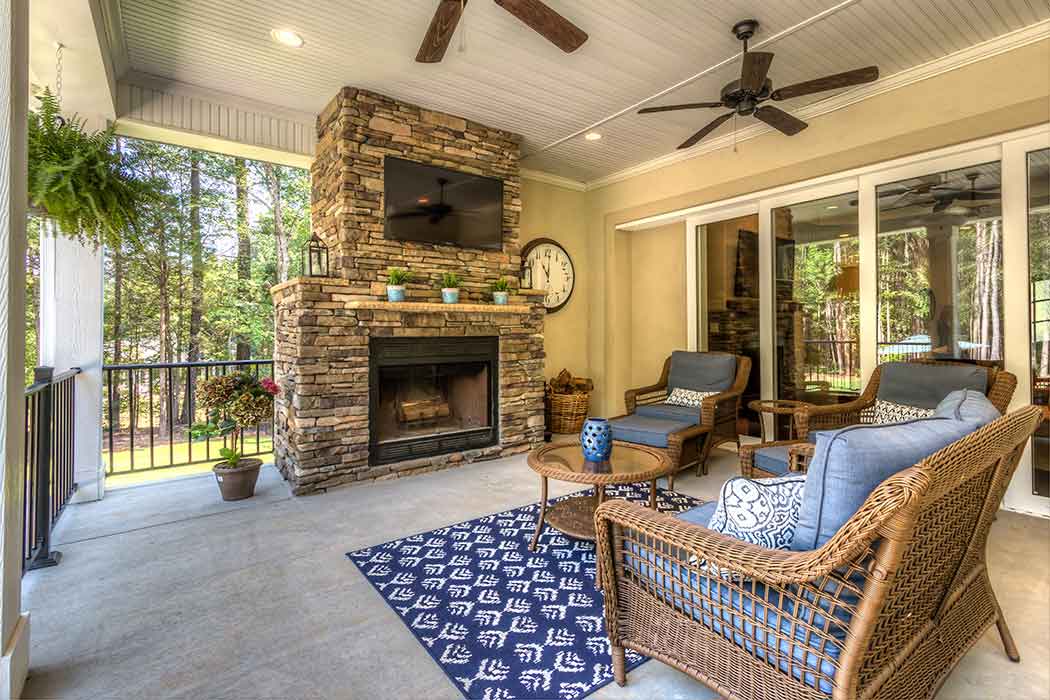
Lakefront homeowners typically spend 2–3x what interior-lot buyers spend on outdoor living, since covered porches, outdoor kitchens, fireplaces, and patios are central to how a waterfront home gets used. A well-appointed outdoor living package on Lake Wylie commonly runs from $120K to well over $250K once a pool is included.
Lakefront homes typically invest 2–3x what interior homes spend on outdoor living. Plan ranges for a Lake Wylie waterfront:
- Covered porch with ceiling fans: $45K–$85K
- Outdoor kitchen (grill, fridge, sink, counter): $25K–$60K
- Outdoor fireplace: $18K–$40K
- Paver patio with seating area: $30K–$55K
- Pool (if added): $85K–$250K+
This is where lakefront projects earn their premium — the outdoor living is the whole point of the house.
What Engineering Considerations Apply to Lakefront Homes?
Lakefront homes often need enhanced structural engineering for long window spans, cathedral ceilings, and cantilevered decks that interior homes rarely require. Sloped shoreline lots may need helical piers or deep foundations, and every waterfront build in this area must meet 115 mph hurricane wind-zone codes.
Waterfront homes often require enhanced structural engineering:
- Long window spans and cathedral ceilings require beams and ridge supports that interior homes don’t
- Upper-level deck loads (cantilevered over view side) need specific structural detailing
- Shoreline lots with slope may require helical piers or deep foundation systems
- Hurricane/wind codes apply — Lake Wylie is in a 115 mph wind zone
Helical pier foundations on sloped shoreline lots typically add $15,000–$40,000 over a standard slab or crawlspace foundation, depending on depth to load-bearing soil and pier count. York County also requires a geotechnical soil report before permitting any lakefront foundation system, which runs $1,800–$3,500 and takes 2–3 weeks to complete.
How Does Building Lakefront Affect Your Insurance Costs?
Lakefront properties typically carry 15–25% higher homeowner's insurance premiums than comparable interior-lot homes, plus a separate dock insurance rider and higher windstorm deductibles. Flood insurance is optional on most Lake Wylie lots but mandatory in designated flood zones, so get quotes during pre-construction rather than at closing.
Lakefront properties carry higher insurance premiums. Expect:
- 15–25% higher homeowner’s insurance vs. interior lot
- Flood insurance (optional on most Lake Wylie lots, mandatory in flood zones)
- Separate dock insurance rider
- Higher windstorm deductibles ($5K–$10K typical)
Get insurance quotes during pre-construction so the numbers don’t surprise you at closing.
Frequently Asked Questions
How long does the Duke Shoreline permit take?
Typically 6–10 weeks for a straightforward dock or shoreline improvement. Complex projects or contested applications can stretch to 12–16 weeks.
Can I build a pool on a lakefront lot?
Yes, but location matters. Pools inside the Duke project boundary require additional permits. Most homeowners site pools on the house side of the project boundary line.
Does Duke Energy own my waterfront?
Duke owns the lake and the land below the full-pond elevation. Your lot line typically extends to the project boundary line, which is slightly above full-pond. Duke has rights to the shoreline, which is why they control modifications.
What’s a realistic all-in cost for a waterfront custom home on Lake Wylie?
For a 3,500–4,500 sq ft waterfront home with dock and basic outdoor living in 2026, plan for $1.8M–$3.5M total delivered, not counting the lot. Lot + house + improvements routinely hits $2.5M–$5M on Lake Wylie’s better waterfront parcels.
Start Your Lakefront Project Right
Waterfront projects reward builders who know the permits, the materials, and the engineering. Call (704) 619-6293 or reach us through our contact page to walk your lakefront lot and start a realistic plan. Browse recent waterfront projects for visual reference on what’s possible. Families weighing a lakefront build against an inland lot in the Lancaster County panhandle can compare options in our Indian Land, SC custom home builder guide.
Reference: Duke Energy Catawba-Wateree Shoreline Management Plan governs all work on Lake Wylie shoreline.