

A pot filler can make a busy kitchen more comfortable, especially when large stockpots, pasta dinners, and batch cooking are part of your routine. Mounted near the cooking surface, this folding faucet supplies water where you need it rather than requiring every pot to start at the sink.
For homeowners considering pot filler installation in a Charlotte kitchen, the important decisions go beyond selecting a finish. The water line, mounting support, faucet reach, backsplash, and cooking appliance all need to work together. A carefully planned installation looks intentional and remains easy to use after the novelty wears off.
CDG Carolinas approaches this feature as part of the overall kitchen remodeling plan. Whether you are updating an existing space or designing a larger renovation in North Carolina, the following considerations can help you decide whether a pot filler belongs in your kitchen.
Is a pot filler worth adding to your kitchen?
The main advantage is straightforward: you can fill a pot while it sits on the cooktop. That reduces the need to carry a heavy container of cold water across the room. It can be particularly useful when the sink is several steps away or when more than one person is preparing food.
A pot filler does not eliminate every lifting task. Once cooking is finished, you may still need to move a pot of hot water to drain it. It also does not replace the kitchen sink, which remains essential for rinsing ingredients, washing cookware, and cleaning up spills.
Think about the meals you actually make. Someone who regularly prepares soups, boils potatoes, or cooks pasta for a household may appreciate the convenience. Someone who mostly uses a skillet or small saucepan may find that improved sink placement would offer more everyday value.
- A pot filler may be useful if you frequently fill large pots and your sink is far from the range.
- It may improve workflow when one person needs the sink while another is cooking.
- It may be less useful if you rarely boil water or already have a prep sink beside the cooking area.
- It adds another plumbing fixture to inspect, clean, and maintain over time.
The best choice is the one that supports your cooking habits, not simply the one that looks appealing in a finished kitchen photograph.
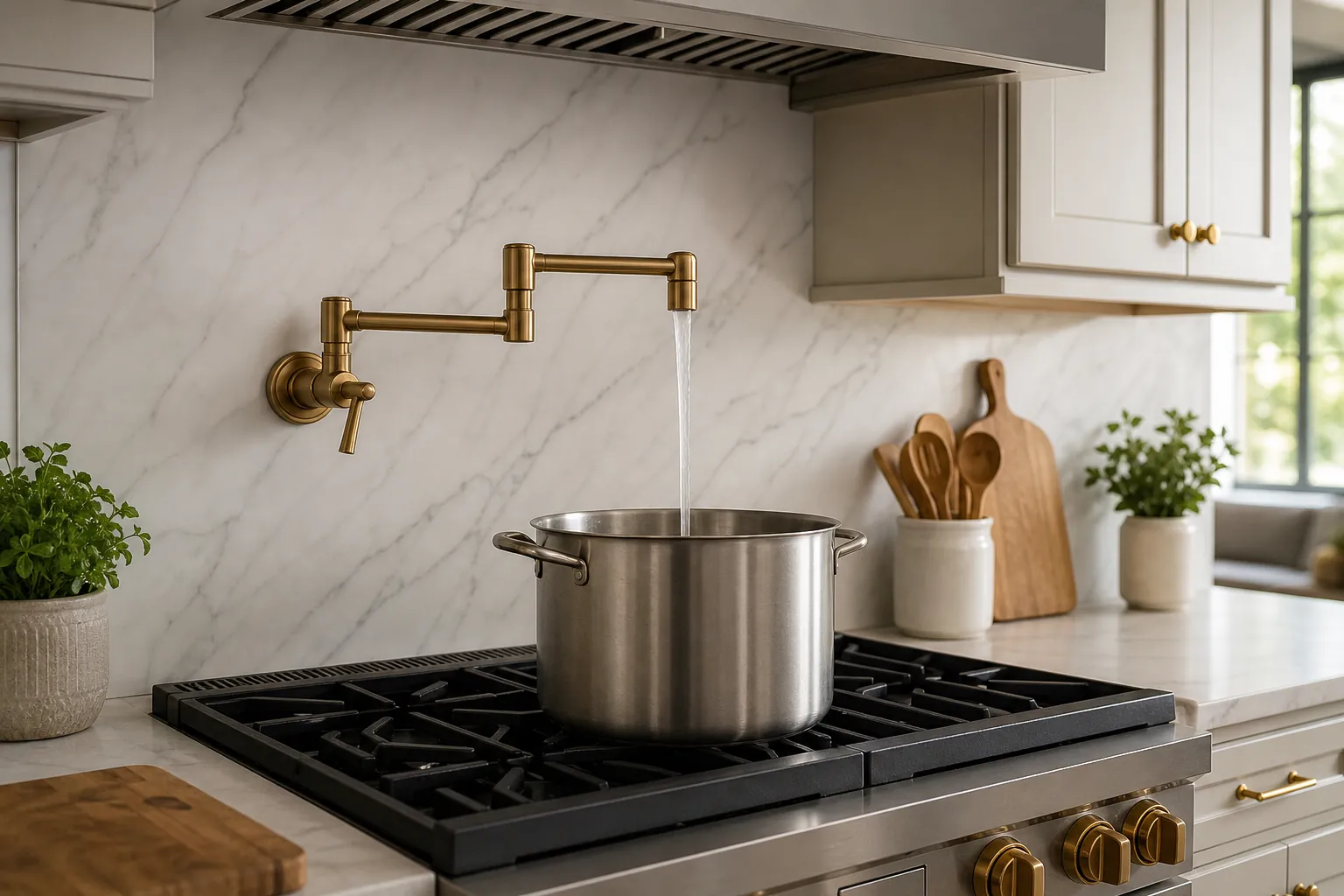
Choose the location around the appliance and cookware
There is no single mounting height that works for every kitchen. The right position depends on the cooking surface, the height of your largest practical pot, the faucet's vertical clearance, and how its arms fold against the wall.
Before setting the plumbing location, gather the specifications for the exact pot filler and cooking appliance. A faucet that appears suitable online may have a reach, handle position, or folding pattern that conflicts with the range, hood, or surrounding cabinetry.
A useful planning exercise is to place your usual stockpot on the burner you expect to use most often. Mark the proposed outlet location and check whether the spout can reach the pot comfortably. Then check smaller pots and neighboring burners. The faucet should not require awkward positioning to perform its main job.
Height matters in both directions. A low installation can prevent a tall pot from fitting underneath. An unnecessarily high installation can make the handles difficult to reach and increase splashing. Handle access should be comfortable without reaching across a hot burner.
- Confirm that the spout reaches the intended pot without stretching the faucet to an awkward limit.
- Check that the folded arms stay clear of the appliance, backsplash features, and hood components.
- Allow room to operate both handles if the model has separate wall and spout shutoffs.
- Review appliance and faucet instructions for required clearances and any heat-related restrictions.
In a custom kitchen, these checks should happen before the rough plumbing is finalized. Moving a supply connection after tile or stone has been installed can create avoidable finish repairs.
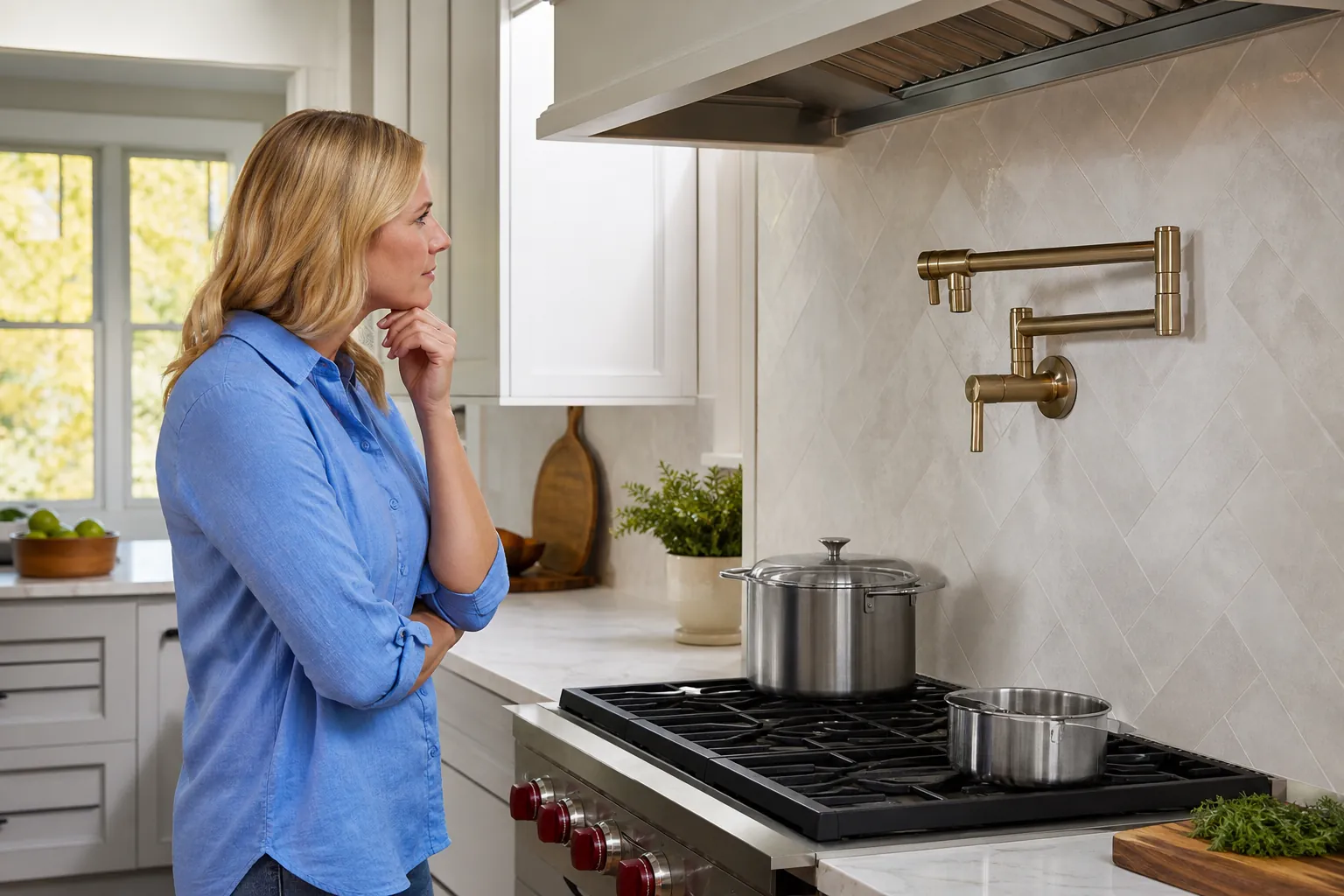
Plan the water supply before closing the wall
A pot filler needs a properly installed potable water supply. Many residential models are intended for a cold-water connection, but the specific product instructions should determine the installation requirements. Do not assume that every faucet has the same connection size or supply arrangement.
The route from the existing plumbing to the cooking wall has a major effect on the project. In some homes, the supply can be extended through accessible framing during a renovation. In others, finished walls, structural elements, cabinetry, or limited access make the work more involved.
The connection also needs appropriate support. Repeatedly extending and folding the faucet places force on its wall attachment. A secure installation depends on the mounting system and backing required by the manufacturer, not on the backsplash material alone.
Charlotte-area homes include a wide range of construction styles and ages. Existing pipe materials, prior alterations, and the condition of accessible plumbing should be reviewed rather than assumed. A licensed plumbing professional can determine an appropriate supply route and connection method.
If the cooking wall is an exterior wall, pipe placement deserves additional attention. North Carolina winters can bring freezing conditions. The installer should evaluate the wall assembly and keep the supply protected within an appropriate conditioned location. Simply adding insulation around an exposed pipe is not a substitute for sound routing.
Permit and inspection requirements depend on the property location and scope of work. Confirm the applicable requirements with the local authority before construction begins. A kitchen project within Charlotte may follow a different approval process than one in another municipality or county.
Understand the leak risk before choosing a fixture
Unlike a sink faucet, a wall-mounted pot filler usually has no drain below it. If it drips or is accidentally left running, water can collect on the cooking surface and surrounding finishes. That difference makes fixture quality, careful installation, and shutoff habits especially important.
Some models provide two operating valves, one near the wall and another near the spout. This arrangement can offer a convenient additional shutoff point, but it does not remove the need to follow the manufacturer's operating instructions or address a leak promptly.
Ask how the fixture can be isolated for service. An accessible supply shutoff can make maintenance easier, provided its location and installation suit the plumbing design. The plan should explain how a plumber would stop the water without unnecessary disruption.
It is also worth discussing leak detection as part of a broader kitchen renovation. A suitable water monitoring system may help identify unexpected use or leakage, though it cannot guarantee protection from every incident. Sensor placement should reflect the appliance and surrounding layout.
- Choose a faucet with clear installation documentation and obtainable replacement parts.
- Have all required connections checked for leaks before the wall is closed.
- Verify operation again after the finished faucet is installed.
- Learn the correct shutoff routine and make it part of normal kitchen use.
- Investigate dripping, loose movement, or moisture around the wall connection promptly.
These steps help make the pot filler a manageable convenience rather than a fixture that receives attention only after a problem develops.
Coordinate the backsplash, hood, and faucet finish
A pot filler sits in one of the most visible areas of the kitchen. Its location should work with the backsplash composition without allowing the decorative pattern to dictate an impractical plumbing position.
For a tiled backsplash, review where the mounting flange falls relative to grout joints and decorative details. A centered installation can look balanced, but an offset position may function better with a particular range or faucet. Usability should guide the final choice.
For a stone slab backsplash, the opening should be coordinated with the fabricator and installer. The supply location, finished wall thickness, and flange coverage all need to be known before drilling. An oversized or misplaced opening may not be concealed by the fixture.
The hood also matters. Its depth, lower edge, and any surrounding trim can affect the faucet's folding clearance and your access to the handles. Review the complete elevation rather than choosing the pot filler independently from the ventilation design.
Matching every metal finish is optional. A pot filler can coordinate with the main faucet, cabinet hardware, or range details without being identical to all of them. What matters is that the combination appears deliberate and the finish suits the cleaning routine.
Ask about finish care before purchasing. Abrasive pads and strong cleaners can damage some surfaces. A fixture above the cooking area will encounter grease and splashes, so an easy-to-clean shape may be more practical than intricate detailing.
Retrofit installation versus a full kitchen remodel
Adding a pot filler during a full renovation is often easier to coordinate because walls may already be open and the backsplash has not yet been installed. The plumbing location, blocking, appliance position, and finish details can be resolved together.
A retrofit can still be feasible, but the amount of disturbance varies. Access from the room behind the cooking wall may reduce disruption to the kitchen in some layouts. Other projects require removing backsplash material or opening the wall directly behind the range.
Before committing to a retrofit, identify what will need to be repaired. Matching older tile can be difficult, particularly if spare pieces are unavailable. A repair that seems minor in the plumbing scope may become a larger finish project.
Consider whether the range must be moved for access and who will handle that work. Gas connections, electrical connections, and appliance protection need appropriate attention. The plan should account for safe reconnection and any required checks after the appliance is returned.
If a larger kitchen remodel is already on the horizon, combining the work may avoid paying for the same wall access and finish repairs twice. If the kitchen is otherwise complete and functioning well, a site review can help determine whether a targeted installation is reasonable.
What affects the cost of a Charlotte pot filler project?
The faucet's purchase price is only one part of the budget. Installation cost depends heavily on the supply route, wall access, mounting requirements, and finish restoration. Two kitchens using the same faucet can require very different amounts of work.
A meaningful estimate should separate the fixture from the installation scope. It should also identify whether drywall repair, painting, tile work, stone fabrication, appliance movement, and applicable permit costs are included.
- Longer or less accessible water supply routes can increase plumbing labor.
- Finished tile or slab backsplashes can make access and restoration more demanding.
- Wall conditions may require additional backing or adjustments to the mounting connection.
- Specialty finishes and higher-end fixtures can increase the material allowance.
- Combining the installation with an existing renovation may reduce duplicated setup and repair work.
Be cautious about comparing estimates that describe the work differently. A low figure for installing a faucet on an existing connection is not equivalent to a complete project that includes new supply plumbing and backsplash repairs.
Ask what assumptions remain unresolved. If the wall has not been opened, the estimate should explain how concealed conditions will be handled. Clear scope notes are more useful than a broad price promise that overlooks the details of your home.
A practical installation sequence
A well-coordinated project starts with product selection and layout, not drilling a hole in the backsplash. The exact fixture should be confirmed early enough for its specifications to guide the rough plumbing and support.
Next, the installer evaluates access and establishes the supply route. Required backing and plumbing connections are installed, and the work is tested and inspected as applicable before being concealed. Keeping the wall open until these steps are complete helps avoid unnecessary rework.
Once the rough work is approved, the wall and backsplash can be completed around the planned connection. The finished faucet is then installed according to its instructions, with attention to alignment, secure mounting, and free movement.
The final review should include filling a pot, folding the arms, operating the handles, and checking for leaks. Follow the manufacturer's flushing instructions before use. Confirm that the faucet remains stable and that its movement does not interfere with the appliance or nearby surfaces.
Keep the model number, warranty information, and care instructions with your other kitchen documents. These records make it easier to identify replacement parts or obtain service later.
Plan your pot filler with CDG Carolinas
A successful pot filler installation begins with a simple question: will this feature make your kitchen easier to use? From there, the project needs a practical layout, a sound plumbing plan, and finish coordination that suits the room.
Before discussing your project, gather a few photos of the cooking wall, the range model, and any faucet options you are considering. Note whether the kitchen is finished or scheduled for renovation, and whether you have spare backsplash material. These details help make the initial conversation more productive.
For pot filler installation planning in your Charlotte kitchen, call CDG Carolinas at (704) 619-6293. Discuss how the feature could fit your remodeling goals, what site conditions need review, and which decisions should be made before work begins.
Call (704) 619-6293 to talk through next steps.