When an older-home work phase involves disturbing painted surfaces, the records that matter most at handoff are the ones that document containment, cleaning method, and verification, not just a list of tasks completed. For pre-1978 properties, this typically means keeping a record of the work area setup, the cleaning sequence used before the area was reoccupied, and any verification step performed to confirm settled dust was addressed, aligned with the EPA's published lead-safe renovation practices.
This article summarizes what current EPA public sources say about renovation cleaning and cleaning verification, and separates that from general project-closeout habits that Cooper Development Group finds useful for planning purposes. It is not a substitute for reading the full EPA program pages, and it is not a code, legal, or environmental compliance determination. Property owners and contractors should confirm current program applicability and required steps with the EPA and any state or local authority having jurisdiction before relying on any summary, including this one.
Direct answer and evidence boundary
Renovation cleaning documentation, at its core, is the paper trail that shows how a work area was contained, how it was cleaned before reoccupation, and whether any verification step was performed to confirm the cleaning was adequate. For homes built before 1978, this documentation carries added weight because painted surfaces disturbed during renovation may involve considerations that newer construction does not. The goal of good documentation is not to create paperwork for its own sake. It is to give the owner, the project team, and anyone reviewing the project later a clear record of what was done at the point the work area changed hands from active construction back to occupied living space.
It is important to be direct about what this article can and cannot tell you. The EPA publishes program-level guidance describing renovation practices and cleaning verification concepts for pre-1978 housing and child-occupied facilities, and separate guidance aimed at do-it-yourself renovators. Those published sources are the factual floor for anything stated here about lead-safe renovation practices. This article does not restate every detail of those sources, does not interpret how they apply to a specific address, and does not substitute for reading the EPA pages directly or consulting the authority having jurisdiction. Any project-specific applicability question, including whether a particular renovation triggers specific cleaning verification requirements, should be confirmed with the EPA and applicable state or local program before work begins.
What current public sources establish
The EPA's Renovation, Repair and Painting Program page is written primarily for contractors and describes practices associated with renovation work in pre-1978 housing and child-occupied facilities, including concepts around containment and cleaning verification. The companion page, Lead-Safe Renovations for DIYers, is written for homeowners handling their own renovation work and covers similar concepts at a level intended for a non-contractor audience. Both pages are maintained by the EPA and are the appropriate starting point for understanding current federal guidance in this area.
Because these are living federal resources, program details, forms, and specific procedural steps can be updated over time. This article summarizes general themes present in those sources as of the time of writing but does not attempt to reproduce every procedural detail, form, or verification method described there. Readers who need the current, authoritative version of any requirement should go directly to the EPA pages linked in this article and, where a project-specific question arises, contact the EPA or the relevant state or local program office rather than relying on a general summary.
- The EPA program page for contractors addresses renovation practices in pre-1978 housing and child-occupied facilities.
- The EPA DIYer page addresses similar concepts for homeowners performing their own renovation work.
- Both sources should be treated as the current factual reference, subject to change over time.
- Project-specific applicability should be confirmed with the EPA and the authority having jurisdiction.
Inputs and existing conditions to document
Before a cleaning record means anything, it needs context. A closeout record that simply says an area was cleaned is far less useful than one that also captures what condition the space was in before work started, what surfaces were disturbed, and what containment measures were used during the work. For pre-1978 properties, this context often matters more than the cleaning step itself, because it tells a future reader what risk profile the work area had and what precautions were reasonably expected.
Existing condition documentation does not need to be complicated, but it does need to be specific enough to be useful later. A vague note that work occurred in a room is not the same as a record noting which surfaces were disturbed, what containment was set up, and what the area looked like before cleaning began. This kind of detail supports both the homeowner's own future reference and, where applicable, review by a qualified professional or inspector.
- Note which surfaces or areas were disturbed during the work phase.
- Record what containment measures, such as plastic sheeting or barriers, were used during the work.
- Document the general condition of the work area before cleaning began.
- Keep dated photos or notes where practical, since visual context supports a written record.
Step-by-step owner and project-team review
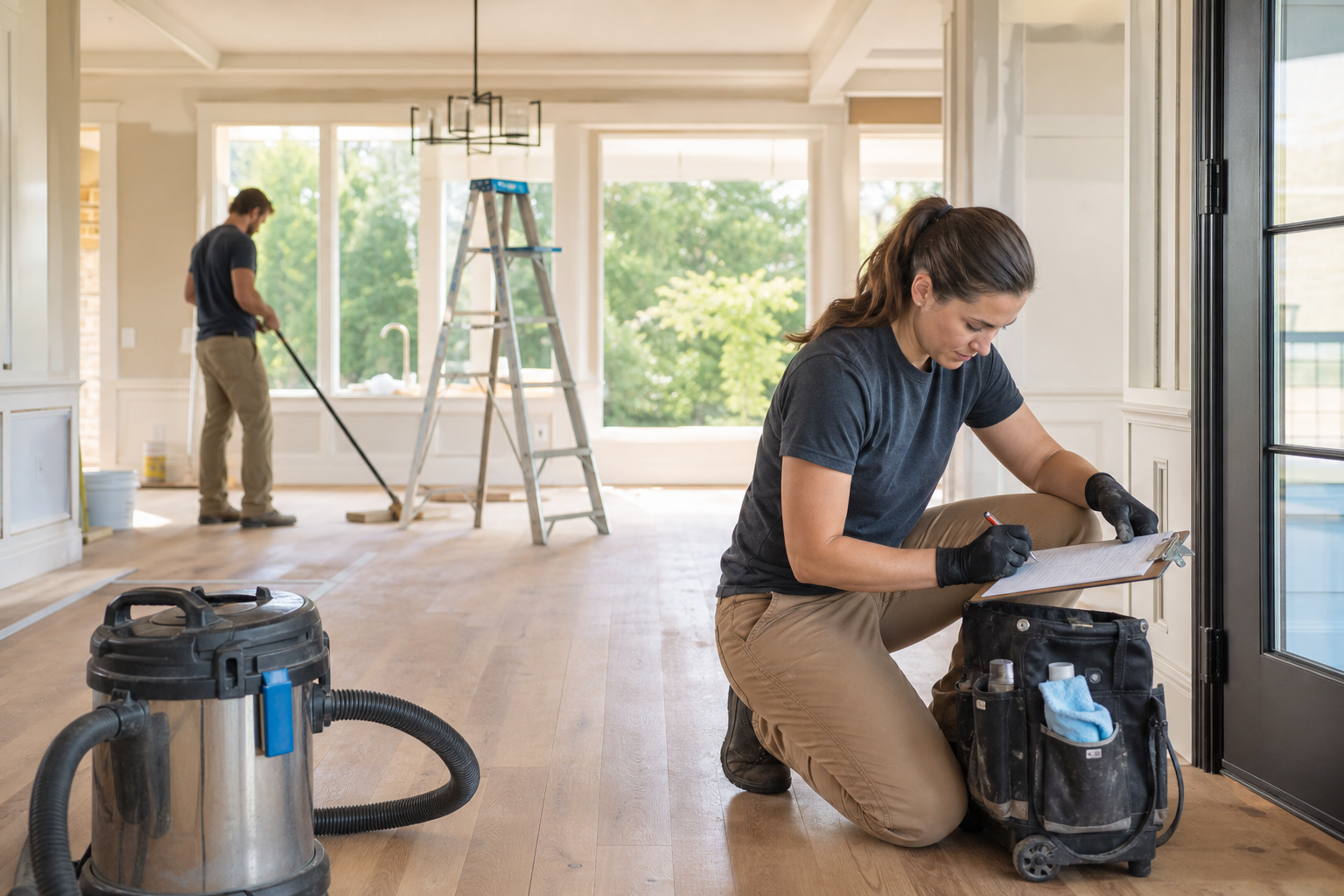
A useful closeout process walks through the work area methodically rather than treating cleaning as a single checkbox. Start by confirming that all tools, debris, and containment materials have been removed from the space. Then move to a review of surfaces, working from higher points in the room downward, since dust and debris tend to settle. Finally, confirm that any cleaning verification step called for by the applicable program, if one applies to the project, was actually performed and recorded, not simply assumed.
This review works best when both the homeowner and the project team walk the space together before it is reoccupied. A shared walkthrough reduces the chance that an assumption on one side, such as the homeowner believing the contractor performed a verification step, goes unconfirmed. Where the project scope falls under a specific regulatory program, the project team should be prepared to explain what was done and why, and the homeowner should feel comfortable asking those questions before signing off on the phase as complete.
- Confirm all tools, materials, and containment items have been removed from the work area.
- Review surfaces from higher points in the room downward before considering the space clean.
- Confirm whether a cleaning verification step applies to the project scope and whether it was performed.
- Walk the space together with the project team before the area is reoccupied.
- Record the date and outcome of the final review in the project file.
Responsibilities, dependencies, and hold points
Clear documentation depends on clear responsibility. Before work begins, it helps to know who is responsible for containment setup, who performs the cleaning, and who confirms the cleaning was adequate before the area is reoccupied. When these roles are undefined, records tend to be incomplete because no one person feels accountable for the full sequence from containment through verification.
Hold points, meaning specific moments in the project where work should not proceed until a review is complete, are a practical way to keep documentation honest. A hold point before reoccupying a cleaned work area gives everyone a natural pause to confirm the record is complete rather than assuming it will be handled later. This is especially relevant on multi-phase renovation projects, where a room might be reoccupied and used for weeks or months before the next phase begins elsewhere in the home.
- Identify who is responsible for containment setup before work begins.
- Identify who performs the cleaning and who confirms it before reoccupation.
- Use a hold point before reoccupying a work area on any phase involving disturbed painted surfaces.
- Do not assume documentation will be completed later once the space is back in use.
Common coordination failures
Some of the most common gaps in renovation cleaning documentation are not caused by carelessness but by unclear handoffs between people who each assumed someone else was tracking the record. A homeowner may assume the contractor is keeping detailed cleaning records as a matter of course, while the contractor may be following an internal process that does not produce a document the homeowner ever sees. Neither side is necessarily wrong, but the result is the same: no shared record exists when it is needed later.
Another common failure is treating a phase as closed simply because the visible work is finished, without confirming that cleaning and any applicable verification step were also completed and recorded. This is especially easy to overlook on projects with multiple trades or multiple work areas, where one crew's cleanup can be mistaken for a completed closeout of the entire phase. Building a habit of asking directly for the closeout record, rather than assuming it exists, helps close this gap.
- Homeowners and contractors may each assume the other is keeping the primary cleaning record.
- A visibly finished work area is not the same as a documented and verified closeout.
- Multiple trades working in the same space can create confusion about who completed which cleaning step.
- Ask directly for the closeout record rather than assuming one has been kept.
Questions for the responsible authority or qualified professional
Because renovation cleaning requirements can depend on the age of the property, the scope of work, and whether the project falls under a specific program, it is reasonable for homeowners to prepare a short list of questions before work begins rather than trying to figure this out after the fact. These questions are best directed to the EPA, the applicable state or local program office, or a qualified professional familiar with the specific project.
Bringing these questions up early, before demolition or surface disturbance begins, tends to produce clearer records later, because everyone understands from the start what documentation will be expected at closeout.
- Ask whether the project scope falls under a specific EPA renovation program given the home's age and use.
- Ask what cleaning verification steps, if any, apply to this specific project.
- Ask who will be responsible for creating and keeping the closeout documentation.
- Ask how the homeowner will receive a copy of the record at the end of each phase.
- Confirm these answers with the EPA, the authority having jurisdiction, or a qualified professional rather than relying on general assumptions.
Next action and related CDG service resource
Closing out a work phase in an older home is easier when the documentation habit is built into the project from the start rather than added at the end. Reviewing the EPA's published guidance for contractors and for DIYers before work begins gives homeowners a clearer sense of what questions to ask and what records to expect, and it puts everyone on the same page about what a completed, documented closeout actually looks like.
Cooper Development Group works on remodeling projects across the areas listed on our site and can walk through general planning considerations for older-home renovation phases as part of an initial conversation. For homeowners weighing a renovation project involving a pre-1978 home, reviewing our remodeling services page, browsing related planning articles on our blog, or reaching out through our consultation page are reasonable next steps. Any project-specific requirements, including those tied to painted surface disturbance in older homes, should still be verified with the EPA and the authority having jurisdiction before work begins.
- Review the EPA program pages linked in this article before finalizing a renovation scope.
- Visit /remodeling/ to see the general scope of CDG's remodeling services.
- Visit /blog/ for related planning articles in this series on pre-1978 remodel planning.
- Visit /consultation/ to start a conversation about general project planning considerations.
Questions homeowners ask
Is renovation cleaning documentation legally required for every older home project?
That depends on the scope of work, the property's age, and whether the work falls under a specific regulatory program. The EPA's Renovation, Repair and Painting Program page describes when certain renovation activities in pre-1978 housing and child-occupied facilities may trigger specific requirements, including cleaning verification steps. Because applicability depends on project-specific facts, this is a question to confirm with the EPA and the authority having jurisdiction before work begins, not something a general article can determine for a specific property.
What is the difference between a cleaning checklist and cleaning verification?
A cleaning checklist is generally an internal record of tasks performed, such as wiping surfaces or removing plastic sheeting, in a specific order. Cleaning verification, as described in EPA public materials, is a distinct step intended to check whether dust and debris have been adequately addressed before an area is reoccupied. The two serve different purposes, and a project record that only lists tasks performed is not the same as a record showing a verification step was completed. Confirm which of these your specific project scope requires with a qualified professional or the responsible authority.
Can homeowners handle renovation cleaning documentation themselves on a DIY project?
The EPA publishes separate guidance for do-it-yourselfers, titled Lead-Safe Renovations for DIYers, which discusses precautions homeowners can consider when disturbing painted surfaces in older homes. That guidance is a useful starting point for understanding general concepts, but it does not replace a homeowner's own review of current program details or, where applicable, consultation with a qualified professional. If a project scope is uncertain, discussing it with a qualified professional or the authority having jurisdiction before starting is a reasonable planning step.
Plan the next step
Use this article as a planning aid, then confirm project-specific requirements with the responsible authority and qualified professionals. Review CDG's related service, construction articles, or consultation page when you are ready to organize the next decision.
Official sources and verification
- U.S. Environmental Protection Agency: Renovation, Repair and Painting Program for Contractors
- U.S. Environmental Protection Agency: Lead-Safe Renovations for DIYers
Authority pages, forms, fees, review steps, and code references can change. Verify the current path for the property and scope before relying on a planning assumption.