
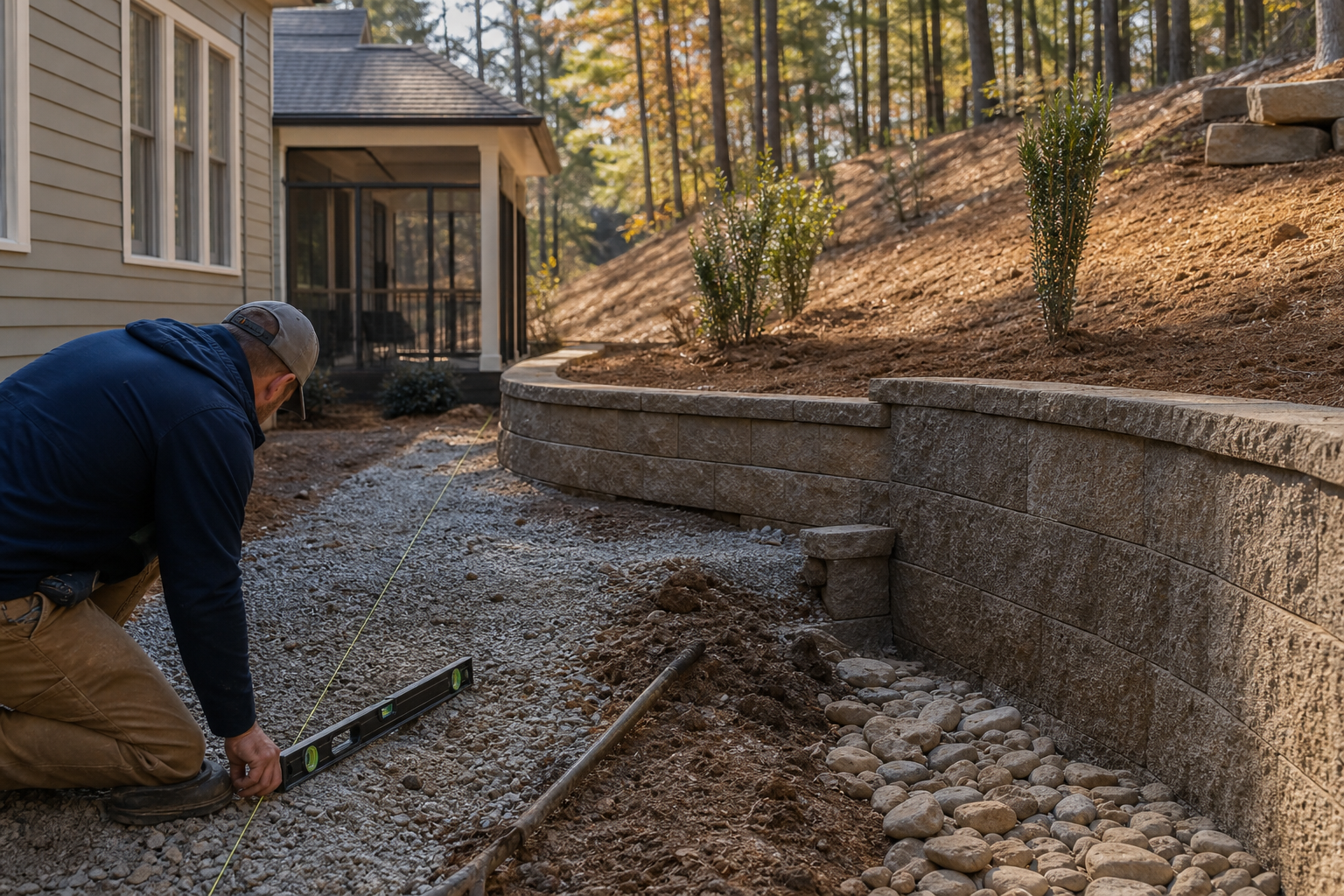
A retaining feature should be evaluated as part of grading and drainage because it does not function on its own. It sits inside a larger water path that includes slope, soil, downspouts, adjacent hardscape, and any nearby structures, and a problem in any one of those areas can show up as cracking, leaning, or erosion at the wall long before anyone traces it back to a drainage cause.
This article is planning guidance from Cooper Development Group, not a design, engineering, or code determination for any specific property. Retaining structures, grading, and stormwater management are regulated locally and can involve engineered design depending on height, load, and site conditions. Always verify current requirements with the authority having jurisdiction, such as York County, South Carolina or the City of Charlotte, before assuming a scope, review path, or approval outcome for your project.
What Current Public Sources Establish
Two published sources anchor this discussion. York County, South Carolina maintains a Stormwater Plan Review process that addresses how site drainage is reviewed for development activity in the county. The City of Charlotte maintains its own Stormwater Regulations page describing how the city approaches stormwater management within its jurisdiction. Both sources exist because grading and water movement on a property are treated as regulated concerns, not purely aesthetic ones.
Neither source is a substitute for a project-specific review, and neither should be read as a universal checklist that applies identically to every lot. Requirements can differ by jurisdiction, by watershed, by lot size, and by the scope of work being proposed. If a retaining feature renovation is being considered near Lake Wylie or anywhere else in the York County or Charlotte service areas, the practical first step is confirming which jurisdiction actually governs the property and which stormwater or grading review path applies before any design work is finalized.
- York County's Stormwater Plan Review page is the primary reference for stormwater-related review in that county.
- The City of Charlotte's Stormwater Regulations page is the primary reference for stormwater review inside Charlotte's jurisdiction.
- Jurisdiction can depend on the exact parcel location, so owners should confirm which authority applies before assuming a process.
Why This Is a Diagnostic Question, Not a Design Question
Retaining feature renovation drainage decisions start with observation, not with a design choice. Before anyone selects a wall material, a batter angle, or a drainage detail, the more useful early step is to build an honest, non-design diagnostic picture of what is actually happening on the site. This means looking at the wall and the ground around it as evidence, not as a finished product waiting for a facelift.
This diagnostic mindset matters because a retaining feature can look structurally fine while still sitting on top of an unresolved water problem, or it can look worn and dated while actually being sound. Treating the review as a fact-finding exercise first, and a design conversation second, helps owners and project teams avoid spending money on a cosmetic fix that does not address the underlying cause.
Inputs and Existing Conditions to Document
A useful starting point is a simple map, even a rough one, of what the property is already telling you. This is not a substitute for a professional evaluation, but it gives an owner language to use when describing the site to a contractor, an engineer, or a local reviewing authority.
The categories below are meant as observation prompts, not a compliance checklist. Documenting what you see, when you see it, and where it happens is often more valuable than trying to diagnose the cause yourself.
- Observed movement: note any cracking, bulging, leaning, or separation in the retaining feature itself, and whether it appears to be getting worse over time.
- Water behavior: note where water pools, where it runs, and whether the pattern changes after heavy rain versus light rain.
- Loads on or near the wall: note any patios, driveways, sheds, pools, or heavy landscaping features that sit above or adjacent to the retaining feature.
- Access conditions: note how equipment or materials would reach the area, including gates, slopes, and existing hardscape that could restrict access.
- Adjacent structures: note the location of the house foundation, other walls, fences, and neighboring property lines relative to the retaining feature.
- Prior work: note any past repairs, replacements, or drainage changes that may already have altered how water moves through the site.
Step-by-Step Owner and Project-Team Review
Once initial observations are documented, a structured review helps keep the process moving in a logical order rather than jumping straight to a design decision. This sequence is a planning approach, not a regulatory requirement, and it should be adapted to the specific property and the guidance of any professional involved.
The goal of this sequence is to make sure drainage and grading are considered before the retaining feature itself becomes the center of attention, since a wall that is renovated without addressing the water path behind it can face the same problems again.
- Walk the site after both dry and wet conditions and record what is observed using the categories above.
- Identify which local jurisdiction applies to the property and review that jurisdiction's published stormwater or grading information.
- Share the documented observations with a qualified professional, such as a structural engineer or licensed contractor, before discussing specific repair or renovation options.
- Ask whether existing grading or drainage patterns need to be addressed as part of the scope, separate from any cosmetic or structural work on the retaining feature.
- Confirm whether the project may require a stormwater or grading review with the authority having jurisdiction before work begins.
- Revisit the observation map periodically during planning, since new information can change the scope.
Responsibilities, Dependencies, and Hold Points
A retaining feature renovation involves more than one party, and it helps to be clear about who is responsible for what before work starts. Property owners are generally responsible for describing existing conditions accurately and for confirming which local requirements apply to their property. Contractors are generally responsible for executing agreed-upon work and communicating when a condition falls outside their scope or expertise.
Some decisions depend on a qualified professional's review and should be treated as hold points, meaning work should not proceed past that point until the review is complete. Determining whether a retaining wall requires an engineered design, determining whether a stormwater plan review is triggered, and confirming any required approvals with the authority having jurisdiction are examples of decisions that should not be assumed by an owner or a general contractor without proper input.
- Owners are generally responsible for documenting observed conditions and disclosing known history of movement or water issues.
- Contractors are generally responsible for flagging conditions that appear to exceed their scope or require specialized review.
- Structural or engineering determinations about the retaining feature itself should come from a qualified professional.
- Jurisdictional questions about stormwater or grading review should be directed to the applicable local authority, such as York County or the City of Charlotte.
Common Coordination Failures
Many retaining feature problems are not caused by a single bad decision but by a series of small coordination gaps between the people involved in a project. Recognizing these patterns ahead of time can help an owner ask better questions during planning.
One common pattern is treating the retaining feature as an isolated cosmetic item, without connecting it to the grading and drainage conditions around it. Another is assuming that because a wall has stood for years without visible failure, the drainage behind it must be adequate, when in fact water may simply be finding a slower or less visible path to travel. A third pattern involves gaps in communication between the owner, the contractor, and any reviewing authority, where each party assumes someone else has already confirmed a requirement.
- Assuming a retaining wall problem is purely cosmetic without checking for a related drainage or grading issue.
- Assuming long-term stability of a wall means the drainage behind it is functioning as intended.
- Skipping documentation of observed water behavior before starting design conversations.
- Failing to confirm which jurisdiction and review process apply before finalizing a renovation plan.
- Leaving structural or stormwater questions unresolved because no one has clearly asked the authority having jurisdiction.
Questions for the Responsible Authority or Qualified Professional
Before finalizing a retaining feature renovation plan, it is worth preparing a short list of questions to bring to the appropriate authority or professional. Framing these as direct questions, rather than assumptions, can help avoid gaps later in the project.
These questions are meant as a starting point for a conversation, not as a complete list of everything that might apply to a given property. The responsible authority or qualified professional may identify additional considerations specific to the site.
- Which jurisdiction governs stormwater and grading review for this specific property?
- Does this renovation scope trigger a stormwater plan review or grading review under current local requirements?
- Does the retaining feature's height, load, or location require an engineered design or a structural evaluation?
- Are there existing drainage easements, utility lines, or setbacks that affect where work can occur?
- What documentation or site information will the reviewing authority or professional need before a determination can be made?
Next Action and Related CDG Service Resource
Reviewing a retaining feature alongside grading and drainage is a planning step, and it fits within the broader question of what needs to happen on a property before exterior work begins. Owners considering this kind of project can review general information about home remodeling planning through Cooper Development Group's remodeling resources, browse related planning topics on the CDG blog, or reach out through the consultation page to start a conversation about next steps.
Because retaining feature renovation drainage checklist items depend heavily on site-specific conditions, the most useful next step for most owners is gathering documentation of observed conditions and confirming the applicable jurisdiction before requesting design or repair options. This keeps the project grounded in verified facts about the property rather than assumptions carried over from a different site or a different set of conditions.
- Review general home remodeling planning information at /remodeling/.
- Browse related planning topics and updates at /blog/.
- Start a conversation about a specific property through /consultation/.
Questions homeowners ask
Why should a retaining feature be evaluated as part of grading and drainage rather than on its own?
A retaining feature is physically connected to the slope, soil, and water path around it, so a problem with grading or drainage can appear as cracking, leaning, or erosion at the wall even when the wall itself was built correctly. Evaluating the feature in isolation risks treating a symptom without identifying the underlying water or soil issue, which is why a broader review of the surrounding conditions is generally a more reliable starting point.
Does every retaining wall renovation require a stormwater or grading review?
That depends on the jurisdiction, the scope of work, and the specific site conditions, and it is not something this article can determine for an individual property. York County, South Carolina and the City of Charlotte each publish stormwater review information, and the applicable authority having jurisdiction should be contacted directly to confirm whether a specific project triggers a review requirement.
Who decides whether a retaining wall needs an engineered design?
That determination should come from a qualified professional, such as a structural engineer, based on factors like the wall's height, the load above it, soil conditions, and any observed movement. This article does not provide that determination, and any specific engineering or structural question should be directed to a licensed professional or the authority having jurisdiction.
What should an owner document before contacting a contractor or engineer about a retaining feature?
It helps to record observed movement in the wall, patterns of water pooling or runoff, any structures or loads near the wall, access conditions for equipment or materials, nearby structures such as foundations or fences, and any history of prior repairs. This documentation gives the professional a clearer starting point and can make the review process more efficient.
Plan the next step
Use this article as a planning aid, then confirm project-specific requirements with the responsible authority and qualified professionals. Review CDG's related service, construction articles, or consultation page when you are ready to organize the next decision.
Official sources and verification
Authority pages, forms, fees, review steps, and code references can change. Verify the current path for the property and scope before relying on a planning assumption.