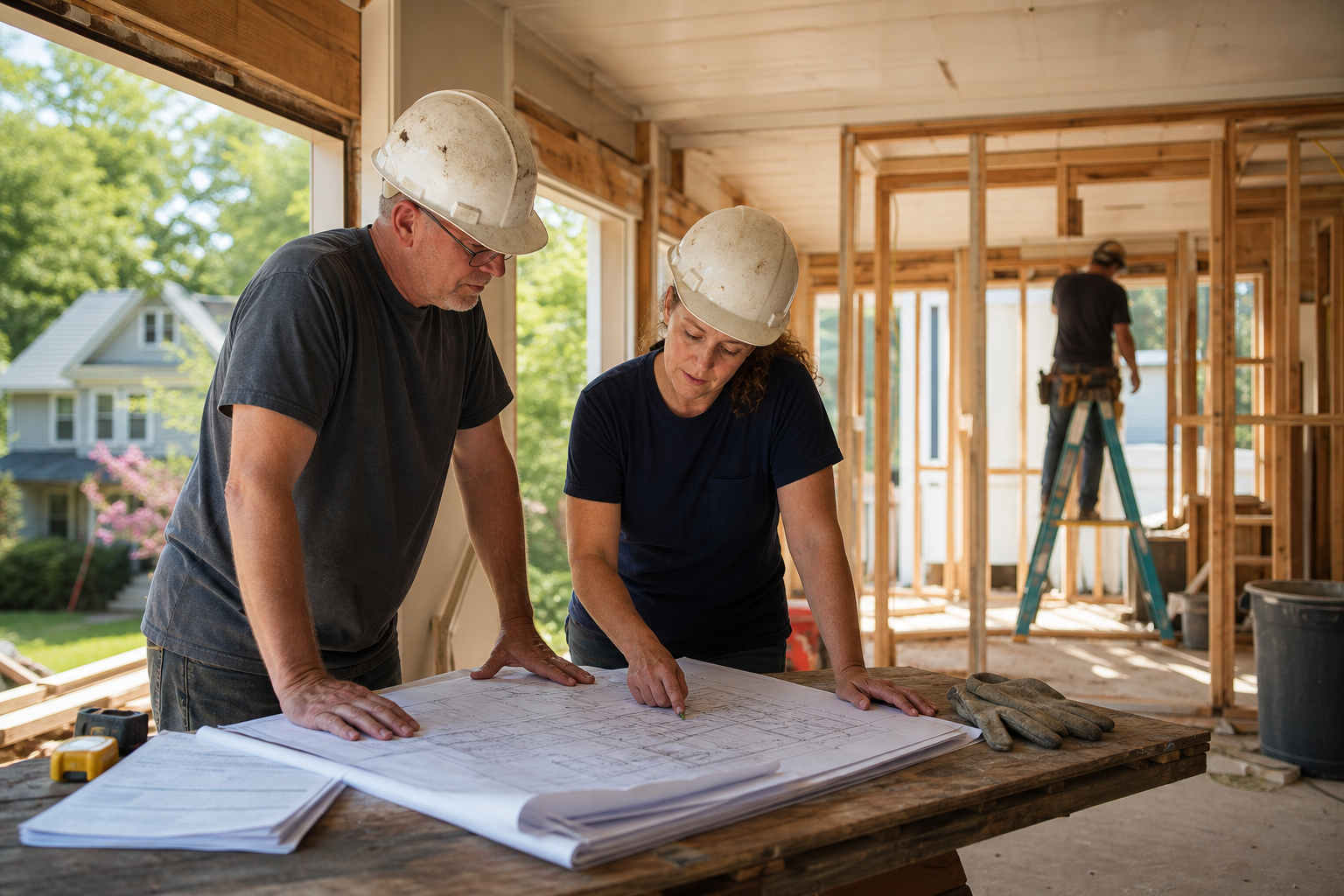
A scope change during demolition or repair in an older home can expose building materials that were not part of the original hazard review, which is why many project teams treat any new disturbance area as a trigger for another materials check before work continues. If a wall, floor, or ceiling section is opened beyond what was originally planned, the paint, plaster, insulation, or flooring in that newly exposed area has not yet been evaluated, and proceeding without that evaluation can create unnecessary exposure risk for occupants and workers.
This article summarizes publicly available guidance from the U.S. Environmental Protection Agency on lead-safe renovation practices, asbestos in home remodeling, and indoor environmental concerns during remodeling. It does not replace a site-specific inspection, a jurisdiction-specific code review, or the judgment of a qualified environmental professional. Homeowners should confirm current requirements with the authority having jurisdiction and with licensed or certified professionals before any demolition or repair work begins or expands.
What Current Public Sources Establish
The U.S. Environmental Protection Agency publishes several resources relevant to renovation work in older homes. Its Renovation, Repair and Painting Program guidance addresses lead-safe work practices during renovation activities in older housing. Its asbestos guidance discusses how asbestos-containing materials may be present in homes built before certain years and outlines general considerations for remodeling projects that might disturb those materials. Its guidance on indoor environmental concerns during remodeling addresses broader indoor air quality considerations that can arise when a home is disturbed during construction work.
These sources describe general principles and practices rather than a single nationwide rule that applies identically to every home, every scope change, and every jurisdiction. Requirements can vary depending on the age of the structure, the specific materials involved, and the jurisdiction where the work is occurring. Because of this variation, homeowners and project teams should treat these EPA resources as a starting point for understanding why hazard review matters, and then verify the specific requirements that apply to their project with the authority having jurisdiction and with qualified professionals.
- EPA's Renovation, Repair and Painting Program page addresses lead-safe work practices for renovation activities.
- EPA's asbestos guidance discusses materials that may be present in older homes and general remodeling considerations.
- EPA's indoor environmental concerns guidance addresses air quality considerations that can arise during remodeling.
- None of these resources substitute for a project-specific review by the authority having jurisdiction or a qualified professional.
Inputs and Existing Conditions to Document
Before any scope change is evaluated, it helps to have a clear record of what was already known about the home. This includes the approximate age of the structure, any prior materials testing that was performed, the specific areas that were already reviewed and cleared or flagged, and any documentation from previous phases of work. Without this baseline, it becomes difficult to tell whether a new area of disturbance is truly new or whether it overlaps with something already reviewed.
Existing conditions documentation should also include photographs or notes describing the physical condition of surfaces before demolition begins, records of who performed any prior testing, and notes on which professional or authority was consulted for that testing. This record becomes the reference point every time a scope change is proposed, because it allows the project team to compare the newly proposed disturbance area against what has already been evaluated rather than starting from scratch or assuming coverage that may not exist.
- The approximate age of the home and any known construction history.
- Records of any prior lead, asbestos, or other materials testing performed on the property.
- Photographs or notes describing the condition of surfaces before demolition began.
- Documentation of which professional or authority was involved in any prior review.
Step by Step Owner and Project Team Review
When a scope change is proposed, a structured review helps ensure that new disturbance areas are not overlooked. The first step is identifying exactly what is changing, such as an additional wall being opened, a different floor being removed, or a repair extending further than originally planned. The second step is comparing that new area against the existing documentation to determine whether it was already covered by a prior review or whether it represents genuinely new territory.
If the new area was not previously reviewed, the next step is determining who needs to be involved in evaluating it, which may include a qualified environmental testing professional, the contractor, and potentially the authority having jurisdiction depending on the nature of the work. Only after that evaluation is complete, or after a qualified professional has determined that further testing is not needed for that specific area, should work proceed in the newly disturbed section. This sequence helps keep the review process tied directly to the physical scope of the work rather than to the project as a whole.
- Identify precisely what part of the scope is changing and where the new disturbance area is located.
- Compare the new area against existing documentation to see if it was already reviewed.
- Determine which professional or authority needs to evaluate the newly exposed area.
- Hold work in that specific area until the appropriate review or professional determination is complete.
Responsibilities, Dependencies, and Hold Points
A change-control loop works best when responsibilities are clear from the start. The homeowner is generally responsible for understanding what has and has not been reviewed on their property and for raising questions when a scope change is proposed. The contractor or project team is generally responsible for communicating when a scope change is being considered and for not proceeding into a newly disturbed area without addressing whether it requires review. Any qualified environmental professional involved in testing is responsible for evaluating the specific area in question based on their own professional judgment and applicable guidance.
Dependencies matter here because a scope change in one area can sometimes affect decisions in another. For example, if a newly disturbed area shares a wall cavity or ductwork with an already reviewed section, that connection may need to be considered before either area is finalized. Hold points, meaning specific moments where work pauses until a review or approval is complete, should be tied to these dependencies rather than treated as arbitrary delays. When a hold point is respected, it means that a newly disturbed area is being checked before further work proceeds in that space, which is the core idea behind an older home remodel scope change hazard review.
- The homeowner is generally responsible for understanding what has already been reviewed on the property.
- The project team is generally responsible for flagging scope changes before proceeding into new areas.
- Qualified environmental professionals are responsible for evaluating specific newly disturbed areas.
- Hold points should be tied to physical dependencies between areas, not treated as arbitrary pauses.
Common Coordination Failures
One common failure is assuming that a hazard review performed for one phase of work automatically covers a later phase, even when the later phase disturbs a different part of the home. Another is treating a scope change as a purely scheduling or budget issue without recognizing that it may also be a materials issue that needs its own evaluation. A third is poor documentation, where no clear record exists of what was tested and where, making it difficult for anyone joining the project later to know what has already been addressed.
Communication gaps between the homeowner, contractor, and any environmental testing professional can also lead to coordination failures. If the contractor does not clearly explain why a scope change might require another review, or if the homeowner does not raise the question when a change is proposed, the loop can break down and work may proceed into an area that has not actually been evaluated. Consistent documentation and clear communication at each proposed change help reduce these gaps.
- Assuming a prior hazard review automatically covers a later, different disturbance area.
- Treating a scope change purely as a schedule or cost issue without considering materials risk.
- Failing to maintain clear documentation of what has and has not been tested.
- Communication gaps between the homeowner, contractor, and any environmental testing professional.
Questions for the Responsible Authority or Qualified Professional
Homeowners considering a scope change in an older home may find it useful to ask specific questions of the authority having jurisdiction or a qualified professional before work proceeds. These questions help clarify whether the proposed change requires additional review and what that review might involve. Because requirements can vary by jurisdiction and by the specific materials and construction methods involved, these questions should be directed to the parties who can speak to the specific property and location rather than answered generically.
It is also reasonable to ask how any new findings from a review of the changed area would be documented and communicated, and how that documentation would be integrated with records from earlier phases of the project. This helps ensure that the overall project record stays consistent even as the scope evolves.
- Does this specific scope change fall within an area that has already been reviewed, or is it new?
- What type of testing or evaluation, if any, is recommended for this newly disturbed area?
- Who is qualified to perform that evaluation, and how should the results be documented?
- How should this new information be integrated with records from earlier phases of the project?
Next Action and Related CDG Service Resource
If you are planning a remodeling project in an older home and anticipate that the scope of demolition or repair might change as work progresses, it can help to think through a change-control approach before work begins rather than after a change is already underway. Establishing how new disturbance areas will be documented, reviewed, and approved from the outset can make it easier to respond consistently if the scope does shift.
Cooper Development Group offers general remodeling services and can be a starting point for homeowners who want to discuss how project planning is typically approached, though any property-specific hazard review, testing, or regulatory determination should come from a qualified environmental professional or the authority having jurisdiction. You can learn more about general remodeling services at /remodeling/, read additional planning-related articles at /blog/, or reach out through /consultation/ to discuss general project planning questions.
- Consider establishing a change-control approach for hazard review before demolition or repair work begins.
- Keep a consistent record of what has been reviewed as the scope of work evolves.
- Direct property-specific testing and regulatory questions to a qualified professional or the authority having jurisdiction.
- Visit /remodeling/, /blog/, or /consultation/ to learn more about general project planning.
Questions homeowners ask
Why does a small scope change matter if the original hazard review already covered the house?
An original hazard review typically covers the specific areas that were planned for disturbance at the time it was conducted. When a scope change opens a wall, ceiling, floor, or other surface that was not part of that original plan, the materials in the newly exposed area have not been evaluated. Because paint, insulation, flooring, and other materials can vary from room to room and even within the same wall cavity in an older home, a change in the physical area of disturbance is generally treated as a reason to revisit the hazard review rather than assume the original findings apply everywhere.
Who decides whether a scope change requires a new materials review?
This depends on the nature of the change, the jurisdiction, and the professionals involved in the project. Homeowners should discuss any scope change with their contractor and, where appropriate, with a qualified environmental testing professional or the authority having jurisdiction. EPA guidance on lead-safe renovation and asbestos in home remodeling describes general practices, but the decision about whether a specific change warrants additional testing or review should be made by the responsible parties on that project, not assumed from a general article.
Does pausing work for a hazard review always mean a hazardous material was found?
No. Pausing to review new information is a precaution, not a finding. A hold point built into a change-control loop simply means that a newly disturbed area is being checked before work continues in that area, consistent with the kind of practice described in EPA materials on lead-safe renovation and indoor environmental concerns during remodeling. The actual result of any review, including whether a hazardous material is present, depends on testing and inspection specific to that home and should be evaluated by a qualified professional.
Plan the next step
Use this article as a planning aid, then confirm project-specific requirements with the responsible authority and qualified professionals. Review CDG's related service, construction articles, or consultation page when you are ready to organize the next decision.
Official sources and verification
- U.S. Environmental Protection Agency: Renovation, Repair and Painting Program for Contractors
- U.S. Environmental Protection Agency: Asbestos and Home Remodeling
- U.S. Environmental Protection Agency: Addressing Indoor Environmental Concerns During Remodeling
Authority pages, forms, fees, review steps, and code references can change. Verify the current path for the property and scope before relying on a planning assumption.