
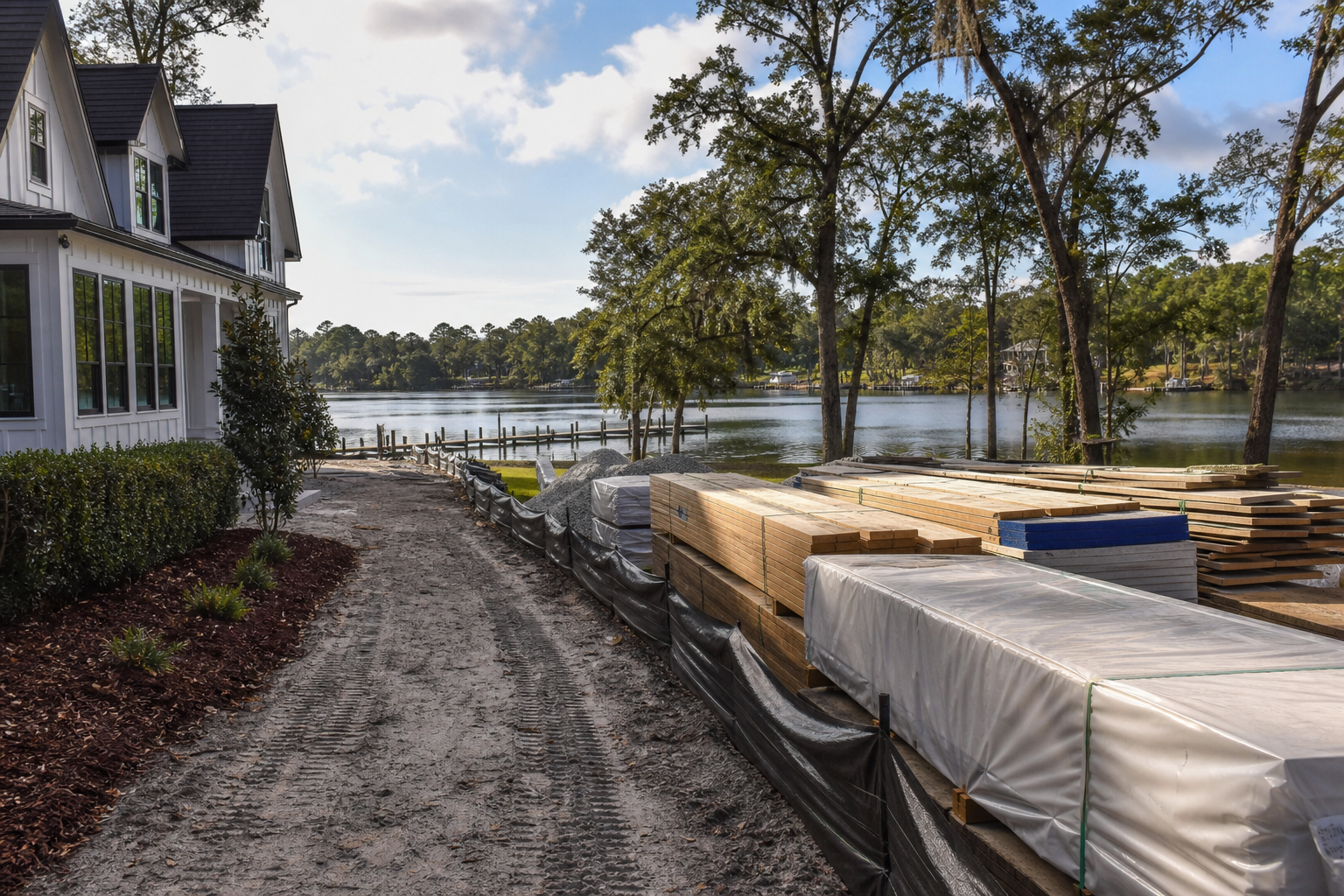
A constrained waterfront lot handles material staging best when the owner and project team map deliveries, storage, and cleanup into distinct phases tied to access routes, slope stability, and runoff controls, rather than treating the yard as one open laydown area. This means identifying where trucks can turn around, where covered storage keeps products dry and secured, which slopes need erosion protection before anything is unloaded, and how debris and packaging move off the property without crossing protected buffers near the water.
This article separates two kinds of information. Some statements describe what York County, South Carolina publishes about construction site runoff control and stormwater plan review, and those statements link directly to the county pages that should be checked before any lake-lot work begins. Other statements describe general planning practices that Cooper Development Group applies when thinking through logistics on tight, sloped, or water-adjacent sites. General planning practices are not a substitute for a site-specific runoff control plan, a stormwater review determination, or any other approval that York County or another authority having jurisdiction may require for a given property.
Direct Answer and Evidence Boundary
For an owner asking how a constrained waterfront site should plan deliveries and temporary storage, the short answer is to break the project into logistics phases before the first truck arrives. Each phase, from initial site access through final cleanup, has its own footprint requirements, its own runoff exposure, and its own storage needs. Planning these phases in sequence, rather than assuming all materials can sit in one place for the duration of a project, reduces the chance that stored products damage a slope, block an access route, or end up in a drainage path that was never meant to carry construction runoff.
The evidence boundary matters here because staging decisions on a lake lot intersect with local stormwater and erosion control requirements that are set by the county, not by a contractor's internal planning process. York County publishes information on construction site runoff control and on stormwater plan review, and those pages describe the county's expectations at a general level. This article uses those published pages as the factual floor. Anything beyond what the county publishes, including how a specific staging plan should be laid out on a specific lot, needs to be confirmed with the York County department responsible for stormwater review or with a qualified professional retained for that purpose.
What Current Public Sources Establish
York County's Construction Site Runoff Control page addresses how the county approaches erosion and sediment control during construction activity, including the general framework the county uses to reduce sediment leaving a construction site and entering nearby waterways. The Stormwater Plan Review page describes the county's process for reviewing stormwater-related plans submitted for development activity. Both pages are the primary sources this article relies on for anything related to runoff control or plan review expectations in York County.
Because requirements, submittal thresholds, and review procedures can change, and because a specific waterfront lot may trigger different requirements depending on its size, slope, and proximity to the water, this article does not restate the county's pages as a complete checklist. Instead, it points readers to the original source and recommends confirming the current process directly with York County before finalizing a staging plan. A property owner or project team should treat the county page as the authoritative starting point and should not rely on secondhand summaries, including this one, for compliance decisions.
- The York County Construction Site Runoff Control page addresses erosion and sediment control expectations for construction activity in the county.
- The York County Stormwater Plan Review page describes the county's review process for stormwater-related plans.
- Both pages should be checked directly for current requirements before a waterfront project begins, since local processes can be updated.
- Neither page is restated here as a complete compliance checklist, since project-specific triggers vary by lot.
Inputs and Existing Conditions to Document
Before any staging plan can be useful, the site itself needs to be documented. On a constrained lake lot, this usually starts with a clear picture of the access route from the public road to the work area, including any pinch points, overhead obstructions, or turning radius limits that could affect delivery vehicles. It also includes an honest assessment of slope grade across the property, since steep grades change how materials can be stored safely and how quickly runoff can move toward the shoreline if it is not controlled.
Existing vegetation, drainage swales, and any prior erosion control features already in place should also be recorded before work starts, since these elements often factor into what a stormwater plan reviewer expects to see addressed. Owners should also document where utility lines, septic systems, wells, or irrigation components are located, since staging areas need to avoid these features entirely rather than working around them after the fact. A written or photographed record of existing conditions gives the project team a shared reference point and gives the county something concrete to review if a stormwater plan submission becomes necessary.
- Access route width, turning radius, and any overhead or underground obstructions along the delivery path.
- Slope grade across the lot, particularly between the work area and the shoreline.
- Existing vegetation, drainage paths, and any erosion control features already present.
- Location of utilities, septic components, wells, or irrigation lines that staging areas must avoid.
- Photographs or notes documenting pre-construction conditions for reference throughout the project.
Step-by-Step Owner and Project-Team Review
A phased logistics review works best when it follows the same order materials will actually move through the site. The first phase covers access, meaning the route trucks and equipment will use to reach the work area, and whether that route needs temporary protection such as matting or gravel to prevent rutting on soft or sloped ground. The second phase covers runoff controls, meaning where silt fencing, inlet protection, or other measures need to be placed relative to the staging area and the shoreline before materials arrive, since controls installed after delivery has already begun are far less effective.
The third phase covers covered and secured storage, meaning identifying a location, ideally on flatter ground away from slopes and drainage paths, where materials sensitive to moisture or theft can be stored under cover. The fourth phase addresses slope stability directly, since any staging area located near a grade change needs a plan for keeping stacked materials from shifting or contributing to erosion. The fifth phase defines discrete work zones so that staging, active work, and clean material storage do not overlap and create confusion about what is protected and what is not. The sixth phase covers retrieval, meaning how materials move from storage to the active work area without repeatedly crossing runoff controls or disturbing protected ground. The final phase covers cleanup, including how packaging, offcuts, and debris are collected and removed so that nothing is left to wash toward the water after the crew leaves for the day.
- Phase one: confirm and, if needed, protect the delivery access route before materials arrive.
- Phase two: install runoff controls at the staging area boundary before deliveries begin.
- Phase three: designate covered, secured storage on flatter ground away from slopes and drainage paths.
- Phase four: address slope stability specifically where staging sits near a grade change.
- Phase five: define separate work zones so staging, active work, and clean storage do not overlap.
- Phase six: plan a retrieval path that avoids repeated disturbance of protected ground or runoff controls.
- Phase seven: schedule daily or regular cleanup so debris and packaging do not accumulate near the shoreline.
Responsibilities, Dependencies, and Hold Points
On a constrained waterfront lot, staging logistics depend on several parties working from the same plan. The owner is typically responsible for confirming property boundaries, easements, and any existing agreements that affect where equipment or materials can be placed. The contractor or project team is typically responsible for sequencing deliveries so that materials do not arrive before the site is ready to receive them, and for maintaining runoff controls throughout the staging period rather than only at the start. Any professional engaged for stormwater plan review or erosion control design is responsible for confirming that the controls proposed match what York County expects for the specific scope of work.
Hold points, meaning stages where work should pause until a condition is confirmed, are especially important on sites near the water. A reasonable hold point is confirming that runoff controls are installed and functioning before the first material delivery. Another is confirming that a stormwater plan review, if required for the project, has been submitted and addressed before significant site disturbance begins. Owners should ask their project team to identify these hold points explicitly rather than assuming they will be handled informally, since a missed hold point on a waterfront lot can be harder to correct once erosion or sediment movement has already occurred.
- Owners typically confirm boundaries, easements, and any recorded agreements affecting staging locations.
- The project team typically sequences deliveries so materials arrive only when the site is ready.
- A qualified professional, when engaged, confirms that proposed runoff controls match what the county expects for the project scope.
- A reasonable hold point is confirming runoff controls are installed before the first delivery.
- Another reasonable hold point is confirming any required stormwater plan review step has been addressed before major site disturbance.
Common Coordination Failures
Several recurring problems show up on constrained waterfront sites when staging is not planned in phases. One common failure is treating the entire yard as available storage space, which often results in materials sitting on slopes or near drainage paths simply because that was the only open area at the time. Another is installing runoff controls only after a complaint or visible sediment movement, rather than before deliveries begin, which defeats much of the purpose of the controls in the first place.
A third common failure is allowing delivery trucks to use routes that were never confirmed for weight or width, which can damage landscaping, driveways, or underground utilities that were not documented ahead of time. A fourth is failing to separate active work zones from material storage, which increases the risk of damage to stored products and makes it harder to keep a clean, organized site near the water. Addressing these failures generally comes down to the same fix: define the phases in advance, in writing, and confirm each hold point before moving to the next phase.
- Using the entire yard as open storage instead of a defined staging area away from slopes and drainage paths.
- Installing runoff controls after materials have already arrived rather than before.
- Sending delivery trucks down routes that were never confirmed for weight, width, or underground utility conflicts.
- Failing to separate storage areas from active work zones, increasing the risk of damage or site disorganization.
Questions for the Responsible Authority or Qualified Professional
Because staging decisions on a lake lot intersect with county-level runoff control and stormwater plan review expectations, owners and project teams should bring specific questions to York County or to a qualified professional before finalizing a plan. These questions should focus on what applies to the specific lot and project scope, since general publications cannot capture every site condition.
Owners should also confirm whether any prior stormwater or erosion control approvals already exist for the property, since those records may affect what is required for a new phase of work. Bringing documented existing conditions, as described earlier in this article, to that conversation tends to make the review process more efficient for everyone involved.
- What does York County's current stormwater plan review process require for a project of this size and location on a waterfront lot?
- Are there specific erosion and sediment control measures the county expects for staging areas near a shoreline?
- Does this property have any existing stormwater or erosion control approvals on file that should inform the current project?
- Who is the appropriate contact within York County to confirm current requirements before staging begins?
- Should a qualified professional be engaged to prepare or review a site-specific runoff control plan for this lot?
Next Action and Related CDG Resource
A constrained waterfront lot rewards early planning more than almost any other site type, since the margin for error near slopes, drainage paths, and the shoreline itself is smaller than on a typical inland lot. Working through access, runoff controls, covered storage, slope stability, work zones, retrieval paths, and cleanup as separate phases, and confirming each phase against current York County requirements, gives an owner a much clearer picture of what a project will actually require on the ground before materials start arriving.
Homeowners considering exterior work on a Lake Wylie or other waterfront property can review general information on home remodeling planning at CDG's remodeling resource, browse related planning topics on the CDG blog, or request a consultation to talk through site-specific logistics questions before finalizing a staging plan.
- Review general remodeling planning information at /remodeling/.
- Browse related site logistics and planning topics on /blog/.
- Request a consultation at /consultation/ to discuss site-specific staging questions before work begins.
Questions homeowners ask
What is waterfront construction material staging?
Waterfront construction material staging refers to how deliveries, temporary storage, and work zones are organized on a lake-adjacent or shoreline property during a remodeling or construction project. Because these sites often combine limited flat area, slopes, and proximity to water, staging typically needs to be planned in phases rather than treated as one open storage area, and it needs to account for runoff control expectations set by the local jurisdiction.
Does a waterfront construction material staging checklist replace a county-required stormwater plan?
No. A general staging checklist, including the phase-based approach described in this article, is a planning tool and does not replace any stormwater plan review or runoff control approval that York County or another authority having jurisdiction may require for a specific property. Owners and project teams should confirm the current, project-specific process directly with the county before finalizing staging decisions.
Who should be contacted to confirm current runoff control requirements for a lake lot in York County?
York County publishes information on Construction Site Runoff Control and Stormwater Plan Review, and those pages identify the county's general approach to these topics. For a property-specific determination, the appropriate York County department handling stormwater review should be contacted directly, since requirements and review procedures can change and can vary based on the lot's size, slope, and location.
How does home remodeling planning differ on a constrained waterfront lot compared to a typical inland lot?
Home remodeling planning on a constrained waterfront lot generally requires more attention to access routes, slope stability, and runoff paths than a typical inland lot, since there is often less flat, open space available and less margin for error near a shoreline. This usually means staging areas, delivery routes, and runoff controls need to be planned and confirmed in phases before work begins, rather than adjusted informally as the project proceeds.
Plan the next step
Use this article as a planning aid, then confirm project-specific requirements with the responsible authority and qualified professionals. Review CDG's related service, construction articles, or consultation page when you are ready to organize the next decision.
Official sources and verification
- York County, South Carolina: Construction Site Runoff Control
- York County, South Carolina: Stormwater Plan Review
Authority pages, forms, fees, review steps, and code references can change. Verify the current path for the property and scope before relying on a planning assumption.