
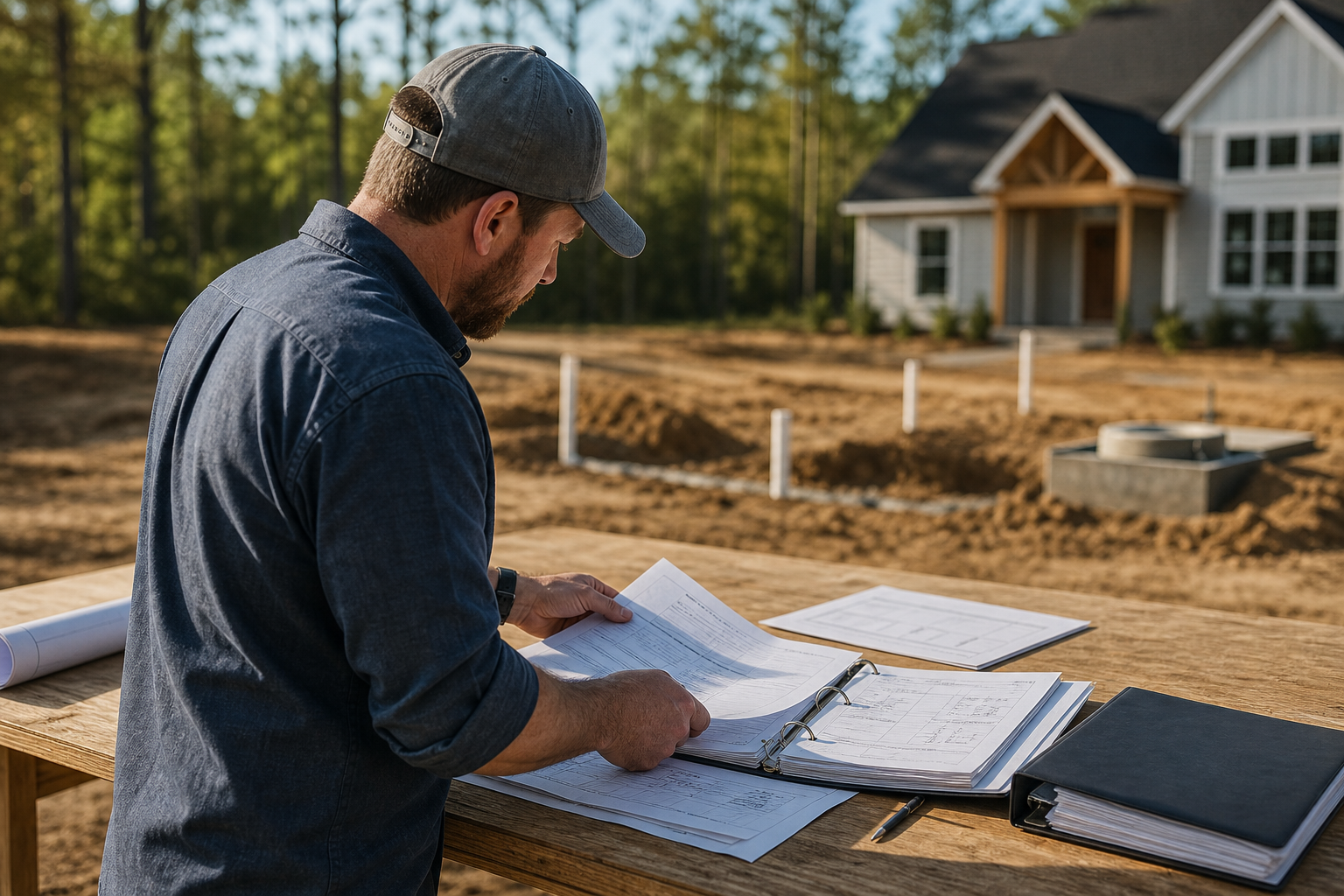
Before relying on any residential septic assumption for a Carolinas lot, a home builder or owner should assemble the property's existing septic and soil records, the current South Carolina Department of Environmental Services (DES) application and permitting information for the specific county, and a clear record of who the responsible licensed professional or agency contact will be for that parcel. This means gathering deed and parcel history, any prior septic permits or repair records tied to the lot, soil or site evaluation documentation if one has already been performed, and confirmation of which DES office or environmental health office currently handles applications for that county.
This article summarizes what the South Carolina Department of Environmental Services publishes about residential septic tank permitting and points to where a builder or owner should look for current forms, fees, and procedures. It does not restate specific application forms, fee amounts, or timelines because those details change and are controlled by DES, not by Cooper Development Group. Every property-specific requirement, application form, fee schedule, and approval decision must be verified directly with DES or the applicable county environmental health office before any construction planning proceeds.
What Current Public Sources Establish
The South Carolina Department of Environmental Services (DES) is the state authority that oversees septic tank permitting for residential construction in South Carolina. DES publishes guidance specifically for single-home builders describing the general process for obtaining septic tank permits, along with a separate page of septic tank regulations, forms, and fact sheets that DES updates as rules or procedures change.
Because these DES pages are maintained by the agency and are subject to revision, this article intentionally does not reproduce specific form numbers, fee amounts, or processing windows. Instead, the useful and durable takeaway for a builder or owner is knowing that DES is the primary source, that county environmental health offices are typically involved in local implementation, and that the current version of any form or fee schedule should always be pulled directly from the DES website or confirmed by phone or in writing with the appropriate DES or county office before it is used in project planning.
Inputs and Existing Conditions to Document
A meaningful septic assumption for a lot depends on assembling accurate existing-condition records rather than guessing based on neighboring properties or general soil maps. A builder should start by identifying whether the parcel has any prior septic system on it, whether that system was ever permitted, repaired, or abandoned, and whether any soil or site evaluation has already been completed by a qualified professional or documented by DES or a predecessor agency.
Other existing conditions worth documenting early include the parcel's boundary survey, any recorded easements or setback restrictions that could affect where a system or drainfield could be placed, floodplain or wetland designations that may be shown on county GIS or FEMA resources, and any note of a well or water supply line location on or near the lot. These records do not replace a professional site evaluation, but having them organized in one place helps the project team and the responsible professional work more efficiently once a formal evaluation is scheduled.
- Prior septic permit or repair history for the parcel, if any exists in county or DES records.
- Any existing soil evaluation or site evaluation report tied to the specific lot.
- Recorded boundary survey and any easements affecting potential drainfield location.
- Known floodplain, wetland, or steep slope designations from county or federal mapping resources.
- Location of any existing well, water line, or utility easement near the building envelope.
Step-by-Step Owner and Project-Team Review
A practical review sequence starts with the owner or builder confirming the county in which the lot sits, since septic administration in South Carolina is coordinated at both the state DES level and through county environmental health offices, and the correct point of contact can vary by location. Once the correct office is identified, the next step is requesting whatever historical file exists for the parcel, including any prior permits, inspection notes, or evaluation reports on record.
After historical records are gathered, the owner and builder should identify which licensed or qualified professional will perform any new site or soil evaluation required for the specific project, and confirm directly with DES or the county office what current application steps, forms, and supporting documentation are expected. This review should happen before house placement or site design is finalized, since drainfield location, required setbacks, and usable building area are often directly tied to where a septic system can be sited on the lot.
- Confirm the county and the correct DES or county environmental health contact for that parcel.
- Request any existing permit, evaluation, or repair history on file for the property.
- Identify the qualified professional who will perform or has performed the site evaluation.
- Confirm current application requirements directly with DES or the county office before design is finalized.
- Document all findings in a single organized file the project team can reference throughout planning.
Responsibilities, Dependencies, and Hold Points
Septic feasibility work sits at an important dependency point in early project planning. House placement, driveway location, well placement, and even landscaping plans can all be affected by where a septic system and its reserve area must be sited, so treating the septic evaluation as an early hold point rather than an afterthought helps avoid costly redesign later. The responsibility for the formal site evaluation and application generally rests with a qualified environmental health professional or the applicant working through DES or the county office, not with the builder alone.
A builder's role is typically coordination and documentation. This includes making sure the correct professional is engaged, that the owner understands which approvals are pending before construction activities begin, and that no site work assumes a septic layout that has not been confirmed by the responsible authority. Treating the septic approval as a hold point means pausing major site decisions, such as finalizing the house footprint or ordering site grading, until the applicable permit or approval status is clearly known.
- Septic siting can directly affect house placement, driveway routing, and well location.
- The qualified environmental health professional or DES-recognized process governs the formal evaluation and application.
- The builder's practical role is coordination, documentation, and scheduling around confirmed information.
- Site work and design finalization should be treated as dependent on septic evaluation outcomes, not run in parallel without confirmation.
Common Coordination Failures
One frequent coordination failure is assuming a neighboring lot's septic approval or soil conditions apply to a new parcel, when in fact soil conditions, lot size, and prior land use can vary significantly even between adjacent properties. Another common issue is relying on outdated forms or fee information found in old files, bookmarks, or third-party summaries instead of confirming current requirements directly with DES or the county office at the time of application.
A third common failure is starting site grading, clearing, or house footprint staking before the septic evaluation and any required approval status is confirmed, which can force costly adjustments if the septic system needs to be relocated. Finally, incomplete communication between the owner, builder, and evaluating professional about who is responsible for submitting which documents can cause delays, so establishing clear points of contact early in the process helps keep the project moving in a predictable way.
- Assuming a neighboring lot's septic history applies without a lot-specific evaluation.
- Using outdated forms, fees, or procedural summaries instead of current DES-published information.
- Beginning site clearing or footprint staking before septic evaluation status is confirmed.
- Unclear division of responsibility between owner, builder, and evaluating professional for document submission.
Questions for the Responsible Authority or Qualified Professional
Because septic permitting decisions are property-specific and governed by DES and county environmental health offices, an owner or builder should prepare a focused set of questions before contacting the responsible authority. These questions should aim to confirm the current process rather than assume it matches what may have applied to a different property or an earlier project.
Useful questions include confirming which office currently handles applications for the parcel's county, what documentation is currently required to begin a site or soil evaluation, whether any prior permit or repair history exists for the lot, and what the general sequence of steps looks like from initial application through any inspection or approval stage. Asking these questions directly of DES or the county office, rather than relying on secondhand summaries, helps ensure the information used in project planning reflects the current process.
- Which office currently handles septic applications for this specific county.
- What documentation is currently required to begin a site or soil evaluation on this lot.
- Whether any prior septic permit, repair, or evaluation record exists for the parcel.
- What the general current sequence of steps looks like from application through any inspection or approval stage.
Next Action and Related CDG Service Resource
Assembling South Carolina septic application records early in the planning process gives an owner and builder a clearer, better-organized starting point before committing to a house placement or site design. This groundwork does not replace a formal site evaluation or a direct conversation with DES or the county environmental health office, but it does reduce the chance of relying on outdated or borrowed assumptions about a lot's septic feasibility.
Owners working through pre-construction planning on a Carolinas lot can review related planning information on the Cooper Development Group blog, explore the pre-construction planning resource for Lake Wylie, SC, or reach out through the consultation page to discuss general project coordination questions. Any septic-specific determination should still be confirmed with DES or the applicable county office as part of that broader planning process.
- Review general pre-construction planning information on the CDG blog.
- See the Lake Wylie, SC pre-construction planning resource for related lot-planning context.
- Use the consultation page to discuss general project coordination and planning questions.
Questions homeowners ask
Where can a builder or owner find the current South Carolina septic application forms and fees?
The South Carolina Department of Environmental Services publishes septic tank regulations, forms, and fact sheets directly on its website, and this is the appropriate place to check for the current version of any application form or fee schedule, since these details are subject to change and are controlled by DES rather than by a builder or third party.
Does a prior septic permit on a lot mean a new house can use the same system or layout?
Not necessarily. Prior permits or repair records are useful historical documentation, but whether an existing system or layout can be used, modified, or must be replaced depends on a current site evaluation and confirmation from DES or the county environmental health office, since soil conditions, system age, and intended use can all affect what is currently allowed.
Who should perform the septic site or soil evaluation for a new home?
A qualified environmental health professional recognized through the DES process, or the applicable county environmental health office procedure, is responsible for performing or overseeing the site or soil evaluation. A builder's role is generally to coordinate scheduling and documentation, not to perform or substitute for that evaluation.
Why doesn't this article list specific South Carolina septic fees or timelines?
Fees, timelines, and specific procedural steps published by DES can change, so this article intentionally avoids restating them as fixed facts. Instead, it points readers to the current DES sources so that any South Carolina septic application records checklist used in project planning reflects up-to-date information confirmed directly with the responsible authority.
Plan the next step
Use this article as a planning aid, then confirm project-specific requirements with the responsible authority and qualified professionals. Review CDG's related service, construction articles, or consultation page when you are ready to organize the next decision.
Official sources and verification
- South Carolina Department of Environmental Services: Septic Tanks for a Residential Single-Home Builder
- South Carolina Department of Environmental Services: Septic Tank Regulations, Forms, and Fact Sheets
Authority pages, forms, fees, review steps, and code references can change. Verify the current path for the property and scope before relying on a planning assumption.