
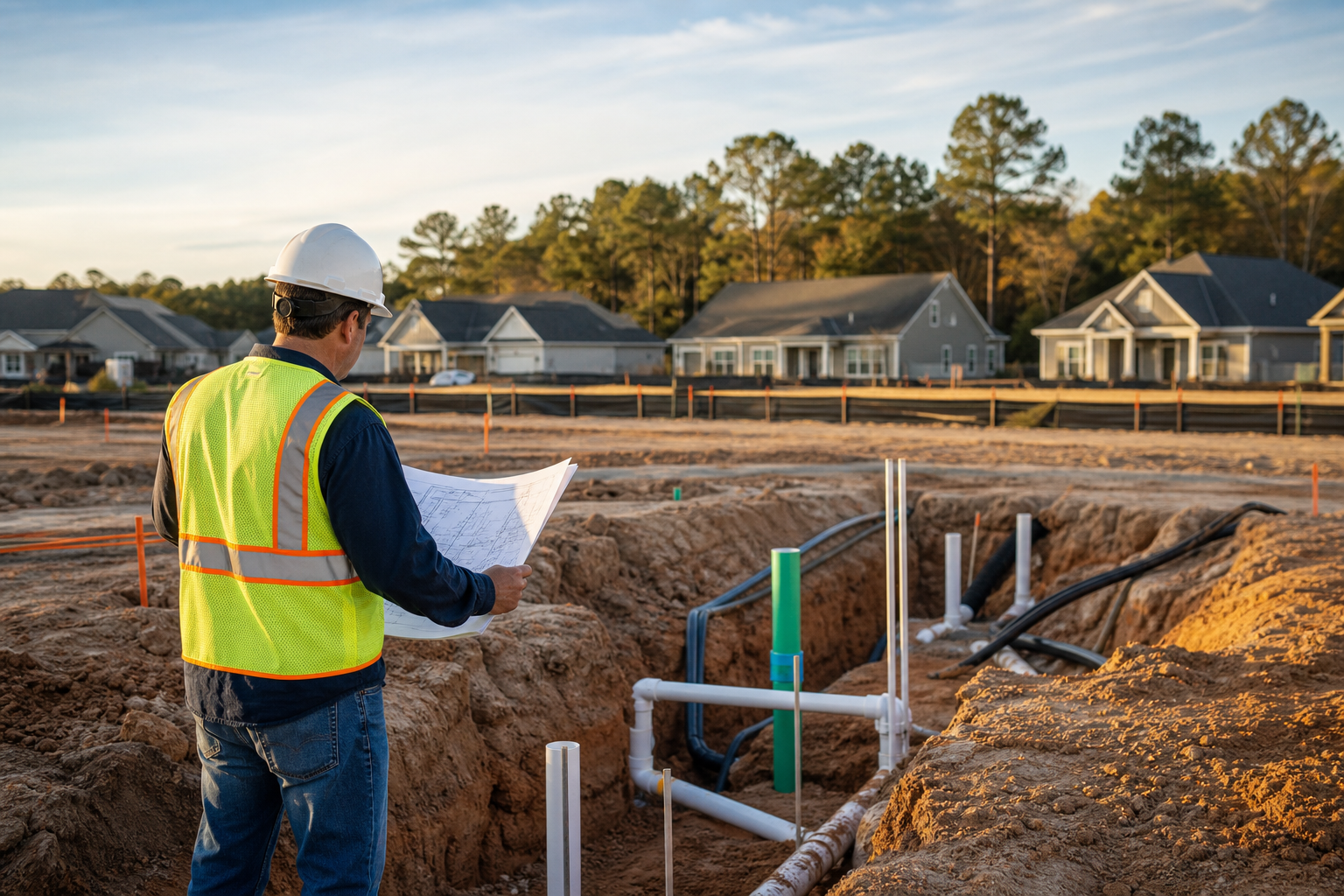
Seeing a water main or sewer line on a public map near a property does not mean that property already has a workable path to service. Utility availability vs connection plan are two different questions: availability describes whether infrastructure physically exists somewhere in the vicinity, while a connection plan describes how a specific project will actually tie into that infrastructure, whether the system has capacity to accept it, who owns the easements involved, what design and installation work is required, and whether the responsible utility and local authority have approved that specific path.
Charlotte Water's published pages on new connection installations and its Capacity Assurance Program describe a structured review and approval process for commercial development connections, separate from simply confirming that a pipe exists nearby. Those pages are the factual floor for this article, and they can change. Anyone evaluating a specific parcel in Charlotte, or any other jurisdiction, should verify current requirements directly with Charlotte Water or the applicable authority having jurisdiction before making planning or financial decisions based on this article.
Direct Answer and Evidence Boundary
The short answer to why nearby infrastructure does not by itself resolve a project's connection scope is that infrastructure presence, system capacity, engineering design, legal easements, physical installation, and formal approval are six separate layers of information, and a public map or utility availability inquiry generally speaks to only the first layer. A property can sit within sight of a water main or sewer line and still face a lengthy, uncertain, or costly path to an actual usable connection once capacity, design, easement, and approval questions are examined.
This distinction matters early in pre-construction planning because owners and project teams sometimes treat a preliminary availability response as if it were a completed connection plan. It is not the same thing, and this article draws that line explicitly using the structure that Charlotte Water itself uses to organize commercial connection work: a new connection installation process on one hand, and a capacity assurance evaluation on the other. Both are described on Charlotte Water's published pages, and both exist because availability alone does not answer the questions a project actually needs answered.
What Current Public Sources Establish
Charlotte Water maintains a page describing New Connection Installations for commercial development, which outlines that connecting to public water and sewer service involves a defined process rather than a single yes-or-no availability check. Charlotte Water also maintains a separate page for its Capacity Assurance Program, which addresses whether the existing system has the capacity to accept additional demand from commercial customers. The fact that these are two distinct published resources, maintained by the same utility, is itself informative: it reflects that the utility treats connection installation and capacity assurance as different functions with different review steps.
These pages are the factual floor for this article and they are subject to change, since utility programs, forms, and review procedures are periodically updated. Readers should treat the general existence of these processes as reliable at the time of this writing, while confirming the current procedural detail, required documentation, and applicable fees or timelines directly with Charlotte Water before relying on them for a specific project.
It is also worth noting that these Charlotte Water resources are specific to that utility and that jurisdiction. Projects located in other cities, counties, or utility service areas will need to identify and consult the equivalent authority having jurisdiction for water and sewer connections, since procedures, terminology, and review structures can differ from one utility system to another.
Inputs and Existing Conditions to Document
Before a project team can meaningfully evaluate a connection scope, a set of existing conditions typically needs to be gathered and documented. This is not a substitute for a formal utility review, but it is the kind of preparatory information that tends to make later conversations with a utility or design professional more productive and less speculative.
Owners and project teams commonly benefit from assembling parcel boundaries and any recorded easements, existing utility record drawings or as-built information where available, a general understanding of anticipated water and sewer demand for the intended use, and any prior correspondence or applications already on file with the utility. None of these inputs by themselves confirm capacity or approval, but they help frame the specific questions that should be directed to the utility and to qualified design professionals.
- Parcel survey information and any recorded easements affecting the property.
- Existing utility record drawings or as-built plans, where they can be obtained.
- A general description of the intended use and anticipated water and sewer demand.
- Any prior correspondence, applications, or determinations already received from the utility.
Step-by-Step Owner and Project-Team Review
A practical review sequence starts with treating utility availability as a starting point rather than an endpoint. The first step is confirming, through the utility's own published information or a direct inquiry, that a main line exists at or near the property and understanding its general location. The second step is recognizing that this confirmation says nothing about capacity, and submitting whatever inquiry or application the utility requires to evaluate whether the system can accept the project's anticipated demand.
From there, the sequence generally moves into design, where a qualified civil or utility engineer works out how a connection would actually be built, including routing, depth, and material requirements consistent with the utility's standards. Easement review follows or runs in parallel, since a design that crosses another owner's property or an area without existing utility rights will need those rights secured before installation can proceed. Only after design, easements, and any required permits are addressed does physical installation occur, followed by the utility's and jurisdiction's final inspection and approval before the connection is placed into service.
This is a general sequence rather than a fixed checklist that applies identically to every project, and the actual order, documentation, and review points for a specific parcel should be confirmed with Charlotte Water or the applicable authority having jurisdiction.
- Confirm general infrastructure presence and location using utility-provided information.
- Request a capacity evaluation appropriate to the project's anticipated demand.
- Engage a qualified engineer to develop a connection design consistent with utility standards.
- Identify and resolve any easement needs before installation begins.
- Complete installation and obtain the utility's and jurisdiction's final approval before activating service.
Responsibilities, Dependencies, and Hold Points
Each layer of the connection process tends to sit with a different responsible party, and understanding those boundaries helps a project team know who to ask rather than guessing. The utility, in this case Charlotte Water, is generally responsible for confirming system capacity and for final review and approval of installed connections. Design work is typically the responsibility of a qualified engineer retained by the owner or contractor, working within the utility's technical standards. Easement matters often involve legal review and negotiation, which may require coordination with adjoining property owners or a title professional.
These responsibilities are also dependent on each other in a specific order, which creates natural hold points in a project schedule. A capacity determination usually needs to happen before a design is finalized, since designing around an assumption of available capacity that does not exist can require rework. Similarly, easements generally need to be secured before installation can be scheduled, since construction crews cannot lawfully install infrastructure across land without the necessary rights in place. Recognizing these dependencies early allows a project team to sequence utility coordination alongside other pre-construction planning tasks rather than discovering a hold point late in the process.
Common Coordination Failures
A number of recurring coordination issues show up when utility availability is mistaken for a completed connection plan. One common failure is proceeding with site design or even permitting submissions based on an assumption that a nearby main automatically provides adequate capacity, only to learn later that a capacity evaluation raises questions that require redesign or additional utility coordination. Another is underestimating the time and legal work involved in securing an easement, particularly when the connection route crosses land owned by a party unrelated to the project.
A third recurring issue is treating a preliminary or informal utility response as if it were a final approval, when in fact the utility's own process, such as the structure described in Charlotte Water's Capacity Assurance Program, may involve multiple review steps before a connection is formally approved. Projects that build their schedules and cost assumptions around an early, informal signal rather than a documented final determination can face avoidable delays when that early signal does not hold up under full review.
- Assuming nearby infrastructure automatically means adequate capacity exists.
- Underestimating the time needed to identify and secure required easements.
- Treating a preliminary utility response as a final approval.
- Finalizing design before capacity has been confirmed by the utility.
- Overlooking that installation and approval are separate steps that both need to be completed.
Questions for the Responsible Authority or Qualified Professional
Because connection scope questions are property-specific and time-sensitive, they are best directed to the utility and to qualified professionals rather than resolved through general research alone. For projects within Charlotte Water's service area, that means using the utility's published New Connection Installations and Capacity Assurance Program resources as a starting point, and following up directly with Charlotte Water for project-specific answers. For projects elsewhere, it means identifying the equivalent water and sewer authority and following that jurisdiction's own published process.
A useful set of questions to bring to that conversation includes whether the existing system has confirmed available capacity for the intended use, what documentation or application is required to begin a formal capacity review, what design standards apply to a new connection in that location, whether any easements will be needed and who holds the relevant property rights, and what the utility's process is for final inspection and approval before service can be activated. These questions are meant to guide a conversation with the authority having jurisdiction and with licensed design professionals, and they are not a substitute for that professional and regulatory review.
- Has capacity been confirmed for this specific use, and what documentation is required to request that review?
- What design standards apply to a new connection at this location?
- Will any easements be needed, and who currently holds the relevant property rights?
- What is the utility's process for final inspection and approval before service is activated?
- Where can current, official process information be found for this jurisdiction?
Next Action and Related CDG Resource
Treating utility availability and a buildable connection plan as the same thing is a common but avoidable planning gap, and closing that gap early tends to make the rest of pre-construction planning more predictable. Reviewing the existing conditions described above, working through the general sequence of capacity evaluation, design, easement resolution, installation, and approval, and directing property-specific questions to Charlotte Water or the applicable authority having jurisdiction are practical steps that any owner or project team can take before locking in a utility plan.
Cooper Development Group's related resource on infrastructure and building systems planning offers further general context for owners thinking through these coordination questions as part of broader pre-construction planning. Readers can also review other planning-related articles on the CDG blog, and those who want to discuss a specific project's planning needs are welcome to reach out through the consultation page. None of these resources replace the responsible utility's own review process, and any property-specific determination should ultimately come from Charlotte Water or the applicable authority having jurisdiction.
- Review Cooper Development Group's infrastructure and building systems resource for related planning context.
- Browse the CDG blog for additional pre-construction planning articles.
- Use the consultation page to discuss a project's general planning needs with CDG.
- Confirm all property-specific capacity, design, easement, and approval questions with Charlotte Water or the applicable authority having jurisdiction.
Questions homeowners ask
If a utility map shows a line on or near my street, does that mean my project has an approved connection point?
Not by itself. A map showing an existing line indicates that infrastructure is present in the area, but it does not confirm that the specific system has available capacity for a new connection, that the alignment and depth work for the project, or that the utility and local authority have reviewed and approved a connection design for that parcel. Those are separate determinations that typically require a project-specific submission to the utility, in this case Charlotte Water, and confirmation should always come from that authority rather than from a general map.
Who decides whether a public water or sewer system has enough capacity for a new project?
The utility that owns and operates the system is responsible for evaluating capacity, and Charlotte Water describes this function through its Capacity Assurance Program for commercial development. Capacity evaluation generally looks at more than just the presence of a pipe, and it can be affected by other projects, system conditions, and utility policies that change over time. Because these evaluations are project-specific and time-sensitive, owners and design teams should request a current capacity determination from Charlotte Water rather than assuming that visible infrastructure equals available capacity.
What is the difference between utility design, easements, and installation approval for a new connection?
Design refers to the engineering work that lays out how a connection will be built, including pipe sizing, routing, and materials, and it is typically prepared by a qualified engineer in coordination with the utility's standards. Easements refer to the legal rights needed to place and access utility infrastructure across a property, which may involve other owners or existing recorded documents. Installation approval refers to the utility's and jurisdiction's sign-off that the physical construction meets requirements before service is activated. Each of these is a distinct step, and confirming where a project stands in that sequence should be done directly with Charlotte Water and the responsible design professionals, not assumed from availability information alone.
Plan the next step
Use this article as a planning aid, then confirm project-specific requirements with the responsible authority and qualified professionals. Review CDG's related service, construction articles, or consultation page when you are ready to organize the next decision.
Official sources and verification
Authority pages, forms, fees, review steps, and code references can change. Verify the current path for the property and scope before relying on a planning assumption.