
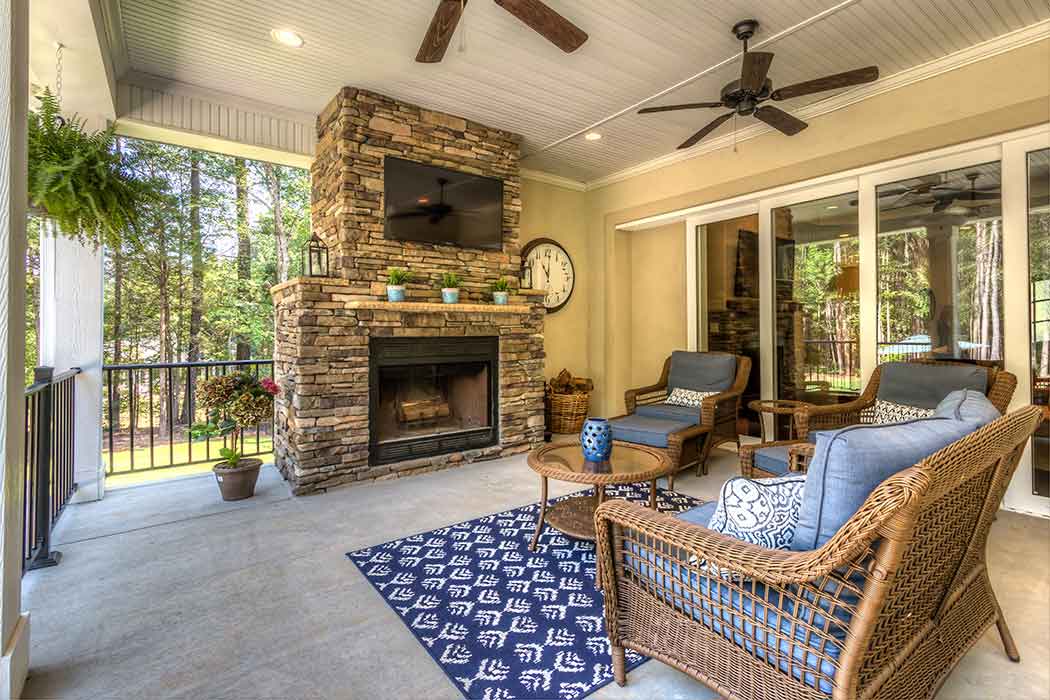
Building a waterfront custom home on Lake Norman is not the same project as a custom build on a typical Charlotte-area lot. The water adds shoreline regulations, flood considerations, dock and pier permitting, soil and grading challenges, and HVAC sizing realities most builders quietly underprice.
We have built across Lake Norman, NC and the broader Charlotte metro for 30+ years, and the constraints below are the ones that actually move budgets and timelines on these projects.
This guide walks through the design and construction realities of a waterfront custom home on Lake Norman: what Duke Energy controls on the shoreline, how flood maps and grading affect site cost, how to design glass walls that perform in Carolina humidity, and where buyers most often underestimate scope.
If you are evaluating a lot or refining a plan in Mooresville, NC, Cornelius, NC, Huntersville, NC, or Denver, NC, this is the conversation we have with every client at the kitchen table.
How Do Duke Energy Shoreline Regulations Affect a Lake Norman Build?
Duke Energy administers the Shoreline Management Plan governing the entire project boundary line, so even deeded lot owners do not have unrestricted shoreline use. Piers, boat lifts, and limited stabilization are typically allowed, while hardscape, retaining walls, and unapproved vegetation removal within the buffer are commonly restricted or prohibited.
Lake Norman is a Duke Energy reservoir, not a public lake. That single fact changes nearly every shoreline decision on a waterfront custom home. Duke Energy’s Lake Services division administers the Shoreline Management Plan that governs anything within the project boundary line — typically the 760-foot full pond elevation contour plus a buffer — and homeowners do not have unrestricted use of the shoreline even on deeded lots.
What Duke Energy permits and what it does not
Permitted activities typically include private piers within size limits, single boat lifts, irrigation withdrawal under permit, and limited shoreline stabilization with approved materials. Restricted or prohibited items typically include hardscape patios on the shoreline, large retaining walls within the buffer, mowed grass to the water’s edge in many zones, vegetation removal beyond approved corridors, and any structure that violates pier-to-pier spacing rules.
Duke Energy’s lakes and shoreline information spells out the current Shoreline Management Plan in detail, and we coordinate every waterfront design with their Lake Services team during early site evaluation.
The practical takeaway: review your lot’s specific shoreline zoning before locking the floor plan. Some lots are zoned for full pier and lift; others are limited to footpath access. We have walked clients away from beautiful but heavily-restricted lots because the shoreline rights did not match the build they had in mind.
That is a lot-evaluation conversation we have on every Lake Norman project before we draw a single line.
- Duke Energy’s Shoreline Management Plan governs everything inside the 760-foot project boundary line.
- Pier, lift, and shoreline stabilization rights are zone-specific — confirm before you buy the lot.
- Hardscape, retaining walls, and unpermitted vegetation removal in the buffer are common violations.
- Coordinate with Duke Energy Lake Services during schematic design, not after framing.
- For more on the broader process, see our Charlotte custom home building process.
How Do Flood Maps and Grading Affect Site Cost on a Lake Norman Lot?
Site cost is the line item that most surprises waterfront buyers, since gentle-looking lots often require significant grading, engineered retaining, and drainage work once a real survey is done. FEMA flood zone data, slope, soil type, and septic versus sewer access all factor into a typical 2026 site-work range of $150,000 to $500,000.
Site cost on a waterfront custom home is the line item that surprises buyers most. A lot that looks gentle in a listing photo often turns out to need significant grading, retaining, drainage engineering, and stabilization once we get a real survey and topographic study on it.
What the topo and flood map actually tell you
FEMA flood maps for Iredell County, NC, Mecklenburg County, and Catawba County, NC each include portions of the Lake Norman shoreline. We pull current FIRM data on every site, identify the Special Flood Hazard Area (SFHA) line, and design finish floor elevations with comfortable freeboard above base flood.
The U.S. Federal Emergency Management Agency’s flood map service center is where we verify current zone designations on each parcel.
Grading is the second cost driver. Many Lake Norman lots slope steeply from the road to the water, which means terraced retaining systems, engineered fill, sometimes pier-and-grade-beam or helical-pile foundations on softer soils, and significant drainage infrastructure. As of 2026, our typical site-work range on a true waterfront lot lands between $150,000 and $500,000 before vertical construction starts, depending on slope, soils, septic versus sewer, and shoreline stabilization scope.
We never quote site work blind — every Lake Norman build starts with a current survey, geotechnical report, and shoreline assessment.
- Pull current FEMA flood mapping for the parcel before signing on the lot.
- Design finish floor elevation with comfortable freeboard above the base flood elevation.
- Site work on Lake Norman lots typically ranges $150,000 to $500,000 as of 2026.
- Steep slopes often require engineered retaining and specialized foundation systems.
- Confirm septic versus sewer and percolation early — a failed perc test reshapes the entire program.
What Does It Really Cost to Design a Lake-Facing Glass Wall?
A wall of glass facing the water requires reinforced structural framing, precisely specified window packages, and a real Manual J HVAC load calculation to avoid comfort and moisture problems. Thermally-broken frames, triple-coated Low-E glass, and a variable-speed heat pump with dehumidification are essential, not optional, for these installations.
Every Lake Norman client wants the same thing: a wall of glass facing the water. Done well, it is the single feature that defines a waterfront custom home. Done poorly, it is the source of comfort, energy, and maintenance complaints for the life of the house.
What a high-performing lake wall actually requires
Big glass changes structural framing, HVAC sizing, and finish budget. Structurally, we design with steel beams or engineered wood headers and lateral bracing strategies that account for the loss of shear walls. Thermally, the window package matters more than any other envelope decision: we specify factory-clad fiberglass or thermally-broken aluminum frames, triple-coated Low-E glass tuned for solar heat gain, argon fill, and warm-edge spacers.
Black frames look correct on the lake aesthetic but absorb more solar heat — that has to be modeled, not assumed.
HVAC sizing is where many waterfront builds quietly fail. Standard rule-of-thumb sizing produces oversized equipment that short-cycles, fails to dehumidify, and leaves the great room sticky in summer. We require a real Manual J load calculation that accounts for the glass area, orientation, shading, and infiltration rate, paired with a variable-speed heat pump and a dedicated whole-house dehumidifier.
Carolina summers do not forgive lazy mechanical design, especially on a wall of west-facing glass over the water. To keep a lakefront home performing through Carolina humidity and storm seasons, our seasonal custom home maintenance checklist for Charlotte lays out what to inspect and when. For more on the envelope side, see our overview of energy-efficient home design.
- Plan structural framing for the lake wall during schematic design, not after permit.
- Specify thermally-broken or fiberglass black-framed windows with triple-coated Low-E glass.
- Require a real Manual J load calc and variable-speed heat pump with whole-house dehumidification.
- Model west-facing glass for solar heat gain; add overhangs or exterior shading where needed.
- Plan annual exterior glass cleaning into your maintenance budget on tall lake walls.
What Should You Know About Permitting Piers, Lifts, and Boathouses?
Dock construction should be coordinated during the main architectural phase, not treated as an afterthought, since Duke Energy permitting for a standard pier and lift runs 60 to 120 days. Typical 2026 costs range from $40,000 to $90,000 for a pier and single lift, up to $250,000 or more for a covered boathouse with two lifts.
The dock is part of the home. Buyers who treat it as a post-construction afterthought almost always overspend and underbuild. We coordinate pier, lift, and boathouse design during the main architectural phase whenever the site plan allows.
What the dock package actually looks like in 2026
A typical Lake Norman waterfront custom home includes a permitted private pier (length and width per Duke Energy zone), one or two boat lifts, often a covered boathouse or shade canopy, pier-side power and water (with shore-power conduits run during foundation work, not retrofitted), and lighting that complies with dark-sky considerations along the shoreline.
Materials matter: marine-grade hardware, composite or pressure-treated structural members, stainless fasteners, and decking that holds up to humidity and sun.
Permitting timelines vary. Duke Energy review on a standard pier and lift typically runs 60 to 120 days; complex requests including significant shoreline work can run longer. We submit dock permits in parallel with home construction documents so the dock is ready when the home is.
Cost ranges in 2026 typically run $40,000 to $90,000 for a standard pier and single lift, $90,000 to $250,000+ for a covered boathouse with two lifts, and more if shoreline stabilization or seawall work is required.
- Permit the pier and any lift, boathouse, or shoreline work during the main design phase.
- Run pier-side power, water, and conduit during foundation work — retrofits are painful.
- Specify marine-grade hardware, stainless fasteners, and durable decking from day one.
- Plan 60-120+ days for Duke Energy permitting depending on scope.
- Typical 2026 ranges: $40K-$90K for pier + single lift, $90K-$250K+ for covered boathouse with two lifts.
How Do Lake Norman Submarkets and Lot Profiles Compare on Cost?
Cornelius and Davidson command the highest per-foot-of-shoreline pricing due to proximity to Charlotte, while Mooresville offers a wider mix of big-water lots. Denver and the western shore trade longer commutes for better value and bigger lots, and Sherrills Ford offers the most acreage among remaining raw waterfront parcels.
Lake Norman is large, and the waterfront custom home market varies meaningfully across submarkets. Where you build affects both the lot acquisition cost and the practical realities of the build.
How Lake Norman submarkets compare
The Cornelius, NC and Davidson, NC corridor offers the closest commute to Charlotte, NC and tends to carry the highest waterfront lot pricing on a per-foot-of-shoreline basis. Mooresville, NC offers a wider mix of lot sizes, more big-water main-channel lots, and slightly more flexibility on architectural style.
Denver, NC and the western shore (Lincoln County, NC) are typically more value-oriented, with longer commutes but bigger lots and quieter water. Sherrills Ford, NC and the Catawba County, NC northern shore offer the most acreage and remaining “raw” lots, often with more grading challenges but stronger value on a per-acre basis.
Lot frontage, water depth at full pond, view orientation (sunset versus sunrise versus main channel), and the shape of the cove all affect both buy price and how the home sits on the lot. We help clients evaluate lots before contract, including coordinating dive surveys for water depth on swim and lift areas, which is something a casual showing will never reveal.
For the broader regional picture, see our Iredell County, NC custom home guide.
- Cornelius and Davidson, NC carry the highest per-foot-of-shoreline pricing; closest to Charlotte.
- Mooresville, NC offers wider variety and more big-water main-channel options.
- Denver, NC and the western shore offer better value with longer commutes.
- Sherrills Ford, NC and northern Catawba County, NC have the most remaining acreage.
- Verify water depth, view orientation, and cove shape before contract — listing photos hide a lot.
What Timeline Realities Should You Expect for Construction Sequencing?
A Lake Norman waterfront build typically runs 14 to 22 months from signed plans to move-in, longer than a standard Charlotte-metro build. Permitting stacks rather than overlaps, site work cannot run parallel with framing, and lake-wall windows often carry 12- to 20-week lead times that must be locked before groundbreaking.
A waterfront custom home on Lake Norman runs longer than an equivalent build on a typical Charlotte-metro lot. We plan for that explicitly so clients are not surprised three months in.
Where the schedule actually grows
Three areas extend the schedule. Permitting is the first: Duke Energy shoreline review, FEMA elevation certification, septic permitting where applicable, and county building permits stack rather than overlap. Site work is the second: grading, retaining systems, foundation engineering on softer soils, and shoreline stabilization all add weeks and cannot be parallel-pathed with vertical framing.
Custom mechanical and lake-wall window orders are the third — large architectural windows often run 12 to 20+ week lead times in 2026, and we lock those orders before we break ground. The interior finish package on a luxury waterfront build also tends to include longer-lead items; see our luxury custom home features overview for the kinds of selections that drive lead times.
From signed plans through move-in, our typical Lake Norman waterfront custom home runs 14 to 22 months in 2026. That includes pre-construction design, permitting, site work, vertical construction, dock construction in parallel, and a careful punch-list and commissioning phase. We give clients a realistic schedule at the front of the project, not an aspirational one.
For more on how we run that timeline, see our Mooresville, NC custom home builder overview.
- Plan 14-22 months from signed plans to move-in for a Lake Norman waterfront build in 2026.
- Permitting stacks: Duke Energy + FEMA + septic + county all add to the schedule.
- Site work cannot be parallel-pathed with framing on most waterfront lots.
- Lake-wall window orders run 12-20+ weeks; lock them before breaking ground.
- Build dock construction into the main schedule, not as a follow-on phase.
Frequently Asked Questions About Waterfront Custom Homes on Lake Norman
How much does a waterfront custom home on Lake Norman cost in 2026?
Vertical construction typically lands $375 to $625+ per finished square foot in 2026 on a true custom waterfront build, plus land, site work ($150K-$500K typical range), and dock package ($40K-$250K+ depending on scope). Final cost depends most on lot complexity, glass package, and dock scale.
Can I build right at the water’s edge on Lake Norman?
No. Duke Energy administers the project boundary line at the 760-foot full pond elevation plus buffer, and structures are not permitted within that zone. Decks, patios, and most hardscape are also restricted. The home itself sits behind that buffer, with permitted shoreline activities like piers and approved stabilization regulated by Duke Energy Lake Services.
Do I need a special foundation for a Lake Norman waterfront lot?
Often yes. Steeper slopes, softer lakeside soils, and engineered fill commonly require pier-and-grade-beam, helical pile, or deep footing systems rather than a standard slab or basement on grade. We require a geotechnical report on every Lake Norman build and design the foundation off real soil data, not assumptions.
How long does dock permitting take through Duke Energy?
Standard pier and single lift requests typically run 60 to 120 days for Duke Energy review, depending on volume and zone. Boathouses, larger pier configurations, and any shoreline stabilization can extend that significantly. We submit dock permits in parallel with main construction documents to keep the schedule on track.
If you are planning a waterfront custom home on Lake Norman — Mooresville, NC, Cornelius, NC, Huntersville, NC, Davidson, NC, Denver, NC, or Sherrills Ford, NC — we would be glad to walk your lot, review shoreline rights and flood mapping, and lay out a realistic budget and schedule.
Call us at (704) 619-6293 or contact our team to start the conversation.