
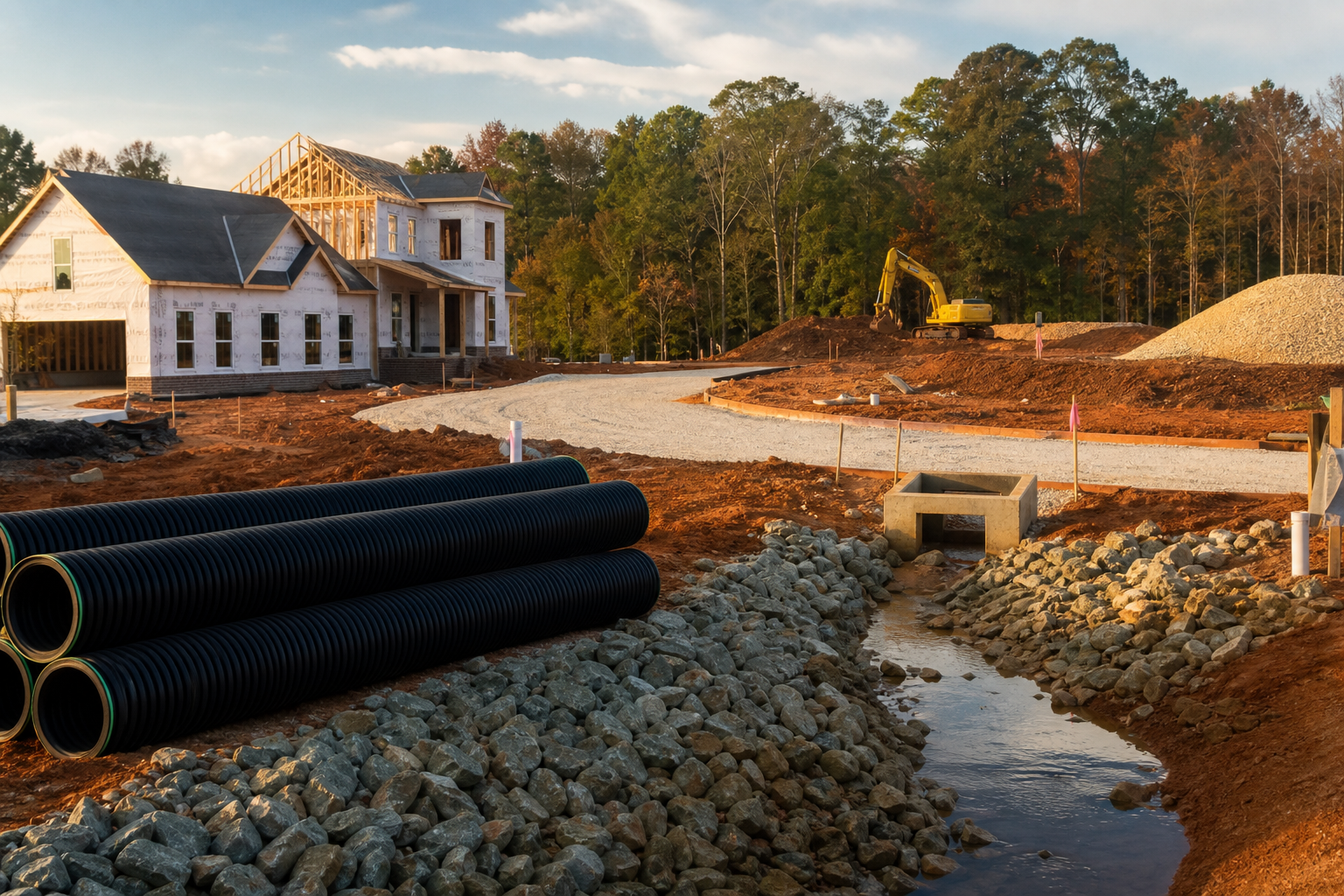
A project team confirms whether York County stormwater review applies by checking the current scope language published by York County's Stormwater Plan Review and Construction Site Runoff Control programs, rather than assuming a fixed acreage or disturbance number applies to every site. The trigger for review, the specific submittal requirements, and the runoff control expectations during construction can vary based on disturbed area, location, and other factors that the County defines and updates on its own pages, so the only reliable way to confirm applicability is to read those current pages directly and, where the scope is unclear, ask the County's stormwater staff before design work advances too far to adjust cheaply.
This article summarizes what York County's published Stormwater Plan Review and Construction Site Runoff Control pages describe in general terms, and it does not restate specific thresholds, fees, or submittal checklists as fixed facts because those details are controlled by the County and can change. Any statement here about what the County reviews, requires, or inspects should be treated as a starting point for a conversation with York County staff or a qualified design professional, not as a substitute for reading the current source pages or securing a written determination for a specific parcel.
Direct Answer and Evidence Boundary
Before a residential or small commercial site plan advances past early sketches, the project team needs a clear answer to one question: does this specific scope of disturbance trigger York County stormwater review, and if so, under which published pathway. The most defensible way to answer that question is to go directly to York County's own Stormwater Plan Review page and Construction Site Runoff Control page, read what is currently posted, and treat any prior assumption about acreage thresholds or exemptions as unverified until the County confirms it for this parcel.
This approach matters because stormwater review triggers are not universal across South Carolina counties, and even within one county the applicable threshold or submittal path can be updated over time. A design assumption carried over from a different jurisdiction, a past project, or general industry habit is not a substitute for confirming the current York County requirement. The evidence boundary here is intentional: this article describes what the County's public pages address in general terms and does not restate specific numeric thresholds, fee schedules, or review timeframes as fixed, because those details belong to the County and are subject to change without notice to this article.
What Current Public Sources Establish
York County maintains two relevant public pages that any project team should read directly rather than rely on secondhand summaries. The Stormwater Plan Review page describes the County's review function for site plans, and the Construction Site Runoff Control page addresses expectations for managing runoff while construction is underway. Both pages are maintained by York County government and are the primary sources a homeowner, builder, or designer should consult first.
Because these pages are controlled by the County and can be revised, this article deliberately avoids repeating specific numbers, fees, or step counts as if they were permanently fixed. Instead, the practical guidance below focuses on how to use those pages correctly: identify the specific scope of work, compare it against the current language on both pages, and document the date and content of what was reviewed in case questions arise later in the project.
Inputs and Existing Conditions to Document
Before contacting York County or a design professional about stormwater review applicability, it helps to have a clear, written description of the project's physical scope on hand. This reduces back-and-forth and gives the County or engineer the information needed to give a useful answer rather than a general one.
A homeowner or project manager should gather basic site facts before making an inquiry. Having this information ready also supports later recordkeeping, since stormwater-related decisions often need to be traceable back to the conditions that existed when the decision was made.
- The approximate area of land disturbance planned for the project, including grading, clearing, and any impervious surface additions.
- Whether the property is part of a larger parent tract or subdivision that may have prior stormwater approvals on file with the County.
- The general topography and existing drainage pattern across the site, including any visible swales, ditches, or discharge points.
- Any known proximity to streams, wetlands, or other water features that could affect review scope.
- The intended sequence of construction activities that could disturb soil or alter existing drainage before final stabilization.
Step-by-Step Owner and Project-Team Review
A practical review sequence starts with reading, not assuming. The project team should open both York County source pages, read the current scope language in full, and note anything that appears to apply to the project's specific disturbance area, location, or activity type. This first pass is informational only and should not be treated as a final determination.
The second step is a direct inquiry to York County stormwater staff with the site-specific facts gathered earlier. Because online guidance is general by design, a written or documented conversation with the County is the only way to get a scope determination that applies to a specific parcel. The team should keep a record of who was contacted, when, and what was communicated, since this record can matter later if questions arise about whether review was properly triggered or waived.
- Read the current Stormwater Plan Review page and the Construction Site Runoff Control page in full before drawing any conclusions.
- Prepare a short written summary of the site's disturbance area, location, and drainage conditions before contacting the County.
- Contact York County stormwater staff directly and ask whether this specific scope requires plan review or falls under a different pathway.
- Document the date, contact method, and substance of any County response for the project file.
- Share the County's response with the design team so plan development reflects the confirmed pathway rather than an assumption.
Responsibilities, Dependencies, and Hold Points
Stormwater review applicability is not usually a single yes-or-no answer that one person can settle alone. It typically depends on coordination between the property owner, the design professional preparing site plans, and York County staff who administer the review program. Each party has a different piece of the puzzle: the owner knows the intended use and scope, the designer translates that scope into a site plan, and the County determines what that plan triggers under current program requirements.
Because of this dependency chain, it is worth establishing a hold point early in the project schedule, meaning a point where design work pauses until the County's applicability determination is in hand. Moving forward with detailed site design before this determination is confirmed risks rework if the eventual review requirement changes the site layout, drainage approach, or sequencing plan.
- The property owner is responsible for providing accurate scope information to the design team and the County.
- The design professional is responsible for translating that scope into plans that reflect whatever pathway the County confirms applies.
- York County stormwater staff are the responsible party for determining whether review is triggered and what it requires for a specific parcel.
- A documented hold point before final site plan submission helps avoid costly redesign if the applicability determination changes assumptions made earlier.
Common Coordination Failures
Several recurring patterns lead to confusion or delay around stormwater review scope. The most common is assuming that because a similar-sized project in a neighboring county or a past project did not trigger review, the same will hold true in York County. Jurisdictional rules differ, and even within the same county, program language can be updated between projects.
Another common failure is treating the County's public web pages as a complete and final answer without following up directly. Public pages are written to be broadly informative, not to answer every site-specific question, and relying on them alone can leave gaps that only a direct conversation with County staff can close. A third failure is separating the stormwater plan review question from the construction-phase runoff control question, when in practice both pages should be read together since a project can have obligations at both the design stage and during active construction.
- Assuming a threshold or exemption from a different jurisdiction or past project applies automatically in York County.
- Treating general web page language as a final, project-specific determination without contacting County staff.
- Reviewing the Stormwater Plan Review page but overlooking the separate Construction Site Runoff Control expectations that may apply once work begins.
- Delaying the applicability question until after site plans are largely finished, which increases the cost and disruption of any needed changes.
- Failing to document who at the County was contacted and what was said, leaving no record if the determination is later questioned.
Questions for the Responsible Authority or Qualified Professional
Because only York County can confirm whether a specific project triggers stormwater review, and only a licensed engineer or qualified site designer can translate that determination into compliant plans, it helps to walk into those conversations with specific questions rather than open-ended ones. Clear questions tend to produce clearer, more actionable answers.
It is also reasonable to ask the County how any determination should be documented for the project file, since this record may be useful later during permitting, inspection, or if the project scope changes and the applicability question needs to be revisited.
- Does the current disturbance area and location for this specific parcel trigger stormwater plan review under the program as it exists today?
- If review is triggered, what submittal pathway and information does the County expect at this stage of the project?
- What construction-phase runoff control expectations apply once grading begins, independent of whether formal plan review is triggered?
- How should the County's applicability determination be documented for the project record?
- If the project scope changes after this determination, should the applicability question be revisited with the County?
Next Action and Related CDG Service Resource
The most useful next step for a homeowner or project team is to read both York County source pages in full, gather the site-specific facts described above, and reach out to York County stormwater staff before finalizing site plan details. This sequence keeps design work aligned with confirmed requirements instead of assumptions, and it creates a documented record that can support the project through permitting and construction.
For readers working on a Lake Wylie area site, Cooper Development Group's site planning service resource at /site-planning-lake-wylie-sc/ offers general information about how site planning conversations are approached, and the CDG blog at /blog/ includes related articles on stormwater topics such as construction runoff control ownership and post-construction impervious area questions. Readers considering a specific project can also use the consultation page at /consultation/ to start a conversation about site planning coordination, while keeping in mind that any final determination about stormwater review applicability rests with York County and any design or engineering decision rests with the licensed professional of record.
Why This Trigger Question Comes Before Design Details
It can be tempting to start sketching grading plans, roof drainage routes, or lot layout before confirming whether stormwater review even applies, especially when a project feels small in scale. But design decisions made before the applicability question is settled can end up being redone if the County's determination changes the required approach to drainage, disturbance sequencing, or stabilization. Settling the trigger question first protects the time already invested in design.
This is also why the review process benefits from being treated as a sequence rather than a single checkbox. Confirming applicability, documenting the County's response, and then proceeding to detailed design in that confirmed direction reduces the risk of late-stage surprises. Related CDG articles on temporary drainage planning during construction and on treating stabilization as a sequence rather than a single closeout task cover how this same principle applies once a project moves past the initial applicability question and into active site work.
Questions homeowners ask
Does every residential lot in York County need a stormwater plan review?
That depends on factors the County defines and can update, including disturbed area and site conditions, so it should not be assumed one way or the other. The only reliable way to know is to check the current Stormwater Plan Review page and, if the scope is still unclear for a specific parcel, ask York County stormwater staff directly before finalizing a site plan.
Who is responsible for construction site runoff control once grading starts?
York County's Construction Site Runoff Control program describes expectations for managing runoff during construction, but the specific party responsible for installing, inspecting, and maintaining controls on a given project is typically established through the plan review, permit, and contract documents for that project. Owners and design teams should confirm this assignment in writing rather than assuming it defaults to any one party.
What should a homeowner do if they are not sure whether their project triggers stormwater review?
The most direct step is to read the current York County Stormwater Plan Review and Construction Site Runoff Control pages and then contact York County staff with the specific site details, since only the County can confirm whether a particular scope of work requires review. Waiting until design is far advanced to ask this question can create costly rework, so it is worth raising early with the County and with any engineer or site designer involved in the project.
Can Cooper Development Group tell a homeowner whether their project needs stormwater review?
Cooper Development Group can help a homeowner organize site information and coordinate with the design team and the County, but the determination of whether a specific project triggers stormwater review rests with York County. Any project-specific regulatory determination should come from the County or from a licensed engineer working on the project, not from general educational content.
Plan the next step
Use this article as a planning aid, then confirm project-specific requirements with the responsible authority and qualified professionals. Review CDG's related service, construction articles, or consultation page when you are ready to organize the next decision.
Official sources and verification
- York County, South Carolina: Stormwater Plan Review
- York County, South Carolina: Construction Site Runoff Control
Authority pages, forms, fees, review steps, and code references can change. Verify the current path for the property and scope before relying on a planning assumption.